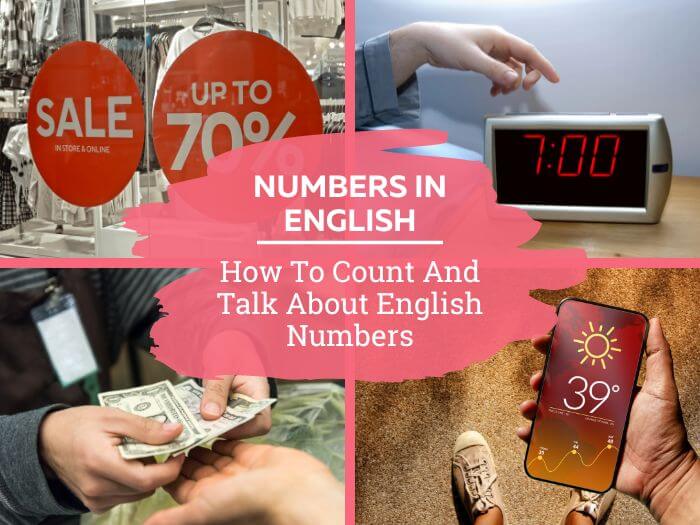

Numbers – we need them all the time! When we talk about the number of friends that are coming to the party, when we ask our boss for a pay rise, when we tell someone the price of something.
Different languages express numbers in different ways. How do we do that in English? I’ll tell you everything you need to know about numbers in English in this post.
You’ll not only learn how to count up to 1 billion, but you’ll also learn how to:
- Tell the time
- Use ordinal numbers
- Talk about percentages
- Talk about fractions
- Say prices
- Express measurements
- Say years and dates
Let’s begin.
Table of Contents
English Numbers From 0 To 10
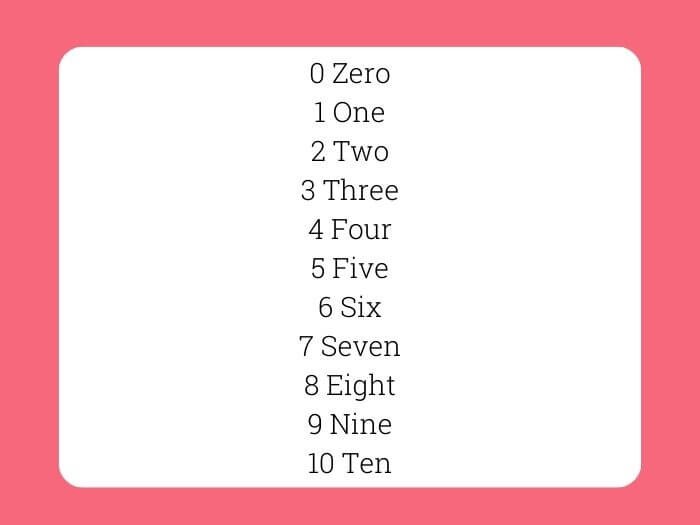
Let’s start with the easiest ones:
- 0 Zero /ˈzɪə.rəʊ/
- 1 One /wʌn/
- 2 Two /tuː/
- 3 Three /θriː/
- 4 Four /fɔːr/ or /fɔː/
- 5 Five /faɪv/
- 6 Six /sɪks/
- 7 Seven /ˈsev.ən/
- 8 Eight /eɪt/
- 9 Nine /naɪn/
- 10 Ten /ten/
English Numbers From 11 To 19
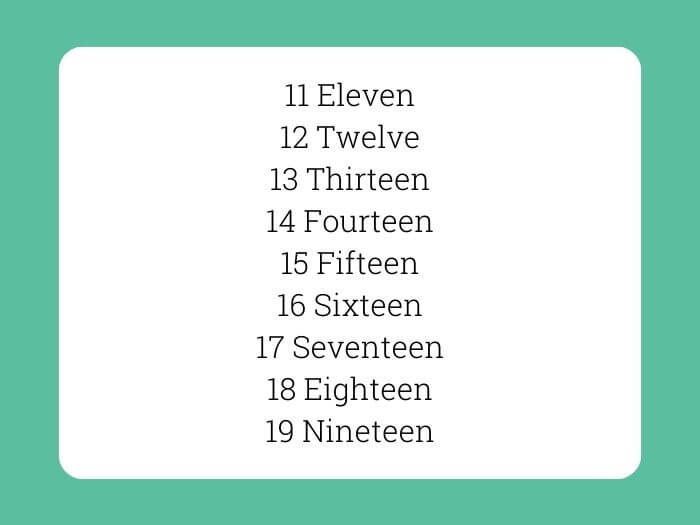
Some other easy ones:
- 11 Eleven /ɪˈlev.ən/
- 12 Twelve /twelv/
- 13 Thirteen /ˈθɜːr.tiːn/
- 14 Fourteen /ˈfɔːr.tiːn/ or /ˈfɔː.tiːn/
- 15 Fifteen /ˈfɪf.tiːn/
- 16 Sixteen /ˈsɪks.tiːn/
- 17 Seventeen /ˈsev.ənˌtiːn/
- 18 Eighteen /ˈeɪˌtiːn/
- 19 Nineteen /ˈnaɪn.tiːn/
English Numbers From 20 To 29
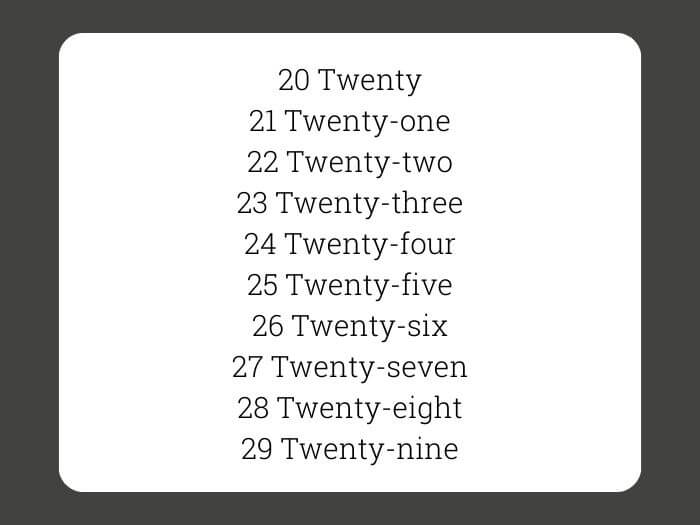
After you get to 20, the story repeats, so:
- 20 Twenty /ˈtwen.ti/
- 21 Twenty-one /ˈtwen.ti wʌn/
- 22 Twenty-two /ˈtwen.ti tuː/
- 23 Twenty-three /ˈtwen.ti θriː/
- 24 Twenty-four /ˈtwen.ti fɔːr/ or /ˈtwen.ti fɔː/
- 25 Twenty-five /ˈtwen.ti faɪv/
- 26 Twenty-six /ˈtwen.ti sɪks/
- 27 Twenty-seven /ˈtwen.ti ˈsev.ən/
- 28 Twenty-eight /ˈtwen.ti eɪt/
- 29 Twenty-nine /ˈtwen.ti naɪn/
English Numbers From 30 To 90 (Tens)
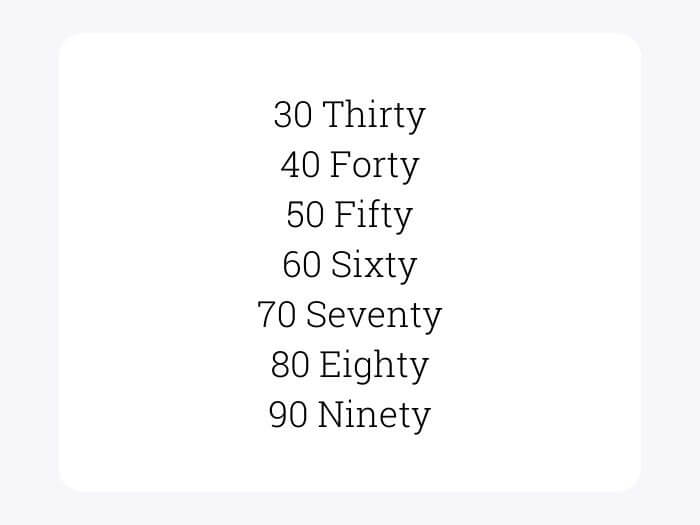
And then we’ve got the tens:
- 30 Thirty /ˈθɜːr.ti/
- 40 Forty /ˈfɔːr.ti/ or /ˈfɔː.ti/
- 50 Fifty /ˈfɪf.ti/
- 60 Sixty /ˈsɪks.ti/
- 70 Seventy /ˈsev.ən.ti/
- 80 Eighty /ˈeɪ.ti/
- 90 Ninety /ˈnaɪn.ti/
Numbers In English: Hundreds And Thousands
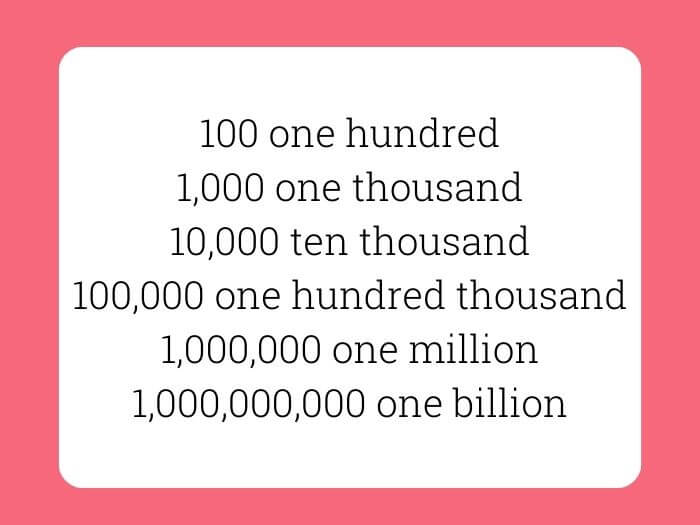
Things are getting bigger and bigger now…
- 100 one hundred /wʌn ˈhʌn.drəd/
- 1,000 one thousand /wʌn ˈθaʊ.zənd/
- 10,000 ten thousand
- 100,000 one hundred thousand
- 1,000,000 one million
- 1,000,000,000 one billion
Did you notice? We separate hundreds and thousands with a comma (,) – not a full stop (.).
How To Say Big Numbers In English (Between 100 And 999,999)
How do we say big, complex numbers in English? Here are some examples:
- 250 Two hundred and fifty
- 1,432 One thousand four hundred and thirty-two
- 5,600 Five thousand six hundred
- 20,083 Twenty thousand and eighty-three
- 78,901 Seventy-eight thousand nine hundred and one
- 304,500 Three hundred and four thousand five hundred
- 999,999 Nine hundred and ninety-nine thousand nine hundred and ninety-nine
- 135,792 One hundred and thirty-five thousand seven hundred and ninety-two
- 506,317 Five hundred and six thousand three hundred and seventeen
- 12,045 Twelve thousand and forty-five
- 88,888 Eighty-eight thousand eight hundred and eighty-eight
How To Say Big Numbers In English (Between 1,000,000 And 1,000,0000,0000)
Okay, this may require a lot of brain work. But don’t worry, once you’ve practised saying a few big numbers in English, everything will become easier.
Here are some examples to help you:
- 619,935,647 Six hundred and nineteen million, nine hundred and thirty-five thousand, six hundred and forty-seven
- 197,954,318 One hundred and ninety-seven million, nine hundred and fifty-four thousand, three hundred and eighteen
- 219,838,539 Two hundred and nineteen million, eight hundred and thirty-eight thousand, five hundred and thirty-nine
- 193,093,268 One hundred and ninety-three million, ninety-three thousand, two hundred and sixty-eight
- 175,163,319 One hundred and seventy-five million, one hundred and sixty-three thousand, three hundred and nineteen
Telling The Time In English

Let’s now have a look at how to say the time in English. But before we look at a list of examples, here are a few important things things to know:
- You use the verb “to be” to give the time. For example, “it's one o'clock”.
- O'clock: we use this for the full hour. For example, 3:00 is “three o'clock.”
- Quarter past: this means 15 minutes past the hour. So 3:15 is “quarter past three.”
- Half past: this means 30 minutes (half an hour) past the hour. So 4:30 is “half past four.”
- You can use “past” with times that are 5, 10, 20 and 25 minutes past the hour. So 2:25 is “twenty-five past two.”
- Quarter to: 45 minutes past the hour, or 15 minutes to the next hour. So 3:45 is “quarter to four.”
- After the first half of the hour (and for times not on the quarter or half-hour) you can also use “to” with 5, 10, 20 and 25. So, 3:40 is “twenty minutes to three.” 5:50 is “ten minutes to six”. And so on.
- In English, we sometimes say the time specifying AM (from Latin “ante meridiem”) or PM (“post meridiem”) because we use 12 hours, not 24. AM refers to the time from midnight to noon, while PM covers noon to midnight. So we never say it’s 19:00 o’clock. We say it’s 7 PM.
- Noon means 12 AM (that’s why we say afternoon, by the way). Midnight is 12 PM.
Okay, let’s now have a look at some examples:
- 1:00 PM One o'clock
- 9:15 AM Quarter past nine
- 10:45 AM Quarter to eleven
- 2:10 PM Ten past two
- 5:20 AM Twenty past five
- 6:35 PM Twenty-five to seven
- 3:50 AM Ten to four
- 8:05 PM Five past eight
- 11:55 AM Five to twelve
Pro Tip
There are some small differences here between British and American English.
For example, instead of saying “past”, Americans use “after”. So 6:10 is “ten after six” in US English. Americans also say “a quarter after” when it's fifteen minutes past the hour. But, for 30 minutes past the hour, they also use “past”, not “after!”
Americans sometimes use “till” instead of “to”. So 3:40 would be “twenty till four”. But you may also hear “to” in this context.
If you're confused, keep reading to the end of the section to discover an easy way to tell the time that works with any variety of English!
For very precise times like the ones below we don't usually use “past” and “to”. In these cases, we read the time just as it's displayed on a digital clock as you can see below.
If you need to specify if it's morning or night, you can add AM or PM at the end but it's not obligatory.
- 3:14 PM Three fourteen
- 6:38 AM Six thirty-eight
- 9:42 AM Nine forty-two
- 7:53 PM Seven fifty-three
- 1:29 AM One twenty-nine
Pro Tip
If you have trouble telling the time the “analogue way” i.e with “past” and “to” as if you were looking at a clock or watch, you can also say times the “digital” way which is a bit easier. So if it's 5:20, instead of saying “it's twenty past five”, you just read the numbers in order and say “it's five twenty”.

Ordinal Numbers In English
We use ordinal numbers to indicate the position or order of items in a sequence. Here are ordinal numbers from 1st to 10th:
- 1st – First
- 2nd – Second
- 3rd – Third
- 4th – Fourth
- 5th – Fifth
- 6th – Sixth
- 7th – Seventh
- 8th – Eighth
- 9th – Ninth
- 10th – Tenth
And here are a few more:
- 11th – Eleventh
- 12th – Twelfth
- 13th – Thirteenth
- 14th – Fourteenth
- 20th – Twentieth
- 21st – Twenty-first
- 30th – Thirtieth
- 100th – Hundredth
- 1,000th – Thousandth
Did you notice the use of suffixes “st,” “nd,” “rd,” and “th”? Here's how we use them:
“st”

“st” (first) is used with numbers ending in 1 (except for 11).
Examples:
- 1st (first)
- 21st (twenty-first)
- 91st (ninety-first)
“nd”
“nd” (second) is used with numbers ending in 2 (except for 12).
Examples:
- 2nd (second)
- 32nd (thirty-second)
- 102nd (one hundred and second)
“rd”
“rd” (third) is used with numbers ending in 3 (except for 13).
Examples:
- 3rd (third)
- 33rd (thirty-third)
- 113th (one hundred and thirteenth)
“th”
“th” is used with all other numbers not ending in 1, 2, or 3, and for numbers ending in 11, 12, and 13.
So…
- 4th (fourth)
- 10th (tenth)
- 25th (twenty-fifth)
- 100th (hundredth)
- 101st (one hundred and first)
- 112th (one hundred and twelfth)
Fractions
You typically express fractions by first saying the numerator and then the denominator. Like this:
- 1/2 – One half
- 1/3 – One third
- 2/3 – Two thirds
- 1/4 – One quarter or one fourth
- 3/4 – Three quarters or three fourths
- 1/5 – One fifth
- 2/5 – Two fifths
- 3/5 – Three fifths
- 4/5 – Four fifths
- 1/6 – One sixth
Percentages

Percentages are easy to express. You just need to say the number followed by the word “per cent.” Some examples:
- 5% – Five per cent
- 20% – Twenty per cent
- 50% – Fifty per cent
- 75% – Seventy-five per cent
- 100% – One hundred per cent
What if you have decimals? It’s easy: you say “point” before the decimals and say each digit individually. Like this:
- 7.5% – Seven point five per cent
- 12.25% – Twelve point two five per cent
- 50.75% – Fifty point seven five per cent
- 99.99% – Ninety-nine point nine nine per cent
- 8.89 % – Eight point eight nine per cent
Pro Tip
You may have seen two spellings of %: “per cent” and “percent”. Both spellings are correct, but “per cent” is more common in British English, while “percent” is the preferred spelling in the USA.
Prices

“Excuse me, how much is this?”
“It’s…..” or “it costs…”.
When you need to say the price of something, you say the numbers followed by the currency (euros, pounds, dollars, etc.).
Like this:
- $5 – It’s five dollars
- £20 – It’s twenty pounds
- €100 – It’s one hundred euros
As you can see, the currency symbol is written before the number, not after, even if we say the currency after the number when we speak!
If you need to include cents, this is how you do it:
- $5.25 – It’s five dollars and twenty-five cents (you will also hear people say “five dollars twenty-five”)
- £20.50 – It’s twenty pounds and fifty pence (again you'll also hear “twenty pounds fifty”)
- €100.99 – It’s one hundred euros and ninety-nine cents
Only cents? Here’s how we say them:
- $0.75 – It’s seventy cents
- £0.50 – It’s 50 pence
- €0.80 – It’s eighty cents

Measurements
There are many things that we can measure. In day-to-day life we usually measure the length, height, width, depth, area, volume, temperature, or weight of something.
So here's a general (and quick) guide on how to say common measurements
Length, Height, Width, And Depth
- 5 m – Five metres
- 10 in – Ten inches
- 2.5 km – Two point five kilometres
- 6 ft – Six feet
- 3 yd – Three yards /θriː jɑːrdz/
Area
Areas are usually expressed in square metres or kilometres.
- 10 m² – Ten square metres
- 5.5 m² – Fifteen point five square metres
- 2.25 km² – Two point two five square kilometres
Volume
We normally talk about volume in litres (l) or cubic metres (m³).
Some examples in litres:
- 2l – Two litres
- 1 gal – One gallon
- 500 ml – Five hundred millilitres
- 1 m³ – One cubic metre
- 0.5 m³ – Half a cubic metre
- 2.75 m³ – Two point seven five cubic metres
Weight
- 20 kg – Twenty kilogrammes
- 4 lbs – Four pounds
- 50 g – Fifty grammes
Pro Tip
When it comes to measurements, there are some more US – UK spelling differences. For example, “metre” is the British spelling while “meter” is American. Here are some more examples:
- gramme (UK) – gram (US)
- litre (UK) – liter (US)
- kilometre (UK) – kilometer (US)
Curious about spelling in English? Check out my post on English spelling rules.
Temperature
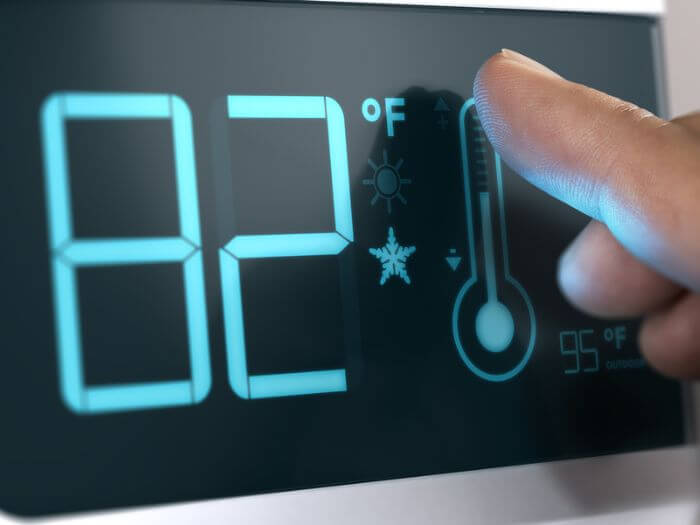
Temperatures can be expressed in Fahrenheit or Celsius.
- 32°F – Thirty-two degrees (Fahrenheit)
- -10°F – Minus ten degrees (Fahrenheit)
- 30 °C – Thirty degrees (Celsius)
- -7 °C – Minus seven degrees (Celsius)
Pro Tip
Weights, measures and temperatures are often different in English-speaking countries. For instance, in the US, people talk about temperatures in Fahrenheit, but in most other English-speaking countries, people use Celsius.
Although the United Kingdom has mostly transitioned to the metric system, many people still use the imperial system in daily life. This means they talk about yards and miles, not metres and kilometres and use stones, pounds and ounces for weights rather than kilogrammes. They measure height in feet and inches rather than in metres in centimetres.
The US is one of the few countries in the world that still uses the imperial system as its official measuring system.
Years And Dates
Finally, let’s look at years and dates:
Years
We say years and dates in different ways. Let’s have a look at some examples:
- 1999 – Nineteen ninety-nine
- 2000 – Two thousand
- 2001 – Two thousand (and) one OR twenty oh-one
- 2020 – Twenty twenty OR two thousand (and) twenty
- 2023 – Twenty twenty-three OR two thousand (and) twenty-three
- 1005 – Ten oh five
- 1989 – Nineteen eighty-nine
- 1800 – Eighteen hundred
- 800 – Eight hundred
- 1807 – Eighteen oh-seven
Dates
Different countries express dates in English in different ways. But they all use ordinal numbers.
In the U.S, they often use the month-day-year format:
- July 4, 1776 – July fourth, seventeen seventy-six
- December 25, 2020 – December twenty-fifth, twenty twenty
In the UK and other countries, however, they often use the month-day-year format:
- 24 December 2020 – The twenty-fourth of December, twenty twenty
- 1 January 2000 – The first of January, two thousand
Decades
Decades are periods of 10 years. That’s why we use the plural “-s” to express them.
- The 1990s – The nineteen nineties (from 1990 to 1999)
- The 2020s – The twenty-twenties
- The 1960s – The nineteen sixties
- The 1980s – The nineteen eighties
- The 2030s – The twenty-thirties
Centuries
For centuries, we use ordinal numbers. So:
- The 19th century – The nineteenth century (from 1801 to 1900)
- The 20th century – The twentieth century
- The 21st century – The twenty-first century
Numbers In English: Time To Notice And Practise Them!
Thanks for reading another of my posts about English, the global language.
I hope you found this useful!
Numbers in English may seem complicated but the secret is to notice and practice saying them. One easy way to do that is to follow the rules of StoryLearning and read books for English learners.
That way you'll come across English numbers in context, which makes it even easier to learn them. If you need a recommendation to start reading, then check out my short stories in English.

Olly Richards
Creator of the StoryLearning® Method


Olly Richards is a renowned polyglot and language learning expert with over 15 years of experience teaching millions through his innovative StoryLearning® method. He is the creator of StoryLearning, one of the world's largest language learning blogs with 500,000+ monthly readers.
Olly has authored 30+ language learning books and courses, including the bestselling "Short Stories" series published by Teach Yourself.
When not developing new teaching methods, Richards practices what he preaches—he speaks 8 languages fluently and continues learning new ones through his own methodology.