You've learned the words. You've studied them. You've reviewed them multiple times. But the moment you open your mouth to speak, they vanish into thin air.
Sound familiar?
This frustration is something every language learner experiences. One learner recently shared their struggle: “I've been having trouble remembering vocabulary, especially when trying to recall it in speaking.”
If you're nodding along, you're not alone. This is completely normal, and what you need is a strategy. Specifically, we need to understand active recall language learning and how it can transform your ability to use vocabulary when it matters most.
Pro Tip
By the way, if you’re serious about improving your language skills, online language courses for fluency can make a huge difference.
I'm offering top-rated online language courses for beginners to advanced learners, covering Mandarin, Spanish, French, Italian, German, Japanese and more.
If you prefer watching videos to reading, hit play on the video version of this post at the top of this page. Otherwise, here's what you'll discover in this article:
Table of Contents
Recognition Versus Recall
At the heart of this problem is the difference between recognition and recall. Let those words sink in for a second – it's a big deal.
Recognition is when you hear a word and understand it.
Recall is when you need a word, retrieve it from your memory and say it – all without slowing down in the sentence.
Two very different things.
And here's the root failure of most traditional language learning methods: textbooks, courses and classes will give you words and say, “Go and learn those words. When you learn them, you know them. Job done.”
Except we know as language learners who actually use languages in the real world that this isn't how it works. You can learn a word and then forget it.
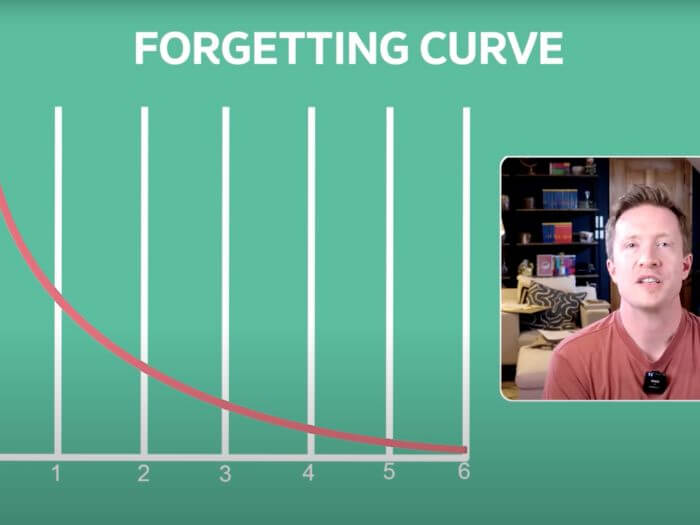
You might have seen the forgetting curve before – it shows that you have to learn a word multiple times, and every time you learn it, it sticks for a little bit longer in your memory.
The reality is that words don't stick the way we want them to. We have to learn them over and over again, usually in lots of different contexts, before we actually remember them reliably.
Why Is Recall So Much Harder Than Recognition?
Susie Dent, the lexicographer and star of the programme Countdown, estimates that native English speakers have an active vocabulary of about 20,000 words and a passive vocabulary of 40,000 words.
What does this mean in practice? You can recognise twice the number of words that you can actually use. Even in your native language.
Recall is harder for the brain than recognition because there aren't as many cues. And it's cues that activate related memories.
When you're listening to someone or watching a film, there are cues everywhere – in the dialogue, the context, the situation. Those cues help you understand what a particular word means.
But when you're the one speaking, you have to create your own cues to remember the word and then use it. It's just a lot harder.
Now imagine doing that in a foreign language. It's many times more difficult because we don't have a whole lifetime of experience with contextual vocabulary to draw upon.
When I want to intentionally improve my vocabulary in a language, I need to practise actively recalling it. More specifically, I try to practise conversations in advance.
Here's why: if I've just learned a word from a book of short stories, I know that when I'm in the middle of a fast-paced conversation on unfamiliar topics, I'm not going to remember that word. So I want to actively practise bringing it back.
But here's the crucial point about active recall language learning: it has to work in combination with input-based learning.
Most people spend all their time doing active learning – trying to memorise things, doing practice exercises.
The problem is there's simply too much to learn in a language. If you spend all your time on active exercises, you'll never cover enough ground.
The approach I find most effective is spending about 80% of my time on input – reading, watching films, having conversations (in a conversation you're also getting lots of input). Then I spend about 20% of my time on active recall language learning.
This way, you get the best of both worlds. You're still spending the majority of your time getting input so your brain can do its whole “passively soaking up by osmosis” thing, which it's extremely good at. But you're also actively reinforcing the vocabulary that matters most to you.
Three Powerful Techniques For Active Recall
1. Reverse Flashcards
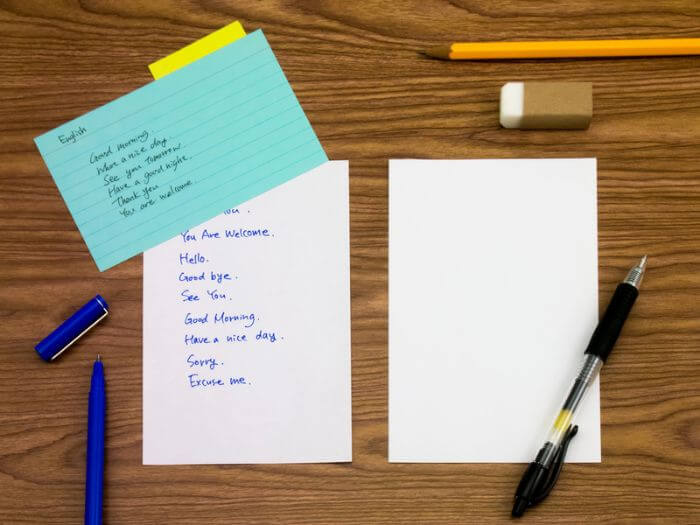
I'm a fan of flashcards for practising high-value vocabulary. When I'm reading, I underline words I want to remember and add them to my flashcards later.
But here's what most people get wrong: they display the word in the target language first and ask themselves, “What does this mean?”
That's practising recognition – you're showing yourself the word and asking what it means in English. It's not helping you recall the word; it's just helping you recognise it.
What I do instead is display the word in English and ask, “How do you say this in Japanese?” or French, or Norwegian, or whatever language I'm learning. Then I force myself to recall it.
This mimics what happens in real conversation. You think, “I need the word for chestnut. What's that word?” You rack your brains, and eventually it comes to you. By practising this process deliberately with flashcards, you're training the exact skill you need.
This approach is manual and you can't do it with thousands of words. But if you deliberately use it with words you really want to remember, it's incredibly effective.
2. Prepared Vocabulary For Conversation Sessions
Whenever I'm having a conversation lesson with a tutor, I prepare a list of five to ten words before the session that I want to actively try using. I give that list to my teacher and say, “I want to practise these words today.”
Then we quite artificially find excuses to inject these words into the conversation. It might feel a bit forced, but guess what? It works.
By the end of an hour-long session where we've deliberately woven certain vocabulary into our discussion, I'm never going to forget those words. We've created multiple contexts and cues around them, and they stick.
3. Reverse Translation
Reverse translation is one of the hardest but most powerful active recall language learning techniques.
Here's how it works: take a short text in your target language and translate it into English yourself. Then cover up the original and translate it back from English into the target language.
Why does this work? Because you're now working from English and you have to recall how to say things in your target language. You're practising active recall in a structured way.
This technique is brilliant for grammar, but it's also excellent for vocabulary.
If you have a passage containing vocabulary you're trying to learn, reverse translation helps you not only recall those words but also understand how to use them in context – which makes the learning much stronger.
Active Recall Language Learning FAQ
What is active recall in language learning?
Active recall in language learning means forcing your brain to remember words or grammar without looking at the answer.
Examples include answering questions, speaking from memory, or translating without notes.
This method strengthens long-term memory and improves fluency more effectively than passive review.
Making Active Recall Language Learning Work For You
Active recall language learning isn't a magic solution that replaces everything else. It's a powerful tool that, when used strategically alongside reading and listening, can dramatically improve your ability to use vocabulary when you need it.
The key is balance. Spend most of your time immersed in the language through reading, watching and listening. Then use that 20% of active practice time to cement the vocabulary that matters most to you.
Struggling to recall words in conversation is completely normal. It happens to everyone, even in their native language. But with the right strategies, you can bridge the gap between recognising words and actually using them.
Olly Richards
Creator of the StoryLearning® Method
Olly Richards is a renowned polyglot and language learning expert with over 15 years of experience teaching millions through his innovative StoryLearning® method. He is the creator of StoryLearning, one of the world's largest language learning blogs with 500,000+ monthly readers.
Olly has authored 30+ language learning books and courses, including the bestselling "Short Stories" series published by Teach Yourself.
When not developing new teaching methods, Richards practices what he preaches—he speaks 8 languages fluently and continues learning new ones through his own methodology.
FREE
Get Your Free Guide:Best Binge-Worthy Resources for Fluency
All the best movies, TV shows, and podcasts hand-picked so you can learn your language just by watching what you already love.
Which language are you learning?
What is your current level in [language]?
Which language are you learning?
What is your current level in [language]?
Which language are you learning?
What is your current level in [language]?
Which language are you learning?
What is your current level in [language]?
Which language are you learning?
What is your current level in [language]?
Which language are you learning?
What is your current level in [language]?
Which language are you learning?
What is your current level in [language]?
Which language are you learning?
What is your current level in [language]?
Which language are you learning?
What is your current level in [language]?
Which language are you learning?
What is your current level in [language]?
Which language are you learning?
What is your current level in [language]?
Download this article as a FREE PDF?
What is your current level in Latin?
Download this article as a FREE PDF?
What is your current level in Norwegian?
Download this article as a FREE PDF?
What is your current level in Swedish?
Download this article as a FREE PDF?
What is your current level in Danish?
Which language are you learning?
What is your current level in [language]?
Download this article as a FREE PDF?
Download this article as a FREE PDF?
What is your current level in Arabic?
Download a FREE Story in Japanese!
Enter your email address below to get a FREE short story in Japanese and start learning Japanese quickly and naturally with my StoryLearning® method!
What is your current level in Japanese?
Download Your FREENatural Japanese Grammar Pack
Enter your email address below to get free access to my Natural Japanese Grammar Pack and learn to internalise Japanese grammar quickly and naturally through stories.
What is your current level in Japanese?
What is your current level in Portuguese?
What is your current level in German?
Train as an Online Language Teacher and Earn from Home
The next cohort of my Certificate of Online Language Teaching will open soon. Join the waiting list, and we’ll notify you as soon as enrolment is open!
Train as an Online Language Teacher and Earn from Home
The next cohort of my Certificate of Online Language Teaching will open soon. Join the waiting list, and we’ll notify you as soon as enrolment is open!
Download this article as a FREE PDF?
What is your current level in Portuguese?
Download this article as a FREE PDF?
What is your current level in Portuguese?
Download this article as a FREE PDF?
What is your current level in Turkish?
What is your current level in French?
What is your current level in Italian?
What is your current level in German?
What is your current level in Japanese?
Download Your FREEJapanese Vocab Power Pack
Enter your email address below to get free access to my Japanese Vocab Power Pack and learn essential Japanese words and phrases quickly and naturally. (ALL levels!)
What is your current level in Japanese?
Download Your FREE German Vocab Power Pack
Enter your email address below to get free access to my German Vocab Power Pack and learn essential German words and phrases quickly and naturally. (ALL levels!)
What is your current level in German?
Download Your FREE Italian Vocab Power Pack
Enter your email address below to get free access to my Italian Vocab Power Pack and learn essential Italian words and phrases quickly and naturally. (ALL levels!)
What is your current level in Italian?
Download Your FREEFrench Vocab Power Pack
Enter your email address below to get free access to my French Vocab Power Pack and learn essential French words and phrases quickly and naturally. (ALL levels!)
What is your current level in French?
What is your current level in Portuguese?
What is your current level in Russian?
What is your current level in Russian?
What is your current level in Italian?
What is your current level in Italian?
What is your current level in French?
What is your current level in French?
What is your current level in Spanish?
What is your current level in Spanish?
What is your current level in Spanish?
What is your current level in Arabic?
What is your current level in Portuguese?
What is your current level in Turkish?
What is your current level in Korean?
What is your current level in Russian?
What is your current level in Japanese?
What is your current level in Chinese?
What is your current level in Spanish?
What is your current level in Italian?
What is your current level in French?
What is your current level in German?
Download Your FREENatural Portuguese Grammar Pack
Enter your email address below to get free access to my Natural Portuguese Grammar Pack and learn to internalise Portuguese grammar quickly and naturally through stories.
What is your current level in Portuguese?
Download Your FREENatural Russian Grammar Pack
Enter your email address below to get free access to my Natural Russian Grammar Pack and learn to internalise Russian grammar quickly and naturally through stories.
What is your current level in Russian?
Download Your FREENatural German Grammar Pack
Enter your email address below to get free access to my Natural German Grammar Pack and learn to internalise German grammar quickly and naturally through stories.
What is your current level in German?
Download Your FREENatural French Grammar Pack
Enter your email address below to get free access to my Natural French Grammar Pack and learn to internalise French grammar quickly and naturally through stories.
What is your current level in French?
Download Your FREENatural Italian Grammar Pack
Enter your email address below to get free access to my Natural Italian Grammar Pack and learn to internalise Italian grammar quickly and naturally through stories.
What is your current level in Italian?
Download a FREE Story in Portuguese!
Enter your email address below to get a FREE short story in Brazilian Portuguese and start learning Portuguese quickly and naturally with my StoryLearning® method!
What is your current level in Portuguese?
Download a FREE Story in Russian!
Enter your email address below to get a FREE short story in Russian and start learning Russian quickly and naturally with my StoryLearning® method!
What is your current level in Russian?
Download a FREE Story in German!
Enter your email address below to get a FREE short story in German and start learning German quickly and naturally with my StoryLearning® method!
What is your current level in German?
Download a FREE Story in Italian!
Enter your email address below to get a FREE short story in Italian and start learning Italian quickly and naturally with my StoryLearning® method!
What is your current level in Italian?
Download a FREE Story in French!
Enter your email address below to get a FREE short story in French and start learning French quickly and naturally with my StoryLearning® method!
What is your current level in French?
Download a FREE Story in Spanish!
Enter your email address below to get a FREE short story in Spanish and start learning Spanish quickly and naturally with my StoryLearning® method!
What is your current level in Spanish?
FREE Download:
The Rules of Language Learning
Enter your email address below to get free access to my Rules of Language Learning and discover 25 “rules” to learn a new language quickly and naturally through stories.
Which language are you learning?
What is your current level in [language]?
Download Your FREESpanish Vocab Power Pack
Enter your email address below to get free access to my Spanish Vocab Power Pack and learn essential Spanish words and phrases quickly and naturally. (ALL levels!)
What is your current level in Spanish?
Download Your FREENatural Spanish Grammar Pack
Enter your email address below to get free access to my Natural Spanish Grammar Pack and learn to internalise Spanish grammar quickly and naturally through stories.
What is your current level in Spanish?
Free Step-By-Step Guide:
How to generate a full-time income from home with your English… even with ZERO previous teaching experience.
Download this article as a FREE PDF?
What is your current level in Thai?
Download this article as a FREE PDF?
What is your current level in Spanish?
Download this article as a FREE PDF?
What is your current level in Cantonese?
Download this article as a FREE PDF?
What is your current level in Russian?
Download this article as a FREE PDF?
What is your current level in Korean?
Download this article as a FREE PDF?
What is your current level in Japanese?
Download this article as a FREE PDF?
What is your current level in Italian?
Download this article as a FREE PDF?
What is your current level in German?
Download this article as a FREE PDF?
What is your current level in French?
Steal My Method?
I’ve written some simple emails explaining the techniques I’ve used to learn 8 languages…
Which language are you learning?
What is your current level in [language]?
Which language are you learning?
What is your current level in [language]?
I want to be skipped!
Join 84,574 other language learners getting StoryLearning tips by email…
“After I started to use your ideas, I learn better, for longer, with more passion. Thanks for the life-change!” – Dallas Nesbit
Which language are you learning?
What is your current level in [language]?
Download this article as a FREE PDF?
What is your current level in Chinese?
Which language are you learning?
What is your current level in [language]?
Find The Perfect Language Course For You!
Looking for a breakthrough in your language learning?
Complete this short survey to find the perfect course for you!