
If you have tried to learn a language before and it did not stick, I want you to know something.
It probably was not your fault.
Most language courses are built around the same idea: memorise rules, repeat phrases, pass tests. The Parrot Method. Repeat after me. Repeat after me. Repeat after me.
For most people, it does not work. Not because they are bad at languages, but because the method ignores how the brain actually picks up a new language.
There is a different approach. One backed by over 40 years of research. One that has been quietly producing fluent speakers while the flashcard apps and grammar drills keep failing people.
It is called comprehensible input.
It changed everything about how I learn and teach languages.
Table of Contents
The Night That Changed How I Learn Languages
I had been struggling with Spanish for over a year.
I was obsessing over grammar, drilling vocabulary, doing all the things you are supposed to do. But my Spanish was still a complete mess.
It all came to a head on a night out in Madrid. I was with a local friend I knew from London, out with some of her Spanish friends. And I realised I could not understand a single thing they were saying.
Then my friend started translating into English for me.
I wanted to die on the spot. I could not understand why Spanish was not getting any easier despite all my studying. It made me feel absolutely horrible about myself.
Fast forward six months. I was in Argentina, up in the Andes, 2,780 metres above sea level. In the middle of the night I got severe altitude sickness. I could not breathe. I was too scared to go back to sleep.
So I grabbed the nearest thing I could find to distract myself. A Spanish novel. Gabriel Garcia Marquez. Cronica de una Muerte Anunciada.
I just started reading.
The strangest thing happened. Even though it was a real struggle, I could get the gist of what was happening. I was guessing words from context. And because I was too scared to sleep, I just kept going.
I could understand a lot more than I thought.
That was the first time Spanish felt like an actual language to me. Not an object of study. An actual, living language.
Over the next few weeks, I read constantly. I finished that book, then picked up another. My Spanish transformed almost before my eyes. Over a few weeks, it went from a language I could barely operate in to one where I felt confident following long conversations.
It turns out there is a very good reason for that.
What Is Comprehensible Input?
Comprehensible input is a simple idea that most language courses ignore.
You acquire a language not by studying rules about it, but by understanding messages in it.
The concept comes from the linguist Stephen Krashen, who introduced it in the late 1970s and laid it out fully in his 1982 book Principles and Practice in Second Language Acquisition.
His argument is straightforward. We learn language the same way children do: by being exposed to language we can mostly understand, with just enough new material to stretch us.
Krashen called this “i+1.” Your current level is “i.” The material you engage with should be just one step beyond that. Not two steps. Not ten. Just one.
This matters because of what happens at either extreme. If the material is too easy, there is nothing new for your brain to pick up. If it is too hard, your brain cannot make sense of it, and nothing sticks.
The sweet spot is material where you understand roughly 80% or more of the words without help. You can follow what is happening. You are guessing some words from context. Your brain is quietly absorbing patterns, grammar, and vocabulary without you consciously studying any of it.
That is comprehensible input.
Why It Works: What The Research Actually Shows
This is not a fringe theory. Comprehensible input has been studied for over four decades, and the evidence keeps pointing the same way.
The Fiji Book Flood
One of the most striking early studies came from Fiji in the early 1980s. Researchers Warwick Elley and Francis Mangubhai gave 380 primary school students access to 250 high-interest English storybooks and tracked them for two years against a control group of 234 students on the standard curriculum.
The reading group effectively doubled their rate of language acquisition. Not just in reading, but in listening, grammar, and writing too. All from reading stories they enjoyed. That study, published in Reading Research Quarterly in 1983, became one of the foundational pieces of evidence for the approach.
Adults Benefit More Than Children
A common objection is: “That is fine for children, but does it work for adults?”
Yes. And it actually works better for adults.
A 2016 meta-analysis by Jeon and Day, published in Reading in a Foreign Language, analysed 49 studies covering nearly 6,000 learners. They found that extensive reading (the practical application of comprehensible input) produced significant gains in reading proficiency across all age groups.
But adults showed larger effects than children and adolescents. And learners studying a foreign language from home showed higher effects than those in immersion settings.
If you are an adult learning a language from your living room, this approach is well suited to you.
30 Minutes Makes A Measurable Difference
You might think this requires hours of daily reading. It does not.
A 2017 study by Namhee Suk, published in Reading Research Quarterly, tracked Korean university students who added just 30 minutes per week of extensive reading.
They improved their reading speed by 35 words per minute (compared to 15 in the control group) and picked up nearly four times as many new words per session.
Thirty minutes. Per week. That is less time than most people spend on Duolingo in a single day, and the results were dramatically better.
The Most Recent Evidence
A 2025 meta-analysis published in Educational Psychology Review, the most comprehensive to date, confirmed that extensive reading remains effective across study designs, languages, and age groups for building reading comprehension, vocabulary, and grammar.
Four decades of research. Thousands of learners. The same conclusion: when people engage with language they can understand, they get better at it.
The Problem With Comprehensible Input (And Why Most People Fail)
If the research is this clear, why is not everybody doing it?
Because comprehensible input is a beautiful theory with a brutal practical problem: finding the right material.
Remember the rule. You need to understand roughly 80% of the words without help. Research by Hu and Nation suggests the ideal threshold is actually 95 to 98% for comfortable, unassisted reading. Below that, comprehension breaks down and reading becomes a chore.
This is exactly the problem I ran into after Argentina. I knew reading worked. I had lived it. But when I tried to replicate that experience deliberately, I hit a wall.
The Spanish novel in Argentina had worked because, by chance, it happened to be close enough to my level. Most real-world material is not. Native novels, films, podcasts, news articles: they are all designed for native speakers, which means they sit at “i+50” for most learners, not “i+1.”
And the advice people give is no better. “Watch Netflix in Spanish.” “Listen to podcasts.” “Read the news.”
For most learners at most levels, this is terrible advice. I have seen it demoralise people over and over.
I tried it myself when I was learning French. I remember sitting in a cafe in Paris with a French novel I had just bought from one of the booksellers by the edge of the river. I sat down, started reading the first page, looked up every word I did not know, and after an hour I had got through exactly one page.
That was not because my French was terrible. It was because I was focused on individual words instead of following the story. The book was far too difficult for my level.
The material problem has two parts.
First, finding content at the right level is hard. There is no shortage of beginner material (too easy) or native content (too hard). The middle ground barely exists for most languages.
Second, without guidance, people do not know what to do with the material once they have it. Do you look up words? When? How many? Do you re-read? The theory says “just get input” but that is not a method. That is a wish.
This gap is what keeps comprehensible input locked inside academic papers instead of producing fluent speakers.
How StoryLearning Solves This

This is the problem I have spent the last 20 years working on.
Comprehensible input on its own is a concept. What you actually need is a system that puts the right material in front of you in the right order, with a clear path to follow.
At StoryLearning, we took the comprehensible input research and built an entire curriculum around it. Around stories, specifically.
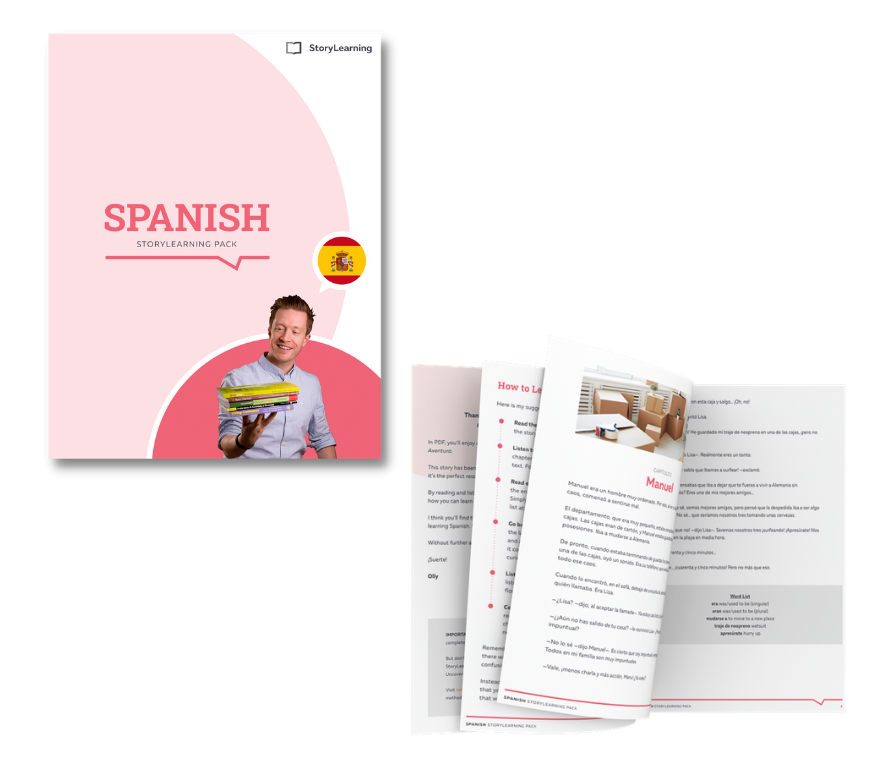
In any of our Uncovered courses, you read and listen to one continuous story from beginning to end. The story is written at your level, pitched to be comprehensible but stretching. Grammar and vocabulary are unpacked from within the story, not taught in isolation.
The story is not a supplement to the course. The story is the course.
In a typical language course, the “input” (the reading, the audio, the example sentences) exists to illustrate a grammar point or practise a vocabulary list. The input serves the curriculum. We reverse that. The curriculum serves the input. Everything you learn comes from engaging with a story you actually want to follow.
Why stories? When you are hooked on a story, your brain releases oxytocin (linked to trust and connection) and dopamine (linked to focus and memory). Every word you encounter inside a story arrives loaded with emotion, tension, and meaning. Your brain flags it as worth keeping.
Compare that to memorising a word list. No context, no tension, no reason for your brain to care. It knows it is a list, and it treats it like one.
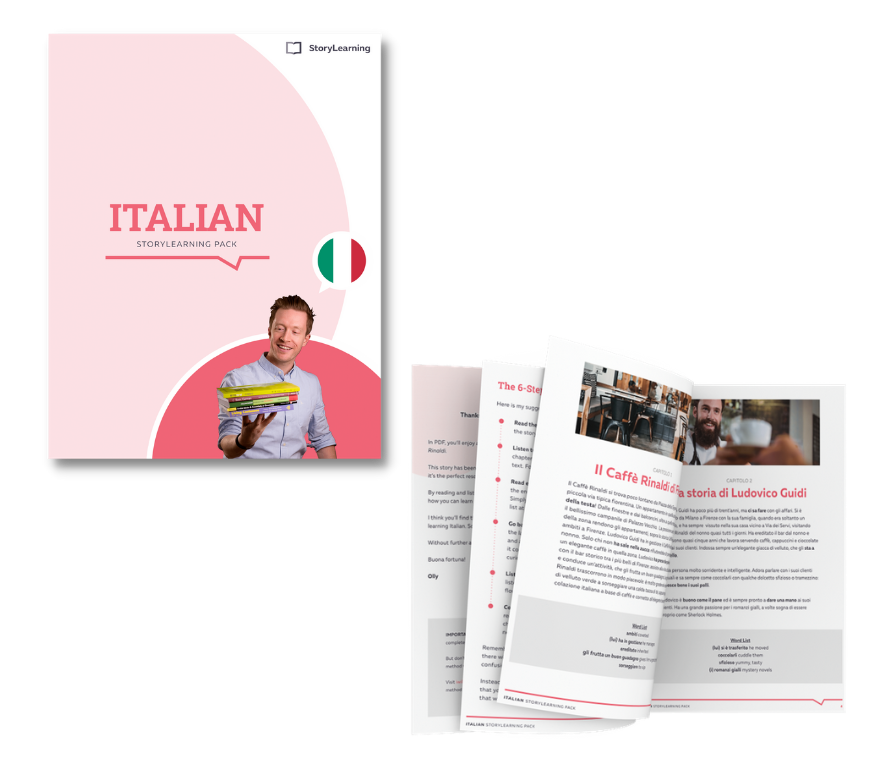
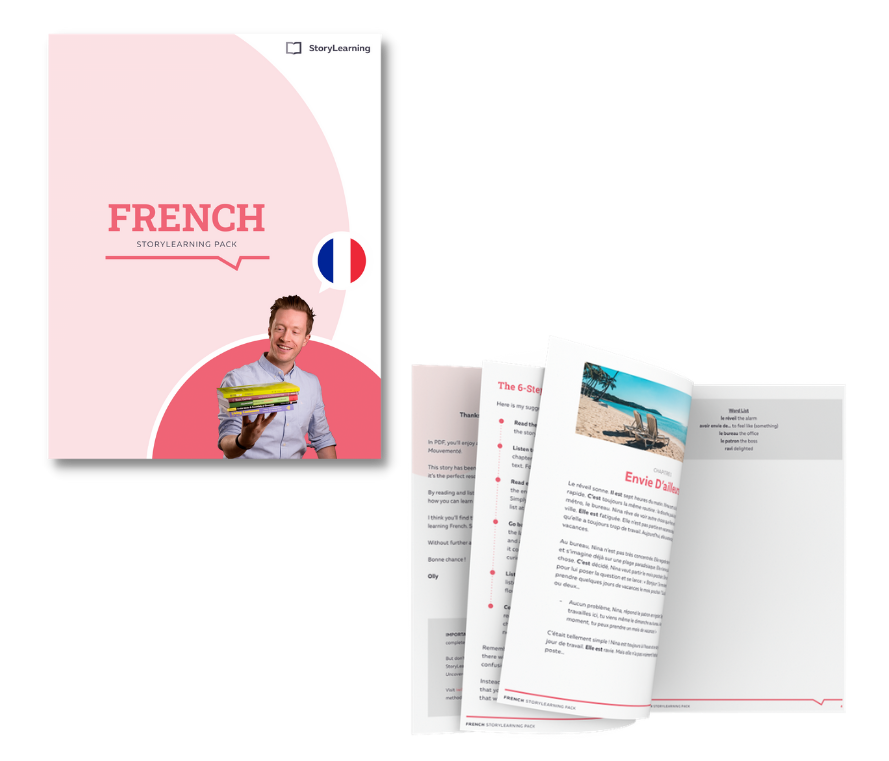
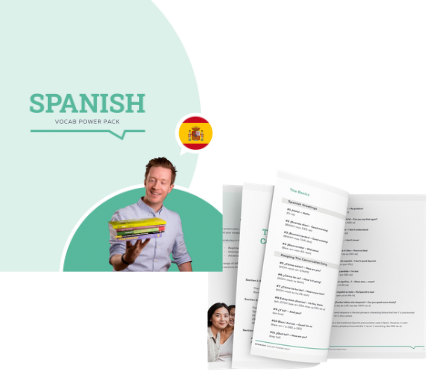
If you want comprehensible input you can dip into daily, without committing to a full course, the StoryLearning app delivers personalised, graded stories matched to your level with one-tap translations and spaced repetition. Fifteen minutes a day of reading at your “i+1,” with the material problem solved for you.
The courses go from complete beginner (A0) to advanced (C2), across 15 languages. That is a full comprehensible input pathway, not a fragment.
How To Start Using Comprehensible Input Today (Six Steps)
Whether you use StoryLearning or not, here is the method I use and teach. I have refined it over 25 years and eight languages.
Step 1: Choose Material At Your Level
This is where most people go wrong.
You should understand at least 80% of the words you read. If you can follow the plot, even loosely, you are at the right level. If every sentence is a puzzle, the material is too hard.
For beginners, this usually means graded readers: short stories written for language learners, with real plots and real characters but controlled vocabulary. For intermediates, it means simplified novels, bilingual texts, or curated story collections.
If you are drowning, it is not a reading problem. It is a material problem. Swap the book, not the method.
Step 2: Use Context Clues Before You Read
Before you read a single word, look at the page. The title, any illustrations, the chapter heading. These are not decorations. They are clues.
Your brain does not have to start from zero. Give it a rough picture of what is coming and everything becomes easier to follow.
Step 3: Read All The Way Through Without Stopping
When you start a chapter, your one job is to reach the end.
Do not stop and look up words. Do not check grammar. Just read. Follow the story. Ignore what you do not understand.
This is hard advice to take, especially if you are the studious type. But the real benefit of reading, the thing that actually makes you fluent, is what researchers call “extensive reading.” Reading a lot, for enjoyment. The kind where you get lost in a story and suddenly an hour has gone by.
You cannot build that habit if you are stopping every 30 seconds to consult a dictionary.
Step 4: Pause And Summarise
When you reach the end of a chapter, stop. Think about what you just read.
What happened? Who are the characters? Where did it take place? Was there a cliffhanger?
This takes 60 seconds. But it matters because when we read in a foreign language, we fall into a word-by-word trap, translating everything, and lose the thread of the story completely. This step trains you to read for meaning, not for translation.
Step 5: Read The Same Chapter Again
The second time feels completely different.
Your brain is not working as hard to follow the story, so you start noticing things that slipped past you the first time. Patterns. Word order. Bits of grammar. This noticing is one of the keys to language learning.
This is also where a dictionary is allowed, but with a strict rule: only look up a word if you have seen it five times. If a word keeps showing up, it matters. Everything else, let it go.
Step 6: Move On And Keep Going
Read the next chapter. Same process. Find out what happens next.
Do not stop to dissect grammar. Do not make word lists. Just keep reading.
The goal is to build a reading habit in your new language that feels exactly like reading in your first language. You pick up the book because you want to know what happens next, not because it is “study time.”
That is the moment you stop studying a language and start living in it.
Comprehensible Input vs Traditional Methods
Most language courses are built around what Krashen calls “skill building.” Learn a rule, practise the rule, test the rule. The assumption is that if you consciously learn enough rules, you will eventually be able to speak.
The research suggests something different. Conscious rule learning produces what Krashen calls “learned” knowledge. The kind you can use on a grammar test but not in a live conversation.
True fluency, the kind where language comes out naturally without thinking, comes from “acquired” knowledge, which only develops through processing meaningful input over time.
This is why so many people can conjugate verbs on paper but freeze the moment someone asks them a question in real life.
It is also why the Parrot Method, the “repeat after me” approach, produces such disappointing results. Repetition without comprehension is not input. It is noise.
I want to be honest about something, though. Comprehensible input is not the only thing that matters. A 2025 paper in Frontiers in Psychology makes the point that input and output are complementary. Input builds the mental representations, but you also need speaking practice to activate them.
I agree completely. Input is the foundation, not the whole building. You need to speak, too. But you cannot speak well without a deep well of input to draw from. Most people try to run before they can walk, forcing output before they have had enough input, and then wondering why their speech feels stilted.
Get the input right first. The speaking will come.

“But Will This Work For Me?”
I hear this question all the time. Usually from someone in their 50s, 60s, or 70s who has already tried Duolingo, Rosetta Stone, a classroom course, and maybe a tutor. They are convinced they are “bad at languages” or “too old.”
The research says otherwise.
The Jeon and Day meta-analysis found that adults benefit more from extensive reading than younger learners. The 2025 meta-analysis in Educational Psychology Review confirmed this across age groups.
Your brain is not too old for comprehensible input. It works the same way it did when you learned your first language as a child. The difference is the method, not the brain.
If your previous methods relied on memorisation, grammar drills, and tests, and they did not work, that does not mean you do not work. The method was wrong.
I have seen this thousands of times. Someone comes to StoryLearning after years of failure, convinced they will never learn. They start reading stories at their level. Within weeks they are understanding more than they ever did with apps and textbooks. Not because they got smarter. Because they had the right input.
What To Read Next
If you want to go deeper on the ideas behind comprehensible input and how StoryLearning applies them:
- The StoryLearning Method: how story-based learning works, step by step
- Stephen Krashen and Language Learning: a deeper look at Krashen's research and what it means for self-directed learners
- Comprehensible Input and Parallel Texts: how parallel texts (side-by-side translation) make comprehensible input accessible at any level
- Best Language Learning Method: a broader look at how to combine input, output, and practice into a complete strategy
Frequently Asked Questions About Comprehensible Input
What is comprehensible input in simple terms?
Comprehensible input means learning a language by reading or listening to content you can mostly understand.
Instead of memorising grammar rules or vocabulary lists, you absorb the language naturally by engaging with material at your level, the same way children pick up their first language.
Does comprehensible input work for adults?
Yes. Research consistently shows that adults benefit from comprehensible input as much as, or more than, younger learners.
A 2016 meta-analysis covering nearly 6,000 learners found that adults showed larger effects from extensive reading than children and adolescents.
How is comprehensible input different from immersion?
Immersion means being surrounded by the language, whether or not you understand it. Comprehensible input is about understanding.
You can be immersed in a language and learn nothing if the input is too far above your level. Comprehensible input is targeted: material pitched at your current level plus one small step.
Can I learn a language just by reading?
Reading is one of the most effective forms of comprehensible input, and the research strongly supports it. But for well-rounded fluency, you will eventually need speaking practice too. Think of reading as building the deep foundation that makes confident speaking possible.
How do I find comprehensible input at my level?
This is the hardest practical question. For most languages, the best options are graded readers (stories written for learners at specific levels), parallel texts, and curated story collections.
StoryLearning's Uncovered courses and the StoryLearning app are built to solve this problem, delivering stories graded to your level across 15 languages.
What Is The Difference Between Comprehensible Input And Extensive Reading?
Comprehensible input is the theory: you learn by understanding meaningful messages. Extensive reading is one practical way to get that input. Reading a large volume of material at your level, for enjoyment rather than study. They work together.
How Long Does It Take To See Results With Comprehensible Input?
Most learners notice a difference within a few weeks of consistent reading. Research shows that even 30 minutes of extensive reading per week produces measurable improvements in vocabulary and reading speed. Consistency matters more than intensity.

Olly Richards
Creator of the StoryLearning® Method


Olly Richards is a renowned polyglot and language learning expert with over 15 years of experience teaching millions through his innovative StoryLearning® method. He is the creator of StoryLearning, one of the world's largest language learning blogs with 500,000+ monthly readers.
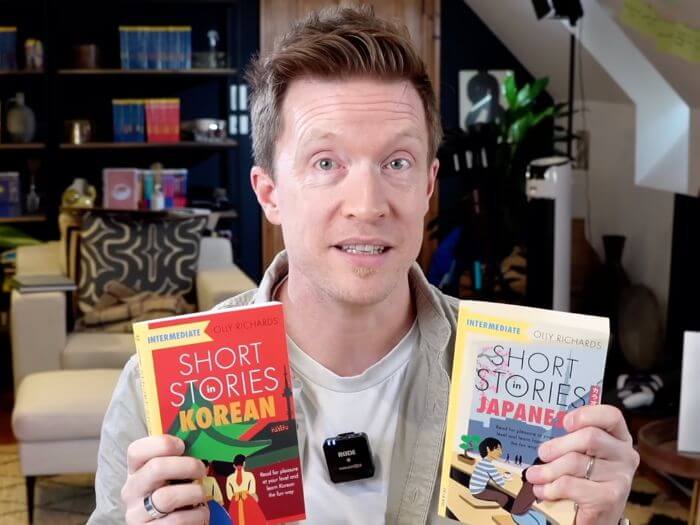
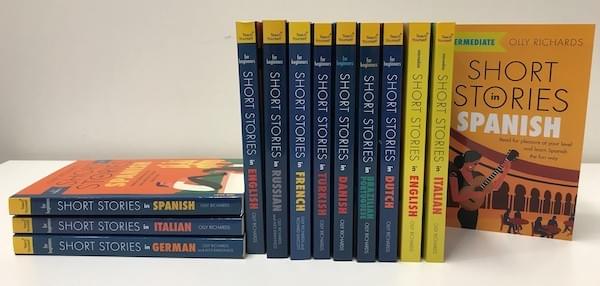
Olly has authored 30+ language learning books and courses, including the bestselling "Short Stories" series published by Teach Yourself.
When not developing new teaching methods, Richards practices what he preaches—he speaks 8 languages fluently and continues learning new ones through his own methodology.