Spanish vs Italian which is easier to learn for a native English speaker? This is a question I got recently from a blog reader.
If you're trying to decide between Spanish and Italian, here's the truth: both languages take about six months of intensive study to reach B2 (upper intermediate) level, making them equally accessible for English speakers.
But the real answer depends on factors most people don't consider. I've learnt both of these languages, so I'm going to walk you through my experience and what really matters when choosing between them.
Pro Tip
By the way, if you’re serious about improving your language skills, online language courses for fluency can make a huge difference.
I'm offering top-rated online language courses for beginners to advanced learners, covering Mandarin, Spanish, French, Italian, German, Japanese and more.
If you prefer watching videos to reading, hit play on the video version of this post at the top of this page. Otherwise, here's what you'll discover in this article:
Table of Contents
The Motivation Factor: More Important Than You Think
Most people would say that both Spanish and Italian are considered easy languages for English speakers. Easy is obviously a relative term. Learning any new language fast and to a high level is difficult.
But in the grand scheme of things, when you're comparing them with some of the more difficult languages around the world, Spanish and Italian are relatively easy.
Here's the thing though: I always have a strange feeling about this question of which language is easier or harder. You could compare a relatively simple language like Spanish with a relatively difficult language like Mandarin Chinese and give a technical answer.
But at the end of the day, it depends which you're most motivated to learn in your own life. If you're learning a language just to collect languages without any underlying motivation, that's one thing.
But if you're learning a difficult language because you've married someone who speaks it, you've got a kid who's now bilingual, or you're living in the country – suddenly you've got some pretty deep-rooted reasons to learn that language.
Those deeper meanings, that motivation, is what's going to ultimately carry you through and help you become more successful, irrespective of how difficult the language is.
Spanish vs Italian: How Long Do They Take To Learn?
B2 is upper intermediate level, and I always use this as the barometer for learning to speak a language when comparing different languages.
The thing about the B2 level is it's the point at which you're able to hold a genuine conversation with friends, coworkers, people you meet in the street, without anyone bending over backwards to accommodate you.
You can understand most of what you hear. You can explain yourself fairly articulately. You can have genuine friends in the language at a B2 level.
Six months of intensive study is a relatively short amount of time. And here's something interesting: I learnt Spanish first and then I learnt Italian afterwards, and I found Italian considerably easier to learn than when I learnt Spanish.
Is that because Italian is easier than Spanish? No, not at all.
It's because I already knew Spanish, and so concepts – grammatical concepts, pronunciation like rolling your Rs, even some cultural elements or noun gender – were a lot easier because I already had that understanding of Spanish.
What Makes A Language Easy Or Hard To Learn?
When we're talking about what makes a language easy or difficult to learn, there's a whole bunch of different factors. The most important is the distance from English.
If you're learning a language like Spanish or Italian, they're not that distant from English linguistically, so they're a lot more is familiar and that's going to make it easier.
If you're an English speaker learning Mandarin Chinese, there's almost nothing in common, so by definition it's harder because literally every single thing you learn requires an equal amount of effort, no matter how advanced you get.
One of the interesting quirks of learning a Romance language like Spanish or Italian is that actually, the more advanced you get, the easier it becomes.
A lot of the more difficult vocabulary you'll find is the same as English, because technical vocabulary and scientific terms tend to use those Latin roots that the languages have in common.
We know those words from English, so it becomes very easy to guess what that word might be.
Other factors that affect difficulty include:
The alphabet or script – You've got to learn Chinese characters, it's going to take you a couple of years before you can even read. But with Spanish or Italian, you can read from day one. Huge advantage there.
Sentence construction – Is it a similar thought pattern to English, or do you have to put ideas in different places?
Grammar – Eastern European Slavic languages have very difficult grammar that requires a lot of adaptation for English speakers.
Tones – Does the language have a tonal system, which makes it more difficult?
Both Spanish and Italian share similar attributes that make them easier to get to grips with for English speakers.
Spanish vs Italian: Key Similarities
Cognates Unlock A Third Of The Language
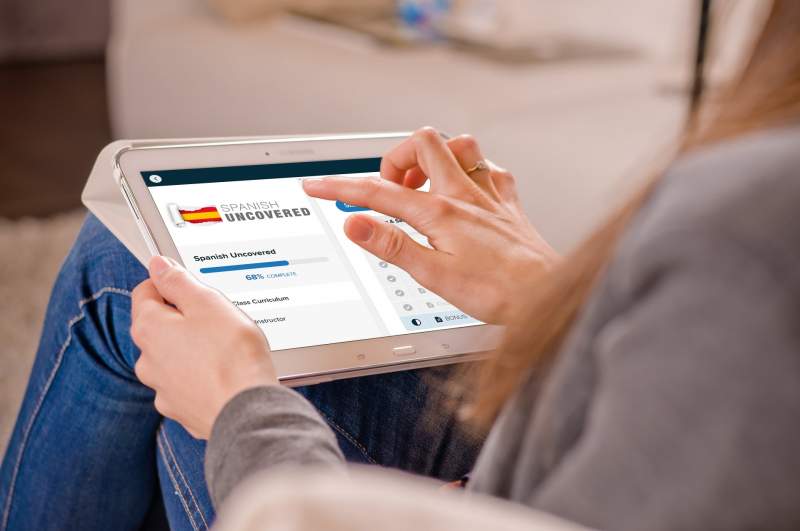
These shared roots in words make learning much easier from the beginning. In fact, in our StoryLearning Uncovered courses where we teach these languages from scratch, we have a section on cognates in every module of the course.
The course is based on a story – we show you the story, have you read and listen to it, and immediately start to teach you the cognates which are there.
Cognates instantly unlock a huge amount of the language. In Spanish or Italian, they probably unlock about a third of the language – at least 20-30% of the language on day one, if you can recognise what those cognates are because they're so close to English.
You Pronounce What You See
For the most part, you pronounce both languages as you see them. There's a strong connection between the spelling and the pronunciation, unlike English, by the way, which is a nightmare for Spanish and Italian speakers learning English.
We'll write words down and say them in a completely different way. Think of words like through, thorough… you have to learn the word disconnected from the spelling.
Advanced Vocabulary Gets Easier
I've explained that vocabulary at higher levels tends to be the same because of those shared roots. The more advanced you get in Spanish or Italian, the more the scientific and technical vocabulary overlaps with English.
Spanish vs Italian: The Subtle Differences
Pronunciation: Spanish Might Be Slightly Trickier
I'm not going to die on this hill, but I have a feeling that in terms of learning to speak the language, Spanish is slightly more problematic for us Brits, and probably for Americans as well.
Both Italian and Spanish are syllable-timed languages, which means for the most part, every sound you pronounce has the same amount of stress.
It's not like English, which is a stress-timed language. Every word in English has its own stress – think of the word “English”. You have to stress “Eng” and not “lish”, because if you say “Eng-LISH”, it doesn't make sense.
Both Italian and Spanish are syllable-timed languages, but Italian is curious because it has elements of stress-timing in it as well. It's more expressive, the sound of Italian. There's a lot more variety of expression in the sounds of the language.
It has elements of stress in it, even though it's still a syllable-timed language, and I think that just makes it a bit more familiar for us as native English speakers.
The pronunciation is just that bit more familiar, whereas with Spanish, you do have to adopt a different sound world. You have to get used to opening your mouth and using your throat in strange ways, a bit like you might do in French as well.
It's not a big deal, but Spanish pronunciation is perhaps a little bit more difficult to really embody.
The Italian Dialect Question
In Italian, the other thing that tends to stump people is the issue of dialect. In Italian you have standard Italian, which everyone in Italy can speak, even if they don't. But then you've got these different dialects in different regions.
People get very hung up on this and say, “I'm going to live in Florence, so I have to learn the local Florentine dialect. Otherwise, no one's going to understand me.” In reality, it's not a big deal because you can go anywhere in Italy, speak standard Italian, and you will be fine.
It's a bit like with Spanish dialects – people get hung up on regional differences. They say, “I want to learn Mexican Spanish, so I can't speak with this Colombian person, or I can't learn from a Spanish textbook.”
But in reality, 99% of the language is the same wherever you go. These are minor things that people get a bit hung up about, but they're really not worth worrying about all that much.
How To Get To Grips With Spanish Or Italian
To really learn either language, there are a few key things you need to do:
Master Verb Conjugations
First, get your head around the verb conjugations, because there is stuff to learn there in different tenses as well – present, present continuous, different forms of the past. You've got to learn your verbs and your grammar.
Do Enough Listening Practice
This goes for all languages really, but make sure you listen enough. The problem that native English speakers have is that we feel embarrassed speaking with a very different accent. There's just something in our brain that blocks us.
It's really important to do as much listening as you possibly can: talking with people, films, TV, podcasts, things like that, so that the language becomes normal.
The more normal the language becomes in your brain, the less weird you're going to feel about trying to make what feels like an exaggerated accent in the language.
Spanish vs Italian Which Is Easier FAQ
Is it easier to learn Spanish or Italian?
Spanish is generally considered easier for most learners because it has more regular spelling rules and is spoken more widely around the world.
Both languages are closely related, so choosing the easier one often depends on your exposure, motivation, and personal preference for the sound of the language.
Is Italian the easiest language to learn?
Italian is often considered one of the easier languages for English speakers because it contains many cognates that look like English words and its pronunciation is straightforward.
However, languages like Spanish or Dutch are sometimes rated even easier due to simpler spelling rules or wider global use.
Ultimately, the “easiest” language depends on your background, motivation, and how much you practise.
Are You Fluent In Spanish Or Italian? Take The Pub Test
Ultimately, the way you know you've got fluent in the language, in my view, is when you can pass the pub test.
My famous pub test is simply: can you walk into a pub and have a conversation with someone without them bending over backwards to accommodate you? Will they just speak to you normally in their language, and can you both enjoy the conversation?
If the answer to that is yes, you pass the pub test. You're probably at more or less a B2, upper intermediate level, and you can now, in my book at least, say that you're fluent in the language.
So, which is easier to learn out of Spanish and Italian for a native English speaker? Honestly, they're both the same. The real question is: which one are you more motivated to learn?
Olly Richards
Creator of the StoryLearning® Method
Olly Richards is a renowned polyglot and language learning expert with over 15 years of experience teaching millions through his innovative StoryLearning® method. He is the creator of StoryLearning, one of the world's largest language learning blogs with 500,000+ monthly readers.
Olly has authored 30+ language learning books and courses, including the bestselling "Short Stories" series published by Teach Yourself.
When not developing new teaching methods, Richards practices what he preaches—he speaks 8 languages fluently and continues learning new ones through his own methodology.
FREE
Get Your Free Guide:Best Binge-Worthy Resources for Fluency
All the best movies, TV shows, and podcasts hand-picked so you can learn your language just by watching what you already love.
Which language are you learning?
What is your current level in [language]?
Which language are you learning?
What is your current level in [language]?
Which language are you learning?
What is your current level in [language]?
Which language are you learning?
What is your current level in [language]?
Which language are you learning?
What is your current level in [language]?
Which language are you learning?
What is your current level in [language]?
Which language are you learning?
What is your current level in [language]?
Which language are you learning?
What is your current level in [language]?
Which language are you learning?
What is your current level in [language]?
Which language are you learning?
What is your current level in [language]?
Which language are you learning?
What is your current level in [language]?
Download this article as a FREE PDF?
What is your current level in Latin?
Download this article as a FREE PDF?
What is your current level in Norwegian?
Download this article as a FREE PDF?
What is your current level in Swedish?
Download this article as a FREE PDF?
What is your current level in Danish?
Which language are you learning?
What is your current level in [language]?
Download this article as a FREE PDF?
Download this article as a FREE PDF?
What is your current level in Arabic?
Download a FREE Story in Japanese!
Enter your email address below to get a FREE short story in Japanese and start learning Japanese quickly and naturally with my StoryLearning® method!
What is your current level in Japanese?
Download Your FREENatural Japanese Grammar Pack
Enter your email address below to get free access to my Natural Japanese Grammar Pack and learn to internalise Japanese grammar quickly and naturally through stories.
What is your current level in Japanese?
What is your current level in Portuguese?
What is your current level in German?
Train as an Online Language Teacher and Earn from Home
The next cohort of my Certificate of Online Language Teaching will open soon. Join the waiting list, and we’ll notify you as soon as enrolment is open!
Train as an Online Language Teacher and Earn from Home
The next cohort of my Certificate of Online Language Teaching will open soon. Join the waiting list, and we’ll notify you as soon as enrolment is open!
Download this article as a FREE PDF?
What is your current level in Portuguese?
Download this article as a FREE PDF?
What is your current level in Portuguese?
Download this article as a FREE PDF?
What is your current level in Turkish?
What is your current level in French?
What is your current level in Italian?
What is your current level in German?
What is your current level in Japanese?
Download Your FREEJapanese Vocab Power Pack
Enter your email address below to get free access to my Japanese Vocab Power Pack and learn essential Japanese words and phrases quickly and naturally. (ALL levels!)
What is your current level in Japanese?
Download Your FREE German Vocab Power Pack
Enter your email address below to get free access to my German Vocab Power Pack and learn essential German words and phrases quickly and naturally. (ALL levels!)
What is your current level in German?
Download Your FREE Italian Vocab Power Pack
Enter your email address below to get free access to my Italian Vocab Power Pack and learn essential Italian words and phrases quickly and naturally. (ALL levels!)
What is your current level in Italian?
Download Your FREEFrench Vocab Power Pack
Enter your email address below to get free access to my French Vocab Power Pack and learn essential French words and phrases quickly and naturally. (ALL levels!)
What is your current level in French?
What is your current level in Portuguese?
What is your current level in Russian?
What is your current level in Russian?
What is your current level in Italian?
What is your current level in Italian?
What is your current level in French?
What is your current level in French?
What is your current level in Spanish?
What is your current level in Spanish?
What is your current level in Spanish?
What is your current level in Arabic?
What is your current level in Portuguese?
What is your current level in Turkish?
What is your current level in Korean?
What is your current level in Russian?
What is your current level in Japanese?
What is your current level in Chinese?
What is your current level in Spanish?
What is your current level in Italian?
What is your current level in French?
What is your current level in German?
Download Your FREENatural Portuguese Grammar Pack
Enter your email address below to get free access to my Natural Portuguese Grammar Pack and learn to internalise Portuguese grammar quickly and naturally through stories.
What is your current level in Portuguese?
Download Your FREENatural Russian Grammar Pack
Enter your email address below to get free access to my Natural Russian Grammar Pack and learn to internalise Russian grammar quickly and naturally through stories.
What is your current level in Russian?
Download Your FREENatural German Grammar Pack
Enter your email address below to get free access to my Natural German Grammar Pack and learn to internalise German grammar quickly and naturally through stories.
What is your current level in German?
Download Your FREENatural French Grammar Pack
Enter your email address below to get free access to my Natural French Grammar Pack and learn to internalise French grammar quickly and naturally through stories.
What is your current level in French?
Download Your FREENatural Italian Grammar Pack
Enter your email address below to get free access to my Natural Italian Grammar Pack and learn to internalise Italian grammar quickly and naturally through stories.
What is your current level in Italian?
Download a FREE Story in Portuguese!
Enter your email address below to get a FREE short story in Brazilian Portuguese and start learning Portuguese quickly and naturally with my StoryLearning® method!
What is your current level in Portuguese?
Download a FREE Story in Russian!
Enter your email address below to get a FREE short story in Russian and start learning Russian quickly and naturally with my StoryLearning® method!
What is your current level in Russian?
Download a FREE Story in German!
Enter your email address below to get a FREE short story in German and start learning German quickly and naturally with my StoryLearning® method!
What is your current level in German?
Download a FREE Story in Italian!
Enter your email address below to get a FREE short story in Italian and start learning Italian quickly and naturally with my StoryLearning® method!
What is your current level in Italian?
Download a FREE Story in French!
Enter your email address below to get a FREE short story in French and start learning French quickly and naturally with my StoryLearning® method!
What is your current level in French?
Download a FREE Story in Spanish!
Enter your email address below to get a FREE short story in Spanish and start learning Spanish quickly and naturally with my StoryLearning® method!
What is your current level in Spanish?
FREE Download:
The Rules of Language Learning
Enter your email address below to get free access to my Rules of Language Learning and discover 25 “rules” to learn a new language quickly and naturally through stories.
Which language are you learning?
What is your current level in [language]?
Download Your FREESpanish Vocab Power Pack
Enter your email address below to get free access to my Spanish Vocab Power Pack and learn essential Spanish words and phrases quickly and naturally. (ALL levels!)
What is your current level in Spanish?
Download Your FREENatural Spanish Grammar Pack
Enter your email address below to get free access to my Natural Spanish Grammar Pack and learn to internalise Spanish grammar quickly and naturally through stories.
What is your current level in Spanish?
Free Step-By-Step Guide:
How to generate a full-time income from home with your English… even with ZERO previous teaching experience.
Download this article as a FREE PDF?
What is your current level in Thai?
Download this article as a FREE PDF?
What is your current level in Spanish?
Download this article as a FREE PDF?
What is your current level in Cantonese?
Download this article as a FREE PDF?
What is your current level in Russian?
Download this article as a FREE PDF?
What is your current level in Korean?
Download this article as a FREE PDF?
What is your current level in Japanese?
Download this article as a FREE PDF?
What is your current level in Italian?
Download this article as a FREE PDF?
What is your current level in German?
Download this article as a FREE PDF?
What is your current level in French?
Steal My Method?
I’ve written some simple emails explaining the techniques I’ve used to learn 8 languages…
Which language are you learning?
What is your current level in [language]?
Which language are you learning?
What is your current level in [language]?
I want to be skipped!
Join 84,574 other language learners getting StoryLearning tips by email…
“After I started to use your ideas, I learn better, for longer, with more passion. Thanks for the life-change!” – Dallas Nesbit
Which language are you learning?
What is your current level in [language]?
Download this article as a FREE PDF?
What is your current level in Chinese?
Which language are you learning?
What is your current level in [language]?
Find The Perfect Language Course For You!
Looking for a breakthrough in your language learning?
Complete this short survey to find the perfect course for you!