
You can follow a Spanish podcast without getting lost.
You can read a restaurant menu without reaching for your phone.
A friend sends a voice note from Madrid and you get the gist.
Then someone turns to you and asks a simple question — and your mind goes completely blank!
If that's you, take a breath 🙂
This is the single most common place adult learners stall. And it is not a sign that you're bad at languages.
Here's what's actually going on. The intermediate wall has two halves: an understanding gap and a speaking gap. No single online Spanish course fixes both — and that's the reality most “best course” articles won't tell you.
The most reliable setup I've seen?
Pair two things.
- A structured input course to carry your comprehension toward B2 (StoryLearning's Spanish Uncovered is the strongest of those).
- And regular real speaking practice to unfreeze your mouth (a tutoring marketplace like italki does the job cheaply).
That's the whole answer in two sentences.
The rest of this guide scores eleven of the biggest names on the same eight criteria, so you can see exactly who each one is for — and just as plainly, who it's not for.
Why Intermediate Spanish Feels Like Hitting a Wall
Start with the maths, because it explains almost everything. Duolingo's core vocabulary tops out at roughly 2,500 words. B2-level comprehension is estimated to need around 5,000. That gap is the reason so many people tell me “the app got me to intermediate, and then nothing.”
The wall has two halves. It helps to see them separately.
Half one is the understanding gap. Early on, progress feels quick, and there is a real reason for that: the 2,000 most frequent words cover roughly 80% of daily conversation. You learn those fast and feel like you are flying.
Then you hit the long tail, the thousands of rarer words and the nuanced grammar (the subjunctive, connectors like aunque and para que) that carry the other 20%, where most of the meaning actually lives. Progress slows right down.
As I have put it before, “you have the impression that you're not progressing as quickly as before.” The fix here is volume of comprehensible input at your level: material you understand about 95 to 98% of, what Stephen Krashen called “i+1”, one small step beyond where you are now.
(That is exactly why reading at your level matters so much at intermediate, and it is the reason we built the StoryLearning app: a daily stream of personalised, graded stories with 1-tap translations, so you can get that input volume in 15 minutes a day without hunting for material. This is not a structured course, though.)
Half two is the speaking gap, and this is the one that hurts. The researcher Merrill Swain noticed it decades ago in Canadian French-immersion students. They understood everything, yet they still could not produce fluent speech.
Her explanation, the output hypothesis, is simple and freeing: comprehension can run on context and half-processing, but speaking forces your brain to do the full grammatical work, live, with no time to think. So input-heavy study builds understanding much faster than it builds speech. That is not a personal failing. It is normal, and it is well documented.
There is a trap hidden inside this. Multiple-choice and word-bank exercises feel easy, and that easy feeling hides the gap. You tap the right tiles, pass every lesson, and still freeze the moment a real person is waiting for you to finish a sentence.
So the honest conclusion is this: no single product does both halves well. The smart move is one thing for input, one thing for output.
One more promise before the scores. We don't link to or earn from any product on this page. There are no affiliate links here. For a scam-wary audience that has been burned before, that matters, and it means we score every provider, our own StoryLearning included, on exactly the same eight things.
| Provider | Best-for CEFR | Primary skill | Speaking support | Structure | Study load | Method | Price (as of July 2026) | Track record |
|---|---|---|---|---|---|---|---|---|
| StoryLearning (Spanish Uncovered) | A0 to B1 | Reading (+ listening) | Guided | Fully sequenced | Medium to Deep | Comprehensible-input story reading | One-time $297/course, often discounted ~$147 | Established indie brand |
| Langua | A2 to C1 (practice) | Speaking (AI) | Feedback (AI) | Loose path | Flexible | AI conversation + SRS content | Subscription, ~$29.99/mo or $199.99/yr | Newer (2024+), widely reviewed |
| italki | Any level, tutor-dependent | Speaking | Live human | Freeform | Deep | Live 1-to-1 tutoring | Pay per lesson, ~$4 to $40/hr | Large established marketplace |
| Pimsleur | A0 to A2/B1 | Listening / Speaking | Scripted | Fully sequenced | Medium | Audio-immersion, graduated recall | Sub or one-time, ~$20/mo, Lifetime ~$475 | Long-established audio brand |
| Busuu | A0 to B1/B2 | Mixed | Feedback (async human) | Fully sequenced | Light to Medium | Lessons + SRS + native correction | Freemium, ~$5.41 to $5.83/mo on long plans | Established (Chegg-owned) |
| Assimil | A0 to B2 | Reading / Listening | None | Fully sequenced | Medium | Bilingual parallel-text | One-time, ~€47 to €62 (Spanish estimated) | French publisher since 1929 |
| Babbel | A0 to B1 | Mixed | Scripted | Fully sequenced | Light to Medium | Structured dialogue lessons | Sub, ~$8.95/mo annual, Lifetime $299 | Long-established, EdTech-credible |
| Duolingo | A0 to A2/low-B1 | Mixed (recognition) | Scripted | Fully sequenced | Light | Gamified SRS | Freemium, Super ~$12.99/mo | Market leader |
| Rosetta Stone | A0 to A2 | Vocab + pronunciation | Scripted | Fully sequenced | Light to Medium | Immersion, no translation | Lifetime list ~$399, usually $149 to $199 | Legacy brand (1990s) |
| Michel Thomas | A0 to A2 | Listening / Speaking | Scripted | Fully sequenced | Medium | Audio “no books” method | One-time, full bundle ~$273 | Legacy audio brand |
| Language Transfer | A0 to A2/low-B1 | Listening / Speaking | Scripted | Fully sequenced | Light to Medium | Audio “thinking method” | Free (donation-supported) | Small indie project |
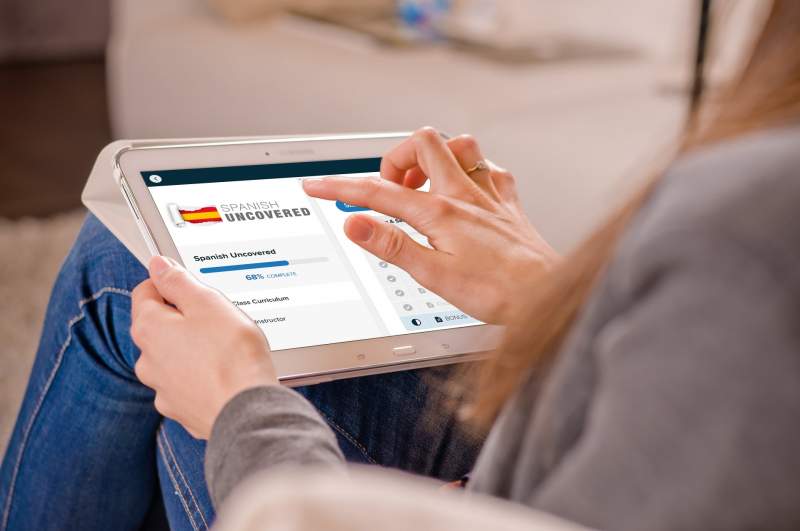
StoryLearning Spanish Uncovered: Best for Closing the Understanding Gap

The StoryLearning method is the main attraction here, so let me describe it plainly:
With this method, you learn Spanish by reading and listening to one continuous story, pitched just easy enough to follow, with the grammar unpacked from the story rather than drilled at you cold. That is comprehensible input in practice, which makes it the right tool for half one of the wall.
Now the honest scoring, and because this is my own product, I will lean harder on its weaknesses than I would for anyone else's.
As an input-based method, the focus is on comprehension, and so you will likely finish a course understanding more than you can spontaneously say, which is exactly the split we have been talking about. The primary skill it builds is reading, with listening close behind.
On speaking, and this is the number that matters most, it is Guided only. The course is comprehension-driven with some speaking prompts, but there is no human on the other end and no speech-recognition feedback. It will not unfreeze your mouth by itself. If active speaking is your bottleneck, this is not the piece that fixes it immediately.
The structure is fully sequenced, a linear course built around one story with a clear next step every session. Study load is medium to deep, chapters of 20 to 45 minutes, and it asks for genuine self-discipline. There is no streak nagging you, no gamified dopamine loop. You show up because you want to.
On price, here it is in full: one-time $297 per course for Spanish Uncovered, with three instalments available, a 7-day trial that gives full access, and a 365-day guarantee. It is frequently discounted to around $147 (as of July 2026). That is premium next to a monthly app subscription. The trade is that it is a one-time payment, not a recurring one.
One reviewer said they would have paid $500 for it, because it ended “a continual cycle of uncertainty” in their learning. That captures the real value here: relief from method-hopping. If you want to layer free comprehensible input alongside it, Dreaming Spanish videos and News in Slow Spanish are good companions.
Best for: the learner who wants to actually enjoy the process, close the understanding gap, and read and listen to real-ish Spanish, and who will show up without a streak nagging them.
Not for: anyone who wants to be spoon-fed bite-size gamified lessons, or who needs live speaking practice as their main thing from day one. It is premium priced, so go in knowing that.
Langua: Best for Unlimited AI Speaking Practice Between Real Conversations
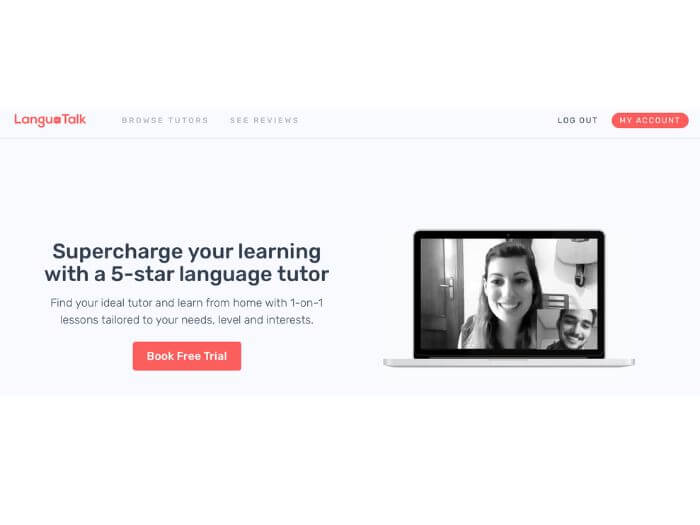
The intimidating thing about speaking practice is another human being hearing you fumble. Langua removes exactly that. You can have a real, spoken Spanish conversation, out loud, with an AI that sounds unnervingly human, as many times as you like, and nobody is judging you. For a nervous intermediate learner that is the quick win: unlimited reps, zero stage fright.
On scoring, Langua suits A2 to C1 for practice. Right now it is primarily a speaking practice tool, not a step-by-step course, so it fits people who already have some Spanish, which is precisely this article's reader. Primary skill is speaking, through AI conversation.
On speaking support it is Feedback (AI), and I want to be precise about what that means. You get free-form spoken or written conversation with real-time corrections, a genuinely human-like voice, and a “Call Mode” for hands-free chat. It is the strongest speaking practice of any app here. But it is an AI, not a real human, so there are no real social stakes. Ranked honestly, it sits below italki's real humans and above all the scripted apps.
Structure is a loose path today. It is a practice tool plus content (AI mini-stories, spaced-repetition flashcards, immersion clips), not yet a sequenced curriculum. That said, the team is actively building structured learning pathways, which would move Langua closer to being a genuine course rather than just a practice tool. Worth watching. Study load is flexible, entirely as much as you drive it.
On price it is a subscription: unlimited access around $29.99/mo or $199.99/yr (promo around $159.99/yr), with a Standard tier around $19.99/mo, plus a 5 to 7 day free trial and a 30-day guarantee (as of July 2026).
Not cheap for an app, but far cheaper per hour than a human tutor if you actually use it daily. It is a newer product, from 2024 onward, though widely reviewed as best-in-class for AI conversation. Worth noting: many of those reviews carry affiliate promo codes, so weigh the “most advanced” claims accordingly.
The limit is real. An AI will not hold you accountable the way a booked human will, and it will not fully reproduce the pressure of a real person waiting for you to finish. If the upcoming learning pathways deliver on the promise of structured progression, that would address the biggest gap, but as of July 2026 it is still primarily a practice tool.
Think of Langua as the flight simulator and italki as the real cockpit: practise daily with the AI to build confidence and fluency, then test it on a human who will stretch you in ways the AI cannot.
italki: Best for Real Speaking Practice, the Output Half
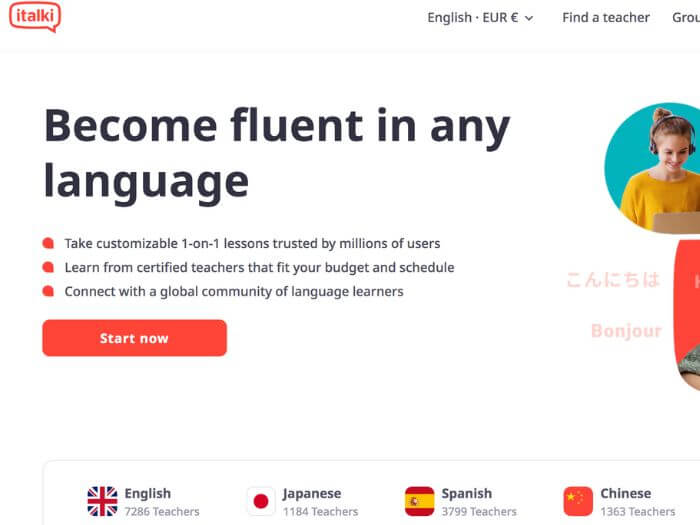
Here is the fact that surprises people. Across every expert source I read, the single biggest thing that breaks the plateau is not more study. It is regular, real speaking under mild pressure. The suggested cadences cluster tightly: two to three times a week, or three to four sessions of 30 minutes. Clozemaster puts it most starkly: one weekly live session can produce more progress in a month than the previous six.
That is the output half of the pairing, and italki is the cheapest reliable way to get it.
On the scoring, italki works at any level, entirely tutor-dependent. Its primary skill is speaking, tutor-led. On speaking support it is the only Live human option in this whole comparison, real one-to-one conversation with a person who corrects you. Say that plainly, because nothing else here can.
Its weakness is structure. It is freeform, with no built-in curriculum. You or your tutor have to supply the shape, which is a real drawback if you want to be handed a plan. Study load is deep, 30 to 60 minute sessions.
The method is a live tutoring marketplace. On price it is strong: community tutors run roughly $4 to $20 an hour, professional teachers roughly $10 to $40 (as of July 2026). You pay per lesson, so you can go at your own pace. It is a large, established marketplace with strongly positive learner sentiment.
The real learner voices tell the story better than I can. One wrote: “Just invested in a 10-lesson package with a tutor on iTalki and it's been a game changer, I'm going to be meeting with him twice a week.” Another: “my ability to express my thoughts on non-trivial topics developed a lot.”
And for anyone worried “will this actually work for me”, cheap trial lessons let you test a tutor's correction style before you commit any real money. If you want higher-volume conversation specifically, BaseLang and WorldsAcross are fair alternatives worth a look, though I would not oversell either.
Best for: anyone who understands more than they can say and needs to practise producing it with correction.
Skip if: you want a set curriculum handed to you, or talking to a stranger on day one feels like too much. Build comprehension first, then come back.
Pimsleur: Best for Building Speaking Confidence From Audio
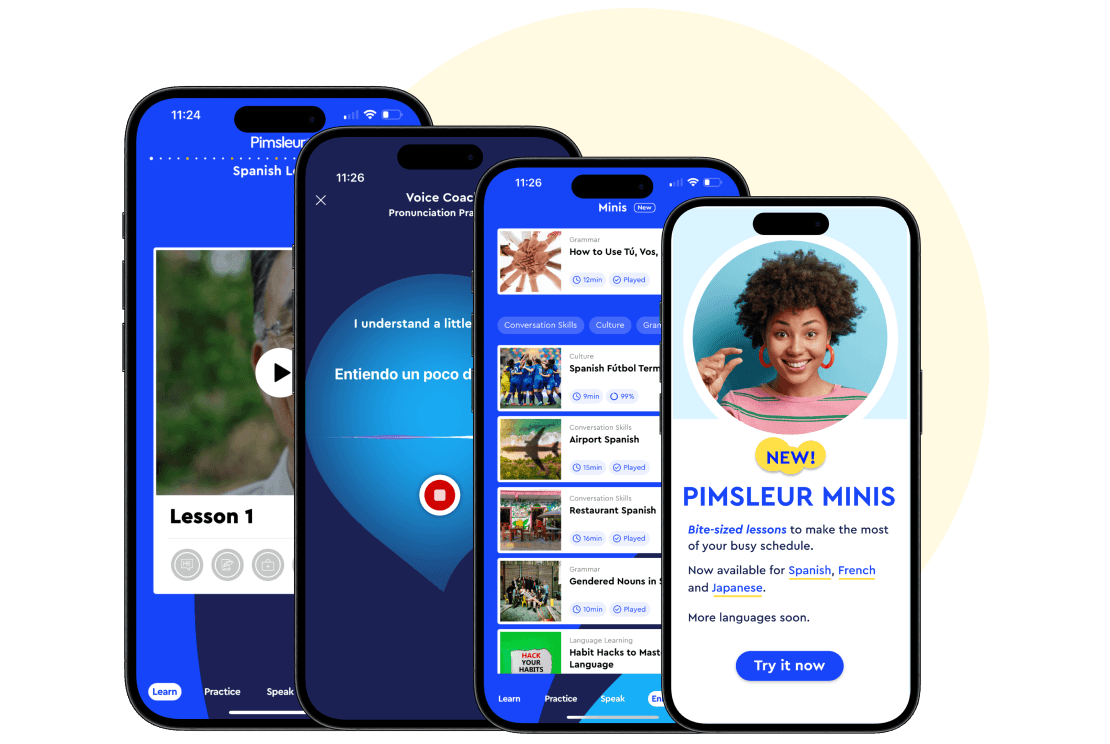
You can do this one with your eyes shut, literally. Pimsleur is 30-minute audio lessons that make you produce Spanish out loud on a graduated-recall schedule, so your mouth gets reps on a walk or a drive. That is the quick win: speaking practice with zero setup.
On the scoring, it covers A0 to A2, stretching to B1 for speaking and listening, with no real reading or writing depth. Primary skill is listening and speaking. Speaking support is Scripted: you repeat and produce spoken Spanish with some speech recognition, but there is no human, so it builds production reps rather than real unscripted conversation. It complements italki rather than replacing it.
Structure is fully sequenced, 30-minute audio lessons in order. Study load is medium, about half an hour a lesson. The method is audio-immersion with graduated-interval recall. On price, it runs as a subscription or one-time purchase: Premium single language around $19.95/mo, All Access around $20.95/mo (annual around $131.96), and Lifetime All Access around $475, with a 7-day trial (as of July 2026).
It is a long-established audio brand with a strong reputation for speaking foundations. The limit: it is slow and repetitive, the vocabulary is narrow, and there is little reading, writing or grammar. At intermediate, its job is topping up your spoken confidence, not carrying you to B2 alone.
A genuinely good way to warm up your spoken Spanish between real conversations, but not a full intermediate course on its own.
Busuu: Best App With Human Feedback and Real B2 Content
Most apps are a closed loop. You tap the right tiles, pass the lesson, and never once find out whether a real person would actually understand you. Busuu does the one thing that breaks that loop.
On the scoring, it runs A0 to B1, and crucially it has genuine B2 content, unlike most apps. Primary skill is mixed. Speaking support is Feedback: async correction of your written output by native-speaker community members. It is the only async human correction in this comparison, so be precise about it, it is human, but not live, and the quality varies because the correctors are volunteers.
Structure is fully sequenced and CEFR-mapped. Study load is light to medium, 10 to 20 minutes. The method is structured lessons plus spaced repetition plus native-speaker correction.
On price, freemium with a Premium tier: roughly $5.41 to $5.83/mo on 12 to 24-month plans, with monthly around $6.99 to $23.49 and annual around $70 to $139.99 (as of July 2026, promo-heavy). Strong value for what you get. It is established, Chegg-owned, with solid independent reviews.
The limit: the native-speaker correction is a real differentiator, but the core lessons are otherwise fairly standard app fare, the feedback depends on who picks up your submission, and it is written, not spoken. It nudges output, but it will not replace live conversation.
Best for: the learner who wants an affordable app that actually reaches B2 and gives real human feedback on their writing.
Not for: anyone whose bottleneck is spoken fluency specifically. Written corrections won't unfreeze your mouth, so pair it with real speaking.
Assimil: Best Budget Self-Study Route Towards B2
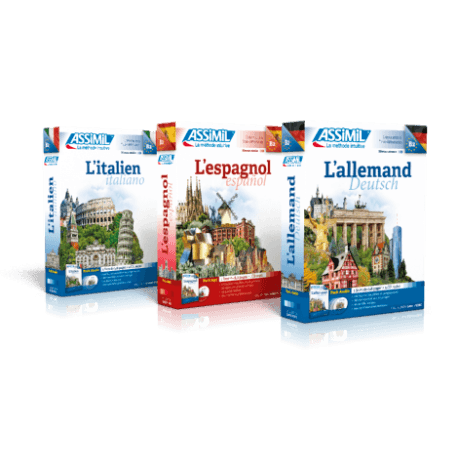
Here is a surprise. A method first published in 1929 outperforms most shiny apps at the one thing they fail at: actually reaching B2. Assimil has been doing bilingual parallel-text learning since before television was in people's homes.
On the scoring, it covers A0 to B2, making it one of the very few self-study courses that genuinely reaches B2. Primary skill is reading and listening, broadening to all-round. Speaking support is None: you shadow the audio, and there are no drills or feedback. That is the trade-off for the price and the depth, so go in clear-eyed about it.
Structure is fully sequenced, daily numbered lessons on a passive-then-active “wave” method. Study load is medium, around 20 to 30 minutes a lesson. The method is bilingual parallel-text with grammar in context, gentler than old grammar-translation.
On price, it is a one-time book or pack: the French “with ease” edition runs around €47 to €62, and the Spanish is comparable, though I should flag that the exact Spanish figure is estimated by analogy (as of July 2026). Strong value: it takes a disciplined learner a long way for very little. It has been published in France since 1929 and is a serious self-study classic.
The limit: it is old-fashioned and dry, it demands real self-discipline, and it gives you almost no active speaking. It builds the input half well and the output half not at all.
Think of Assimil as the cheaper, drier cousin of a story-based course: it will get you reading toward B2 for the price of a paperback, if you can stomach the lack of polish and bring your own speaking practice.
Babbel: The Most Polished App, and Its Ceiling
If any app was going to carry you through intermediate on its own, it would be this one. And even Babbel thins out right where you need it most.
On the scoring, it covers A0 to B1 and gets noticeably thinner beyond B1. That ceiling is the key point. Primary skill is mixed, grammar and dialogue together. Speaking support is Scripted, via speech recognition; Babbel Live adds real classes, but that is a separate paid product, so I will not fold it in here.
Structure is fully sequenced. Study load is light to medium, 10 to 20 minutes. The method is structured dialogue lessons with explicit grammar and vocabulary and some spaced repetition.
On price, it is a subscription for a single language: monthly around $17.95, annual working out around $8.95/mo, and a Lifetime option at $299 for all languages, often discounted to around $170 to $200 (as of July 2026). Fair value, though note the standard subscription is one language only. It is long-established and EdTech-credible, built for adults.
The limit: it has genuinely the clearest grammar explanations of the mainstream apps, but it is app-bound with limited real speaking, and it does not have the depth to take you through B1 to B2 by itself.
The best-made app on this list and a fine backbone up to B1, but treat it as a starting point, not the thing that gets you speaking. Skip if you are already at solid intermediate and need output, not more polished input.
Duolingo, Rosetta Stone, Michel Thomas and Language Transfer: Good Tools That Won't Break the Plateau Alone
These are almost certainly the tools that got you here, and there is no shame in that. They are good at what they do. They just aren't built for the wall you are now standing at.
Duolingo is brilliant at one thing: building a daily habit, for free. But the ceiling is real. Its core vocabulary of roughly 2,500 words falls well short of the 5,000 that B2 comprehension is estimated to need, and its recognition-heavy tapping rewards streaks over real ability. As one analysis put it, a 600-day streak might represent only about 50 hours of genuine input, and the classic experience is someone from Madrid sending a voice note of which you understand three words. Speaking support is Scripted (Max adds AI roleplay, still no human). Best for building a habit and the absolute basics, not for intermediate.
Rosetta Stone does decent pronunciation through its TruAccent tool and offers real immersion for absolute beginners, but its no-translation approach frustrates grammar and it stalls early, around A0 to A2. Price: lifetime list around $399, but almost always $149 to $199 in practice (as of July 2026).
Michel Thomas is the fastest way to get an intuition for how the language actually works when you are starting out. But the ceiling is low (A0 to A2), the recordings are dated, and there is no reading or writing. It is a one-time purchase, with the full Spanish bundle around $273 (as of July 2026).
Language Transfer is genuinely insightful on how Spanish fits together, and it is completely free, donation-supported. Its breadth is limited and it is audio-only, running A0 to low-B1. I recommend it warmly as a free supplement, and I can do that cleanly precisely because we earn nothing from saying so.
Best for: getting started, building a habit, or grasping the basics cheaply (Language Transfer for free).
Not for: breaking the intermediate plateau on their own. Use them, then move on to input volume plus real speaking.
The Bottom Line: Pair One Input Course With One Speaking Option
Here is the freeing part. You don't need the one perfect course. You need two things that each do one job well. That is easier, and cheaper, than method-hopping through a shelf of half-finished apps.
The pairing. For the understanding half, pick a structured input course. StoryLearning's Spanish Uncovered is the most enjoyable of them, and Assimil is the cheapest that still reaches B2. For the speaking half, get regular real practice, and think of it as a ladder: italki for real humans, the gold standard; Langua for unlimited AI conversation if a live tutor feels like too much yet, or if you just want daily low-stakes reps; and Pimsleur as a hands-free scripted stepping stone. Almost everyone who breaks the plateau does some version of input plus output, not one product alone.
If you're on a budget. Language Transfer (free) plus Assimil (the price of a paperback) plus a handful of cheap community italki lessons is a genuinely strong plateau-breaking kit for very little money. I can say that openly because we earn nothing either way.
If you only do one thing. Book regular speaking practice. Across every expert source I found, real output under mild pressure is the single biggest lever, more than any further course or vocabulary drill. So if you take one action after reading this, make it that.
And once more, lightly: there are no affiliate links on this page. We scored our own product on the same yardstick as everyone else, and named its weaknesses in plain text. That is the whole point.
Intermediate Spanish: Common Questions Answered
Is Spanish Uncovered worth $297?
It can be, if you value ending method-hopping and prefer a one-time price to endless subscriptions. It comes with a 7-day full-access trial and a 365-day guarantee, and one reviewer said it stopped “a continual cycle of uncertainty” in their learning. It is premium priced but the content is extremely comprehensive.
Can I get past intermediate Spanish without a tutor?
Yes, but it is harder and slower. Self-study works if you deliberately build in real output, recording yourself, writing, structured conversation exchanges, but a tutor or conversation partner is the most reliable route, because apps and courses rarely force you to produce language under pressure. The strongest approach is apps plus a tutor, which beats either one on its own.
How long does it take to go from B1 to B2 in Spanish?
Commonly 150 to 250 additional hours on top of the roughly 140 to 150 hours it takes to reach B1. Intensive classroom courses often frame the B1 to B2 jump as about 12 weeks, while part-time and self-study learners frequently report it taking up to a year. Your pace depends heavily on how much real speaking practice you fold in.
Are apps enough at the intermediate level?
Not on their own for full B1 to B2 progress. Duolingo's roughly 2,500-word vocabulary ceiling falls short of the estimated 5,000 words needed for B2, and apps are recognition-heavy rather than production-heavy, which is exactly the skill that stalls at intermediate. Use them additively: keep the app for habit, then add real input volume and speaking practice.
Why can I understand so much Spanish but freeze when I try to speak?
Because understanding and speaking are different skills, and this split is normal and well documented. Merrill Swain's output research shows that comprehension can run on context and partial processing, while speaking demands full grammatical processing in real time. So input-heavy study builds understanding faster than it builds fluency. It is not a sign that you are “not a language person”.
What's the single biggest lever to break the intermediate plateau?
Regular real speaking under mild pressure, not more passive study. Suggested cadences range from two to three times a week to three or four 30-minute sessions weekly. One source notes that a single weekly live session can produce more progress in a month than the previous six. If you change one habit, make it consistent speaking practice with correction.

Olly Richards
Creator of the StoryLearning® Method


Olly Richards is a renowned polyglot and language learning expert with over 15 years of experience teaching millions through his innovative StoryLearning® method. He is the creator of StoryLearning, one of the world's largest language learning blogs with 500,000+ monthly readers.
Olly has authored 30+ language learning books and courses, including the bestselling "Short Stories" series published by Teach Yourself.
When not developing new teaching methods, Richards practices what he preaches—he speaks 8 languages fluently and continues learning new ones through his own methodology.