
You can order a coffee in Paris without panicking.
You can follow the gist of a film if the subtitles are on.
You can read a simple article and get through it without reaching for Google Translate every other line.
And then a real French person talks to you at normal speed and you are lost within seconds.
If that is you, you are not failing. You are intermediate.
The problem is not you. The problem is that whatever got you here, whether it was an app, a class, or a textbook, was not built to take you further.
At intermediate, the rules change completely. You do not need more gamification. You do not need another app that gives you disconnected sentences about ordering coffee one minute and visiting the zoo the next.
So what is the best online French course for intermediate learners?
What you need is a serious course that gives you rich, sustained input at your level, so you can actually live inside the language rather than tap at it from the outside.
Here is the short version.
The most reliable setup for an intermediate French learner is to pair a structured input course that carries your comprehension toward B2 with regular real speaking practice to unfreeze your mouth.
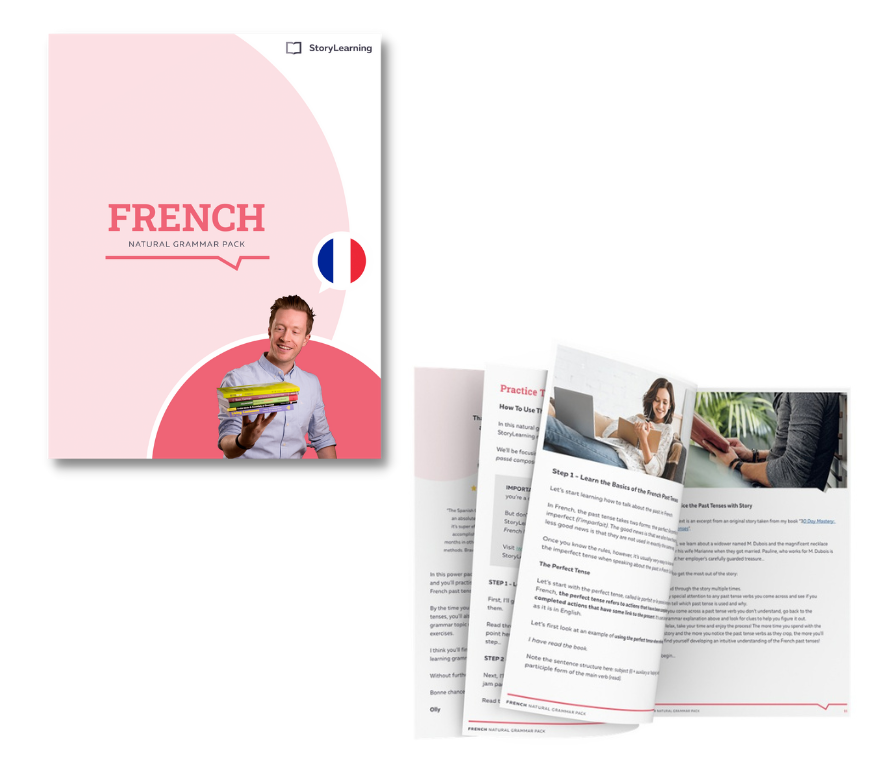
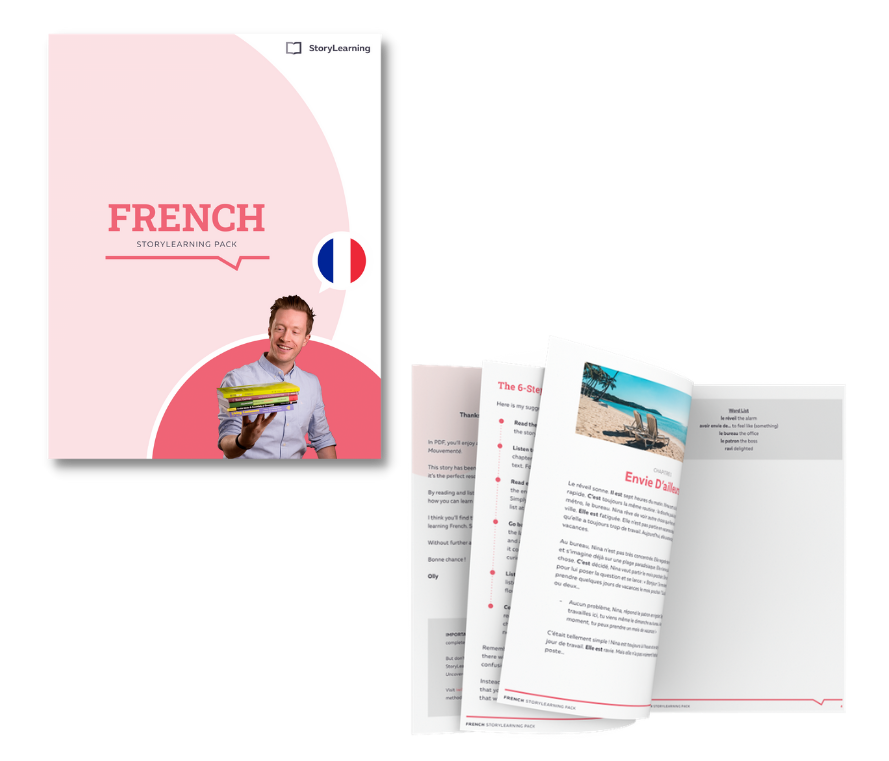
For the input half, StoryLearning's French Uncovered is the strongest option: courses from A0 to C2 built around comprehensible input through stories. For the speaking half, italki gives you real human tutors cheaply.
The rest of this guide scores eleven of the biggest names on the same eight criteria, so you can see exactly who each one is for, and which is likely to be the best intermediate French course for you.
Table of Contents
Why Intermediate French Feels Like Hitting A Wall

I remember this feeling vividly, because French was my first foreign language.
I was 19, working behind reception at a youth hostel in France. Two French lads came down and asked me for couverts (cutlery) to eat their pasta.
I confused it with couvertures (blankets).
I told them I would be right back, served other customers for 20 or 30 minutes, then returned proudly carrying two blankets.
They were sitting there with their stone-cold bowls of pasta looking quite unhappy. I was so ashamed, because it was my poor French that had let me down in that moment.
But I never forgot those words. 25 years later, I still remember them like it was yesterday.
That is the role of emotion in language learning. And it is exactly what apps cannot give you.
The intermediate wall has two halves. It helps to see them separately.
The first half is the input gap.
Early on, progress feels fast because high-frequency words cover most of what you hear. The linguist Paul Nation's research on vocabulary coverage estimates that the most frequent 2,000 word families cover roughly 80% of everyday conversation.
But at intermediate, you hit the long tail. The thousands of less common words and the nuanced grammar (the subjunctive, relative pronouns, register shifts between tu and vous) that carry the other 20%, where most of the meaning actually lives.
This is where apps collapse. They were built for the first 2,000 words, not the next 5,000.
What you need now is volume. Hours and hours of meaningful French at your level, stories, articles, podcasts, conversations, so that the language stops being a puzzle and starts being a medium.
I had a similar breakthrough years later, in a completely different language. I was in the mountains in Argentina, hit by altitude sickness at 3am, unable to sleep.
I grabbed a book in Spanish and started reading with zero agenda, no flashcards, no “study mode,” just reading for the experience of it.
And that is when I realised for the first time that I could understand so much more than I thought, if I just allowed myself to.
That is what the right intermediate course should feel like. Not more drilling. Not more points and streaks. Just rich, sustained contact with the language until it starts to feel normal.
The second half is the speaking gap.
Research by Levelt and others on speech production models shows that speaking requires a completely different processing chain from comprehension.
Understanding lets you guess from context. Speaking forces you to retrieve vocabulary, assemble grammar, and produce sounds, all in real time with someone waiting.
So you can read a French novel and still freeze when someone at the boulangerie asks you a question you were not expecting.
No single product does both halves well. The smart move is one thing for input, one thing for output.
And once more, before the scores: there are no affiliate links on this page. We score every provider, our own StoryLearning included, on exactly the same eight criteria.
So here are the best online French courses for intermediate learners, properly assessed:
| Provider | Best-for CEFR | Primary skill | Speaking support | Structure | Study load | Method | Price (as of July 2026) | Track record |
|---|---|---|---|---|---|---|---|---|
| StoryLearning (French Uncovered) | A0 to C2 | Reading (+ listening) | Guided | Fully sequenced | Medium to Deep | Comprehensible-input story reading | One-time $297/course, often discounted ~$147 | Established indie brand |
| Busuu | A0 to B1/B2 | Mixed | Feedback (async human) | Fully sequenced | Light to Medium | Lessons + SRS + native correction | Freemium, ~$5.41 to $5.83/mo on long plans | Established (Chegg-owned) |
| Babbel | A0 to B1 | Mixed (grammar + dialogue) | Scripted | Fully sequenced | Light to Medium | Structured dialogue lessons | Sub, ~$8.95/mo annual, Lifetime $299 | Long-established, EdTech-credible |
| italki | Any level, tutor-dependent | Speaking | Live human | Freeform | Deep | Live 1-to-1 tutoring | Pay per lesson, ~$4 to $40/hr | Large established marketplace |
| Langua | A2 to C1 (practice) | Speaking (AI) | Feedback (AI) | Loose path | Flexible | AI conversation + SRS content | Subscription, ~$29.99/mo or $199.99/yr | Newer (2024+), widely reviewed |
| Pimsleur | A0 to A2/B1 | Listening / Speaking | Scripted | Fully sequenced | Medium | Audio-immersion, graduated recall | Sub or one-time, ~$20/mo, Lifetime ~$475 | Long-established audio brand |
| Assimil | A0 to B2 | Reading / Listening | None | Fully sequenced | Medium | Bilingual parallel-text | One-time, ~$50 to $65 | French publisher since 1929 |
| Duolingo | A0 to A2/low-B1 | Mixed (recognition) | Scripted | Fully sequenced | Light | Gamified SRS | Freemium, Super ~$12.99/mo or ~$95.99/yr | Market leader |
| Rosetta Stone | A0 to A2 | Vocab + pronunciation | Scripted | Fully sequenced | Light to Medium | Immersion, no translation | Lifetime list ~$399, usually $149 to $199 | Legacy brand (1990s) |
| Michel Thomas | A0 to A2 | Listening / Speaking | Scripted | Fully sequenced | Medium | Audio “no books” method | One-time, full bundle ~$273 | Legacy audio brand |
| Language Transfer | A0 to A2/low-B1 | Listening / Speaking | Scripted | Fully sequenced | Light to Medium | Audio “thinking method” | Free (donation-supported) | Small indie (French partially covered) |
StoryLearning French Uncovered: Best For Closing The Input Gap
The StoryLearning method is the whole point here, and it is the opposite of what most apps do.
You learn by reading and listening to one continuous story, pitched just easy enough to follow, with the grammar unpacked from the story rather than drilled at you cold. That is comprehensible input in practice.
Where an app gives you disconnected sentences about random topics, this programme gives you a story you actually want to finish. And at the intermediate level, that difference matters enormously.
Because the real job at intermediate is not learning more isolated facts about French. It is spending enough time inside the language that it starts to feel natural.
I learned this the hard way with Cantonese. After months of grinding through textbooks for two hours every evening after work, I was burned out.
So I gave up “proper” studying and just lay on the sofa watching a Cantonese TV drama called Triumph in the Skies, 96 episodes across two seasons.
I watched hundreds of hours. The very opposite of forcing it.
But that experience allowed a huge wave of language to wash over me. My pronunciation, my vocabulary, my intonation, everything improved. My teacher told me afterwards that I sounded much more native-like, simply because I had been exposed to so much real language.
A good intermediate French course should work like that. Not more flashcard drilling. Real, sustained, meaningful input that you actually enjoy.
On CEFR range, the Uncovered courses run from A0 all the way to Mastery (C2), with separate courses for each level. That is one of the few course lines that genuinely covers the full journey.
The premise of the StoryLearning method is that you need to build your knowledge before you can speak. Long-term, that makes this the strongest bet of all, provided you are happy to take a long-term view in your learning.
On speaking, it is Guided only. The course is comprehension-driven with some speaking prompts, but there is no human on the other end. It will not unfreeze your mouth by itself.
If active speaking is your bottleneck, this is not the piece that fixes it. Pair it with real speaking practice.
Structure is fully sequenced. Study load is medium to deep, chapters of 20 to 45 minutes, and it asks for real self-discipline.
On price: one-time $297 per course, with three instalments available, a 7-day full-access trial, and a 365-day guarantee. Frequently discounted to around $147 (as of July 2026).
If you want daily reading practice alongside the course, there is also the StoryLearning app: 15 minutes a day of graded stories in French, with 1-tap translations. Built as a supplement to slot in alongside whatever else you are using.
Best for: the intermediate learner who wants to actually enjoy the process and build deep comprehension through real stories.
Not for: anyone who wants bite-size gamified lessons, or who needs live speaking as their main thing from day one. It is premium priced, so go in knowing that.
Busuu: The App That Actually Reaches B2 (With Human Feedback)
If you want to stay in app territory but need something that goes meaningfully further than Duolingo, Busuu is the strongest option.
Most apps stall around A2. Busuu has genuine B2 content, which alone puts it in a different category for intermediate learners.
Speaking support is Feedback: async correction of your written output by native-speaker community members. It is human, but not live, and the quality varies because the correctors are volunteers.
Structure is fully sequenced and CEFR-mapped, so you always know where you are. Study load is light to medium, 10 to 20 minutes.
On price, it is freemium with a Premium tier: roughly $5.41 to $5.83/mo on 12 to 24-month plans (as of July 2026, promo-heavy). Strong value for what you get.
The limit: the native-speaker correction is a real differentiator, but the core lessons are otherwise standard app fare. The feedback is written, not spoken. It nudges output, but it will not replace live conversation.
Best for: the learner who wants an affordable app that genuinely reaches B2 and gives real human feedback on their writing.
Not for: anyone whose bottleneck is spoken fluency. Written corrections will not unfreeze your mouth.
italki: The One Thing No Course Can Give You
Here is the uncomfortable truth about intermediate French.
You can take every course on this list and still freeze when someone talks to you. Because speaking is a separate skill that only improves by doing it.
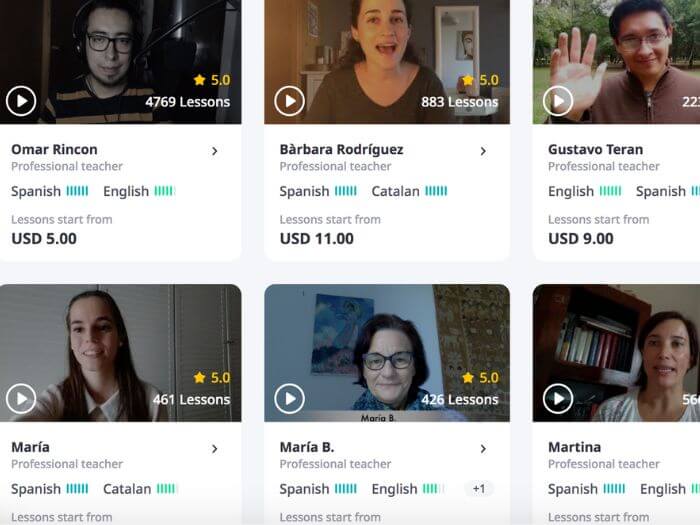
italki is the cheapest reliable way to get real, live French conversation with a person who corrects you. Nothing else on this list does that.
Its weakness is structure. It is freeform, with no built-in curriculum. You or your tutor have to supply the shape.
Study load is deep, 30 to 60 minute sessions. On price: community tutors run roughly $4 to $20 an hour, professional teachers roughly $10 to $40 (as of July 2026). Cheap trial lessons let you test a tutor's style before committing.
Best for: anyone who understands more French than they can say, and needs to practise producing it with correction.
Not for: anyone who finds talking to a stranger too much just yet. Build comprehension first, then come back.
Langua: Unlimited Speaking Practice Without The Stage Fright
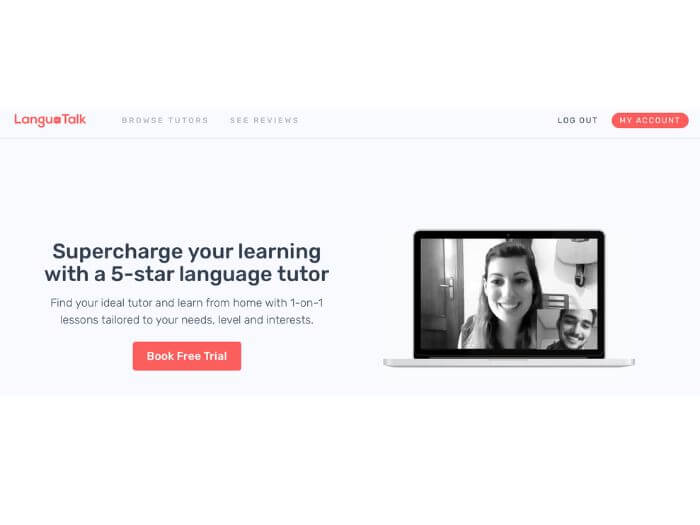
If booking a real tutor feels like too much, Langua removes the pressure.
You can have a spoken French conversation with an AI that sounds unnervingly human, as many times as you like, and nobody is judging you.
I actually found this quite emotional when I tried it with French recently. I learned French at 19, living in Paris, over 25 years ago. I had not spoken much French since. Using Langua enabled me to get French out of my mouth for the first time in over a decade.
It was not about having a perfect conversation. It was that I had not used those muscles, had not made those sounds, for so long. And now I was doing it for 5 minutes, 10 minutes, 15 minutes, day after day. It was genuinely moving.
On speaking support it is Feedback (AI): free-form spoken conversation with real-time corrections, a genuinely human-like voice, and a hands-free Call Mode. It sits below italki's real humans and above every scripted app.
Structure is a loose path today, not a sequenced curriculum. Study load is flexible.
On price: unlimited access around $29.99/mo or $199.99/yr (as of July 2026). Worth noting: many reviews carry affiliate promo codes, so weigh the claims accordingly.
Best for: the nervous learner who wants unlimited low-stakes French speaking reps.
Not for: anyone who needs structured progression, or the accountability only a booked human provides.
Babbel: The Most Polished App, and Its Ceiling
If you liked app-based learning but wanted it to treat you like an adult, Babbel is the natural step up from Duolingo.
The difference is methodology: where Duolingo shuffles you through decontextualised exercises, Babbel builds lessons around structured dialogues with explicit grammar explanations.
It has genuinely the clearest grammar explanations of any mainstream app. For a French intermediate learner trying to finally understand the subjunctive or the difference between the imparfait and the passé composé, that clarity matters.
On the scoring, it covers A0 to B1 and gets noticeably thinner beyond B1. That ceiling is the key point for intermediate learners. If you want to see how different language learning apps compare more broadly, I have written a separate guide.
On price: subscription for a single language, monthly around $17.95, annual around $8.95/mo, Lifetime $299 for all languages, often discounted (as of July 2026).
Best for: the learner who wants clearer grammar and a grown-up app up to B1.
Not for: anyone already at solid B1 who needs depth and output, not more polished input.
Pimsleur: Best for Building Spoken Confidence From Audio
You can do this one with your eyes shut, literally.
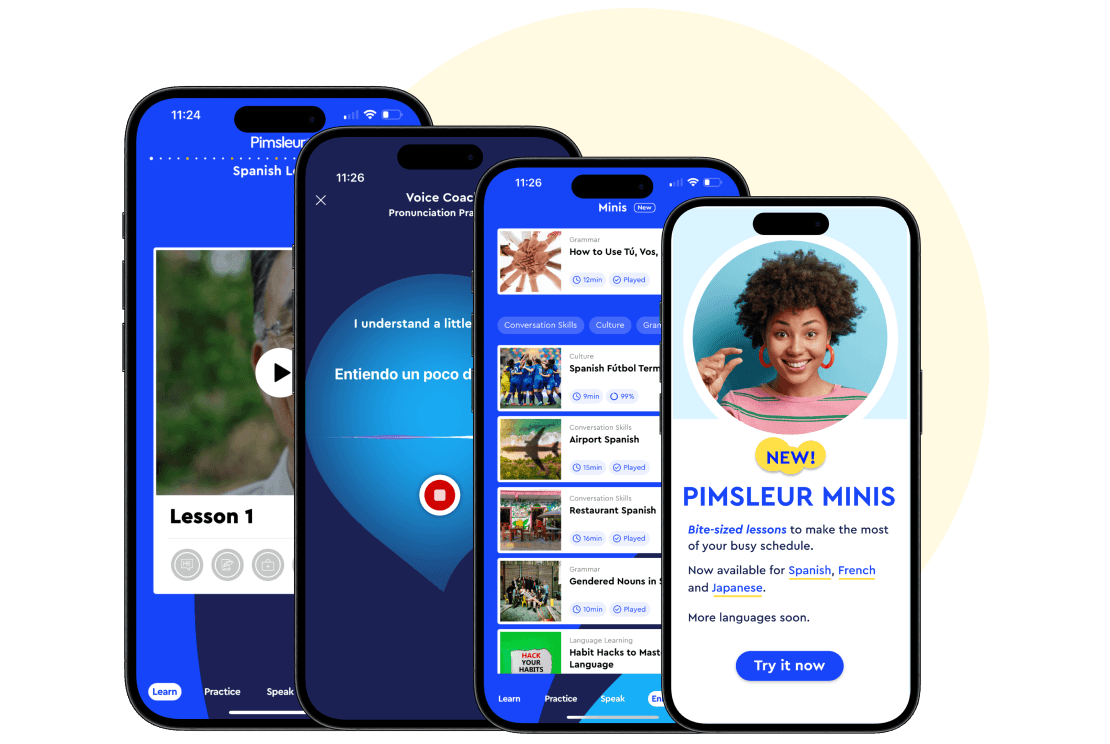
Pimsleur is 30-minute audio lessons that make you produce French out loud on a graduated-recall schedule. Your mouth gets reps on a walk or a drive.
Its methodology, graduated-interval recall, forces you to produce language from memory, not pick it from a list. That is the one thing most apps never ask you to do.
On the scoring, it covers A0 to A2, stretching to B1 for speaking and listening. No real reading or writing depth.
On price: Premium single language around $19.95/mo, Lifetime All Access around $475 (as of July 2026).
The limit: it is slow, repetitive, and narrow. Its job is warming up your spoken confidence, not carrying you to B2 alone.
Best for: the learner who freezes out loud and wants low-effort spoken reps.
Not for: anyone who wants reading, writing, grammar depth, or a full route to B2.
Assimil: The French Classic That Actually Reaches B2
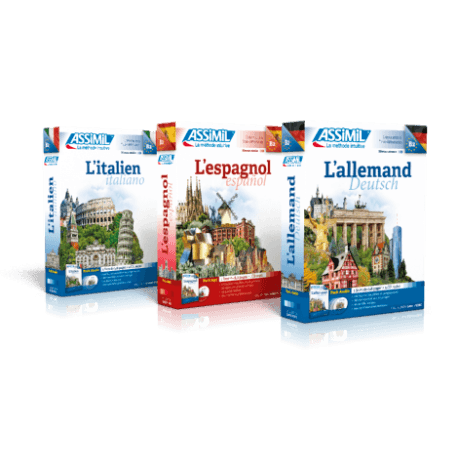
Assimil is a French publisher. It has been teaching languages through bilingual parallel texts since 1929.
For a French learner, there is something fitting about using a method that was literally invented in France.
And it is one of the very few self-study courses that genuinely reaches B2.
Structure is fully sequenced, daily numbered lessons on a passive-then-active “wave” method. Study load is medium, 20 to 30 minutes.
Speaking support is None: you shadow the audio, and there are no drills or feedback. That is the trade-off for the price and the depth.
On price: one-time, roughly $50 to $65 for the French edition (as of July 2026). For a course that takes you toward B2, that is extraordinary value.
The limit: it is old-fashioned and dry, it demands real self-discipline, and it gives you no active speaking.
Best for: the disciplined self-studier who wants a cheap, one-time route toward B2 and will bring their own speaking practice.
Not for: anyone who needs gamified motivation or real speaking built in.
Duolingo, Rosetta Stone, Michel Thomas And Language Transfer: Where They Stall
These are the tools that probably got you here. They are not bad. They are just not built for where you are now.
Duolingo is brilliant at building a daily habit, for free. But its exercises are recognition-heavy and its content thins out sharply past A2. At intermediate, you need depth, not more tile-tapping. If you are reading this article, you have almost certainly outgrown it.
Rosetta Stone does decent pronunciation work but stalls around A0 to A2. Its no-translation approach frustrates grammar at the intermediate level. Price: usually $149 to $199 for lifetime (as of July 2026).
Michel Thomas is the fastest way to get an intuition for how French works at the beginning. But the ceiling is A0 to A2, and there is no reading or writing. Full French bundle around $273.
Language Transfer is insightful and completely free, but French is only partially covered. Useful as a supplement, not a main course.
Best for: getting started.
Not for: breaking past the intermediate plateau on their own.
The Bottom Line: Move Beyond Gamification
Here is the freeing part.
The reason you are stuck is not that you need a better app. It is that you have outgrown apps entirely, at least as your main tool.
At intermediate, you need two things.
First, serious input. A course or method that gives you hours of meaningful French at your level, stories, articles, conversations, so the language stops being a code to crack and starts being a world to live in.
StoryLearning's French Uncovered does this through comprehensible input. Assimil does it through parallel texts. Busuu does it through structured B2 content with human feedback.
Second, real speaking. italki for live tutors. Langua for unlimited AI conversation if a live tutor feels like too much yet. Pimsleur as a hands-free stepping stone.
For a daily habit that actually moves the needle. Reading at your level for 15 minutes a day is the single most useful thing you can do at intermediate. The StoryLearning app is built for exactly that: graded French stories with 1-tap translations, designed to slot in alongside whatever course or tutor you choose.
If you are on a budget. Assimil (the price of a paperback) plus a handful of cheap community italki lessons is a genuinely strong kit for very little money. If French coverage improves, Language Transfer is free and worth adding.
If you only do one thing. Stop tapping and start reading. Real French, at your level, for as long as you can manage. That alone will move you further than another year of app streaks.
There are no affiliate links on this page. We scored our own product on the same yardstick as everyone else, and named its weaknesses in plain text.
Intermediate French: Common Questions Answered
What is the best online French course for intermediate learners?
There is no single best course, because the intermediate wall has two halves: an input gap and a speaking gap.
For input, StoryLearning's French Uncovered (A0 to C2, comprehensible input through stories), Busuu (genuine B2 content with human feedback), and Assimil (bilingual parallel texts) all go meaningfully deeper than apps.
For speaking, pair any of these with italki (live tutors) or Langua (AI conversation). The strongest setup is one course for input and one option for speaking.
Can I get past intermediate French with just an app?
Not realistically. Most apps stall around A2 to low-B1 because their exercises are recognition-heavy and their content thins out sharply past beginner level.
At intermediate, you need sustained, meaningful input at your level and real speaking practice. Apps can supplement, but they should not be your main tool.
How long does it take to go from B1 to B2 in French?
The Alliance Française and CEFR benchmarks generally estimate 200 to 250 guided learning hours to move from B1 to B2. Self-study learners often report it taking 6 to 12 months depending on daily time invested. The biggest variable is how much real speaking practice you fold in alongside input.
Is Duolingo enough for intermediate French?
No. Duolingo is excellent for building a daily habit and the absolute basics, but its content is recognition-heavy and stalls around A2 to low-B1.
At intermediate, you need real depth: stories, articles, and conversations at your level, not more tile-tapping. Keep it for habit if you like, but add a serious input course and real speaking.
What is the single biggest lever to break the intermediate plateau in French?
Volume of meaningful input. At intermediate, the gap is not that you lack knowledge of how French works. The gap is that you have not spent enough time inside real French at your level for it to feel natural.
Read, listen, and watch as much as you can at a level where you understand most of it but are still learning. Then pair that with regular speaking practice.

Olly Richards
Creator of the StoryLearning® Method


Olly Richards is a renowned polyglot and language learning expert with over 15 years of experience teaching millions through his innovative StoryLearning® method. He is the creator of StoryLearning, one of the world's largest language learning blogs with 500,000+ monthly readers.
Olly has authored 30+ language learning books and courses, including the bestselling "Short Stories" series published by Teach Yourself.
When not developing new teaching methods, Richards practices what he preaches—he speaks 8 languages fluently and continues learning new ones through his own methodology.