
Can AI actually help you speak better French, or is it all hype?
Reality check: it depends entirely on the app. Some of what's come out in the last couple of years is genuinely useful. A lot of it isn't.
I've put a fair few of these tools through their paces in a quest to find the best French AI app — testing them with real conversations, looking at how they handle feedback, and noting where they fall apart.
Below is what I'd actually recommend, ranked by how useful I think they'd be for a French learner specifically.
A quick note before we start: French throws up some particular challenges for AI apps. Liaison, nasal vowels and the gap between written and spoken French all matter. Not every app on this list handles them equally well and I've flagged it where it counts.
Pro Tip
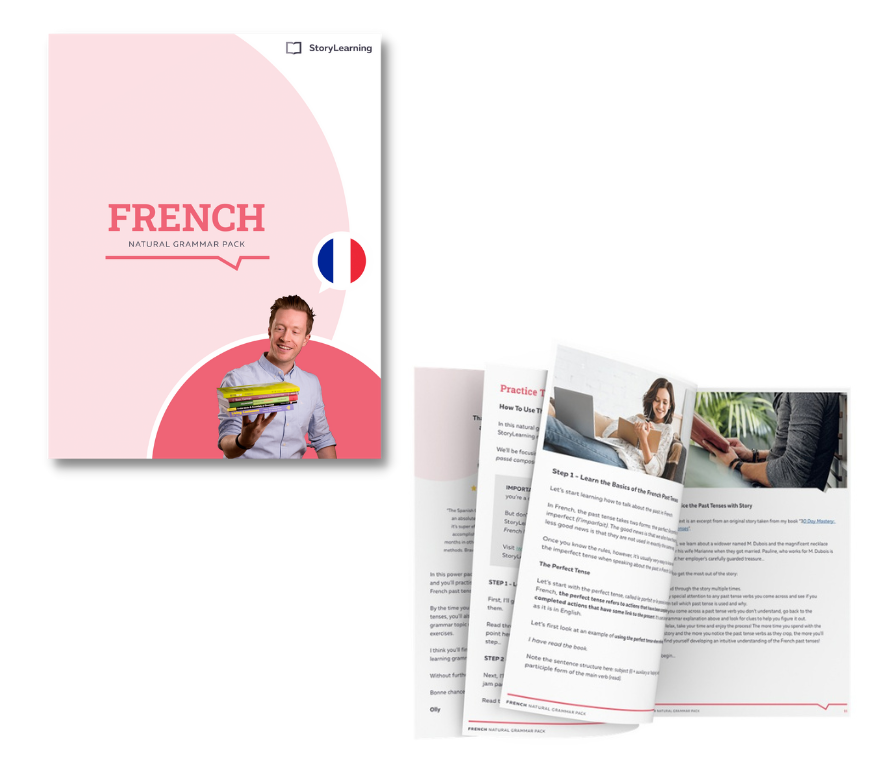
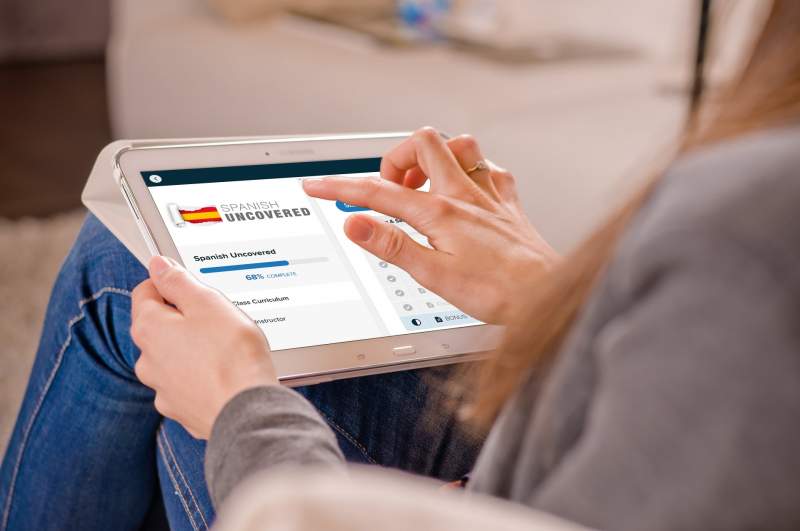
By the way, if you want to learn French fast by reading, my top recommendation is French Uncovered which teaches you through StoryLearning®.
With French Uncovered, you’ll use my unique StoryLearning® method to learn French through story…not rules. It’s as fun as it is effective. If you’re ready to get started, click here for a 7-day FREE trial.
Table of Contents
1. Langua
Where it shines: serious speakers who want detailed feedback after every conversation
I'll be upfront — Langua is the AI French app I keep coming back to, and the one I'd point any committed French learner towards first.
Here's why. Most AI conversation tools give you a chatbot and call it a day. Langua actually treats you like a learner.
You can pick between Chat Mode (text-based) and Call Mode (hands-free, like a phone call with a French friend), and within those, choose from a proper menu of exercises: role-plays, debates on your interests, vocabulary drills, free conversation.
Whatever you actually want to practise.
The voices matter too. They're cloned from real native speakers — including some well-known French YouTubers — rather than synthesised from scratch, and you can really hear the difference.
The rhythm of French, the elisions, the way native speakers actually slur certain phrases together: it's all there.
But the standout feature, for me, is what happens after the conversation. You get a written report of your mistakes, and the app then builds personalised grammar drills around the errors you're actually making.
So if you keep mixing up passé composé and imparfait, you'll get targeted practice on exactly that. You can also dial in how the AI corrects you in the moment — explicit, subtle, written, or spoken — depending on what doesn't break your flow.
One bit of polish I appreciate as a learner: if you genuinely can't find the French word, you can drop into English and the AI keeps up. That sounds minor. It isn't. It's the difference between a productive 30 minutes and a frustrated 10.
Beyond conversation, Langua also has podcasts and videos with interactive transcripts, AI-generated stories using vocabulary you've saved and spaced repetition flashcards.
So if you'd rather not bounce between five different apps for input, vocabulary, and speaking, this covers most of it under one roof.
Transcription does occasionally mishear you — true of every AI tool — but Langua lets you switch between the leading transcription models to find one that works best with your accent.
Pricing: $12–$29/month. Free account available, plus a 7-day free trial of Pro.
2. ChatGPT

Where it shines: as a free, flexible starting point if you're happy to build your own structure
ChatGPT needs no introduction. And yes, you can practise French with it.
But I want to be careful here, because there's a tendency to lump ChatGPT in with the dedicated apps, and that comparison doesn't really hold.
ChatGPT is a general-purpose AI. It happens to speak excellent French. It isn't a language learning product, and using it as one means doing the design work yourself.
That said — if you're willing to roll your sleeves up, it works. The voice mode is impressively natural and lets you interrupt mid-sentence, which feels much more like a real conversation than the stilted turn-taking of older tools.
The catch? Pause for more than a second or two to think, and it'll often start talking again, assuming you're done. For a learner reaching for the right word, that's maddening.
The deeper problem is the lack of any learning scaffolding. No curated topics, no vocabulary tracking, no grammar log, no spaced review. Every session starts from zero.
You can ask it to correct your French, but you have to remember to ask every time — and most people drift away from that within a few sessions.
There's also no way to set a specific regional French. It tends to land somewhere generic and slightly Parisian-leaning. If you're specifically learning Quebecois, Belgian, or African French, that's a meaningful limitation.
Pricing: Free (with limits), or $20/month for ChatGPT Plus.
3. Copycat Cafe

Where it shines: beginners who want a proper learning path with AI practice built in
Most of the apps on this list are conversation tools first, lessons second (or never). Copycat Cafe flips that around.
It's built primarily as a structured course — 200 lessons that take you from absolute beginner up to B2 — with AI conversation practice woven in alongside the lessons rather than bolted on as an afterthought.
The AI side comes in the form of Copy, the platform's mascot, who you can practise with as you go.
Nothing fancy on the personality front, but the integration matters: you learn something in a lesson, then go and use it in conversation, then come back. That's the loop most beginner-focused apps fail to close.
The pronunciation scoring caught my attention. Every response you give gets a score out of 100, broken down word by word so you can see exactly where you're slipping.
For French — where the gap between “I think I said that right” and “a native speaker actually understood me” can be vast — that kind of feedback is genuinely useful.
Worth flagging that no AI pronunciation tool is 100% reliable, but it gives you something concrete to work on.
If you're A1 or A2 and the open-ended “just chat to the AI” approach has been leaving you stuck, Copycat Cafe is probably a better fit than something like ChatGPT. You're not staring at a blank page wondering what to say.
The trade-offs are real, though. The AI conversation isn't as deep as Langua's — fewer modes, less sophisticated feedback, no spaced repetition tying it all together.
And there's no mobile app yet; it's web only, though the team told me one's in development. So if you're hoping to do a lesson on the bus, you'll need to use a phone browser for now.
Pricing: $14.50/month on an annual plan ($174/year), or $29/month if you want to go month-by-month. There's also a family plan at $240/year covering up to five accounts.
You get the full lesson library plus 1,000 daily AI messages — which is reasonable value if you're using both sides of the platform. 7-day free trial with no card up front, plus a 30-day money-back guarantee.
4. Speak
Where it shines: total beginners who want something they can open and follow
Speak is a polished app, and you can tell real product thinking has gone into it.
The onboarding is smooth, the French voices sound good, and the early lessons walk you through everyday scenarios in a sensible order: greetings, ordering food, asking for directions, making small talk on a train.
If you're at the very beginning of your French journey and the prospect of “just go practise” feels paralysing, Speak gives you a path to walk. That has real value.
The issue is what happens once you've been at it for a few months. Feedback stays quite surface-level — you'll see when something's flagged as wrong, but the why often isn't explained in any depth.
The content also doesn't scale particularly well into intermediate territory; the lessons start to feel like more of the same. And there's no spaced repetition for vocabulary, which for a language with as much lexical richness as French is a real omission.
Pricing: Varies by country, with the Premium Plus tier (unlimited custom lessons) noticeably pricier than the base. The tier structure is a bit of a maze.
5. Duolingo
Where it shines: keeping you consistent, day after day
Duolingo doesn't need a sales pitch — it's the app most people have either tried or felt guilty about not finishing.
And French is one of the languages it's invested most heavily in.
In 2024, Duolingo added two AI-powered features worth mentioning: Video Call (a conversation with the mascot, Lily) and Adventures (interactive scenario-based simulations). These started out behind the Max paywall but have been opening up.
Here's the honest take. For showing up consistently, nothing on this list beats Duolingo. The streaks, the gamified loops, the little dopamine hits — they work, and consistency is genuinely the thing that decides who learns a language and who doesn't.
But if your aim is to actually speak French, the AI features feel bolted onto a product that was built for something else. The conversations are less open, less natural, and less corrective than what you'd get from a tool like Langua. Treat them as a nice extra, not as your main speaking practice.
Pricing: Duolingo Super is around $20/month; Max is $30/month.
6. TalkPal
Where it shines: a no-friction option if you just want to chat
TalkPal was built specifically for language learners, and French is well supported.
Getting started takes about a minute, and there's a decent spread of conversation formats: role-plays, topic discussions, image-based prompts.
In use, though, it feels noticeably more basic than the leaders here. The voice quality is more synthetic than Langua's or Speak's — you can tell you're talking to a machine.
There's no vocabulary saving, no flashcard system, and no record of grammar issues across sessions. So whatever you learn in one conversation isn't really feeding the next.
One thing that genuinely made me laugh during testing: the prompts can be wildly out of scale with the level setting. On a fairly modest setting, one of the opening prompts invited me to debate capitalism versus socialism. In French. That's a stretch in your mother tongue.
Pricing: $11.99/month (cheaper annually). No proper free trial, but there's a limited free tier so you can have a poke around before committing.
7. Teacher AI

Where it shines: intermediate and advanced learners who want to fine-tune their practice
Teacher AI supports 30 languages, and French is one of the better-served ones.
What sets it apart is the level of customisation: you can pick from a range of AI French teachers with different personalities and backgrounds, then dial in their speaking speed, formality, correction frequency, and how much English they're allowed to fall back on.
Like Langua, the voices are cloned from real native speakers, so the audio feels human rather than generated. If you know exactly what kind of conversation practice you need — say, fast informal French with frequent corrections — you can engineer that here.
A caveat: this isn't really an app for beginners. Without a conversational foundation, the freedom to customise becomes overwhelming rather than useful.
But for intermediate or advanced learners who've outgrown the structured-lesson apps and want a flexible speaking partner, it's worth a look.
Pricing: $15/month, or $97/year. Free trial available.
The Missing Ingredient: Reading Stories
The apps in the list above are all about practising speaking or drilling vocabulary and grammar. But did you know that reading stories is the single most useful thing you can do to improve your French?
Reading stories at your level helps you learn new words and absorb grammar naturally. Once you start reading in French, you'll find that things start to click, including those tricky conjugations.
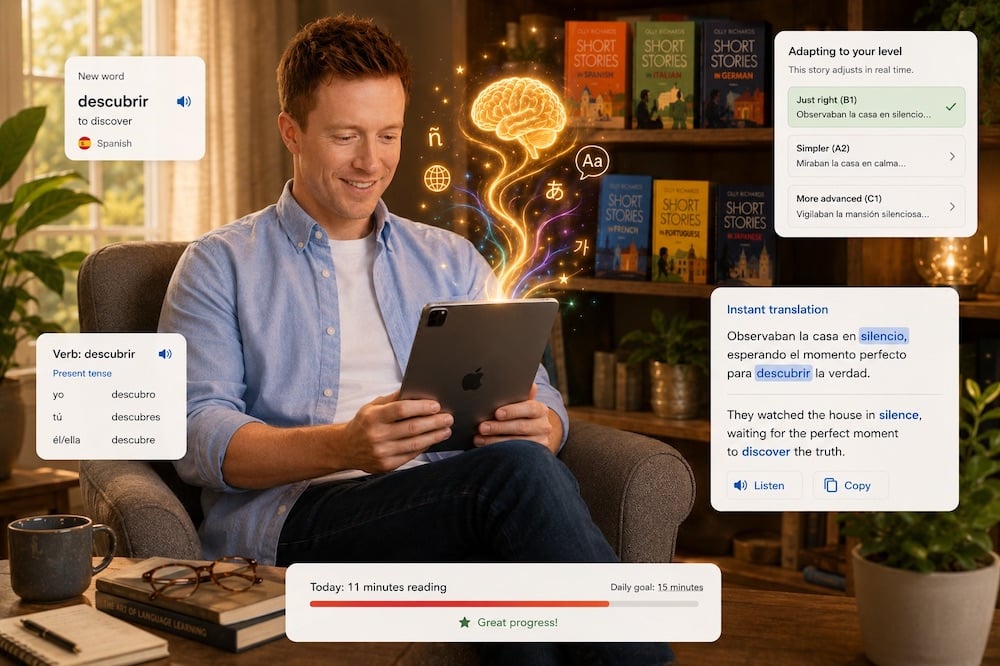
The StoryLearning App is built for this. It creates short stories tailored to your level and to your reading preferences, with tools to translate and review new words.
If you add just fifteen minutes a day of reading into your routine along with practising speaking, you'll improve much faster than you ever could by only focusing on one skill at a time.
FAQs About Best French AI App
Can I learn French with AI?
Yes, you can. Here are ten ways to learn French with AI.
1. Ask the AI chatbot to talk to you in French to boost fluency, learn new vocabulary, improve your listening and get feedback.
2. Get AI to help you role play scenarios in French that you need in real life – ordering food, going to the post office etc.
3. Ask AI for feedback on your French writing to improve your written use of both grammar and vocabulary.
4. Prompt AI to create stories at your level about topics that interest you to read or listen to (or both!)
5. Get a chatbot to create lists of relevant French vocabulary about a specific topic.
6. Ask the AI chatbot to explain differences between words that are similar like laid and moche which both mean “ugly”.
7. Prompt AI to give you grammar explanations and examples for areas that you struggle with.
8. Generate French vocab and grammar exercises and tests with AI.
9. Prompt AI to create practise tests to prepare for exams like the DELF.
10. Ask AI for suggestions for other French resources or areas to work on.
Can I use ChatGPT to learn French?
Certainly. ChatGPT can be a useful tool for learning French. It can provide translations, give lists of relevant vocabulary, and even assist with conversational skills.
You can also use AI to generate grammar or vocabulary exercises and even prepare for French exams like the DELF.
Is there a bot to speak French with?
Yes, you can speak French with chatbots like Langua from LanguaTalk. This chatbot offers French as a language as well as many other languages.
With Langua, you can enjoy French conversations designed to build fluency, including role-plays, debates, vocabulary practice, and more with a human-sounding AI that you choose.
You get instant feedback from your French AI conversation partner. You can also save new words from your French conversation and learn them via AI-generated stories and flashcards.
If you get stuck you can ask the AI to help by speaking in your native language. And if you don't know what to say, in one click Langua will suggest some responses in French.
Can you use AI to learn a language?
Yes, AI can be used to learn languages.
You can use AI for speaking practice in your new language. AI can also create stories and tests for you at your level.
You can prompt AI to suggest learning resources and strategies personalised to you. AI can also evaluate your writing and give your feedback.
Finally, AI can help you prepare for language exams by generating sample test papers.
My Verdict On The Best French AI App
The honest reality is that AI has changed what's possible for French learners. Five years ago, getting daily speaking practice without paying for tutors or finding a language exchange was genuinely difficult. Now it isn't.
But “AI for French” and “AI for learning French” aren't the same thing. The general-purpose tools — ChatGPT being the obvious example — can produce excellent French. They just won't teach it to you in any structured way.
If you want a tool that's actually built for the job — one that tracks your mistakes, builds vocabulary around your conversations, and gives you both speaking and listening practice in one place — Langua is what I'd point you to. It's the only app on this list that does all three properly.
One last thing. AI is a supplement to real human conversation, not a substitute for it. Use these tools to build the confidence and reflexes you need between your conversations with real French speakers, and you'll get far more from both.

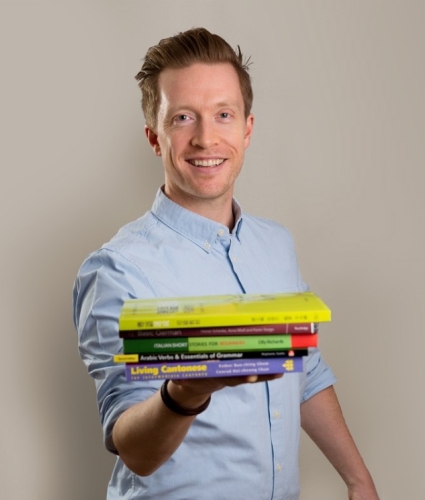
Olly Richards
Creator of the StoryLearning® Method


Olly Richards is a renowned polyglot and language learning expert with over 15 years of experience teaching millions through his innovative StoryLearning® method. He is the creator of StoryLearning, one of the world's largest language learning blogs with 500,000+ monthly readers.
Olly has authored 30+ language learning books and courses, including the bestselling "Short Stories" series published by Teach Yourself.
When not developing new teaching methods, Richards practices what he preaches—he speaks 8 languages fluently and continues learning new ones through his own methodology.