Few goals come up more often among readers than this one: learning how to sound like a native speaker.
My old friend Dave Pinto manages it. He is an American who teaches English pronunciation in Spain — yet to my ear he passes for a native Spanish speaker. Online, Spaniards even accuse him of being one of them, pretending to be American.
He did not get there by accident. Here is what Dave taught me about how to sound like a native speaker — and why much of it has nothing to do with your tongue.
Pro Tip
By the way, if you’re serious about improving your language skills, online language courses for fluency can make a huge difference.
I'm offering top-rated online language courses for beginners to advanced learners, covering Mandarin, Spanish, French, Italian, German, Japanese and more.
If you’ve been looking for a story-based online course to learn languages, this is your chance! Get a free 7-day trial of the course of your choice.
If you prefer watching videos to reading, hit play on the YouTube version of this post at the top of the page. Or listen to the podcast version below. Otherwise, here's what you'll discover in this post:
Table of Contents
Is Pronunciation Really Just A Technical Skill?
There is a temptation to treat pronunciation as a purely physical, technical problem. And of course, some of it is physical: you cannot produce certain sounds like a rolled R without getting your mouth shape right and your tongue in the correct position. That part is real.
But in my own languages — the ones where I feel my pronunciation is genuinely good — the battle was never mainly technical. It was psychological.
It came down to identity and confidence far more than physiology. Learning to make the sounds was the easy bit; learning to believe I could own them was the real work.
Dave agreed that there is far more going on than articulation. Yes, there are the sounds coming out of your mouth, and your intonation. But there is also body language, and even the tiny, unconscious noises we make.
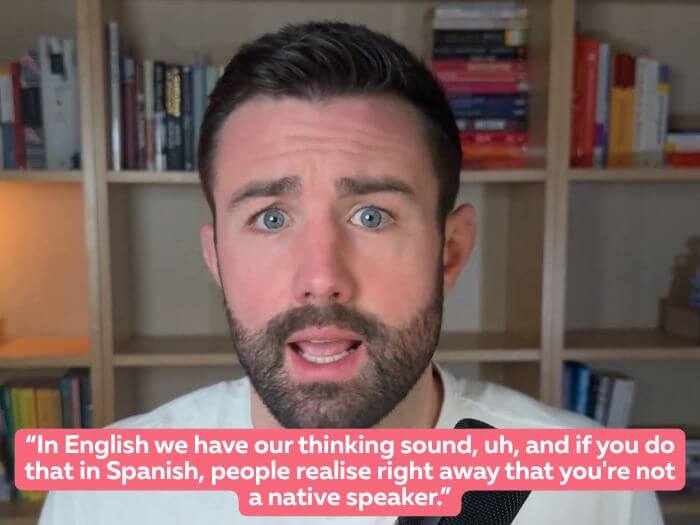
In English, our thinking sound is “uh”. Do that in Spanish, Dave pointed out, and people clock you as a foreigner instantly. The signals that give you away are often the ones you would never think to study.
What Does It Mean To Get Inside A Native Speaker's Head?
Dave talks about having done a “deep dive” on Spanish — really trying to understand how Spanish speakers think and how their brains work. I wanted to know what that actually means in practice.
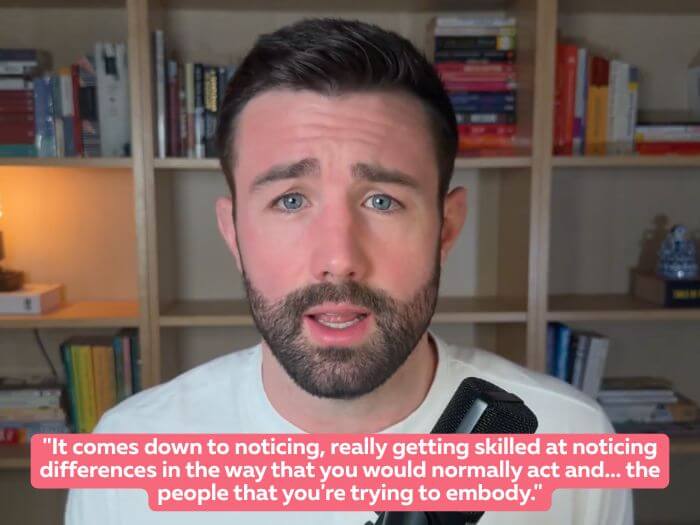
His answer came down to one word: noticing. “It comes down to noticing, really getting skilled at noticing differences in the way that you would normally act and… the people that you're trying to embody,” he told me.
Whatever group of native speakers you are aiming to sound like, the skill is spotting the gap between how you naturally behave and how they behave — and then closing it.
The catch is that the more time you spend around native speakers, the more of these tiny differences you pick up. Which is exactly why doing this from your bedroom, in a country where the language is not spoken, is so hard.
I saw it myself recently in Japan, and again in South Korea: the way people stand, the way they position themselves when they approach you, the demeanour — it gives you away in an instant, and there is almost no way to learn it online.
You can build an immersive environment for yourself anywhere, but it takes real effort, and some things only come from being there.
The Daily Practice Behind Native-Like Pronunciation
So what did Dave actually do, day to day, when he set out to improve his accent and sound Spanish? This is where it got concrete.
When he was focused on pronunciation, he would read the first chapter of a book out loud and record himself. Then he would play a native speaker reading the same text — an audiobook or a recording — and compare the two forensically.
He would listen back, notice where he was struggling, pay attention to the transitions from one sound to the next, and hunt down the precise moments where he sounded different from the native speaker. Then he would drill those.
What struck me was how much of this was driven by sheer curiosity. “Curiosity drove a lot of my learning,” he said — and it is hard to hand someone that curiosity if they do not already have it.
The recording exercise was just one piece of a wider daily routine, a checklist of things he did to squeeze as much exposure out of the language as possible.
If you want to sound native, this is the unglamorous truth: it is built from small, repeated acts of attention, done consistently, because you actually want to.
Why Should You Escape The Expat Bubble?
There is a trap that catches almost everyone who moves abroad, and Dave named it without hesitation: the expat bubble.
You arrive somewhere new, and the easiest thing in the world is to find other foreigners who share your interests and your language. There is no friction in those conversations — you all speak English — so you settle into them.
The problem is that comfort comes at a cost. As I see it, living abroad well means accepting short-term pain for long-term gain.
Making local friends when your language level is low is genuinely difficult, and I have felt real loneliness abroad precisely because I stubbornly refused to retreat into the expat bubble.
Those very human needs — to be around other people, to feel happy — make it desperately hard to keep the language as the focus of your energy for long enough to succeed.
But that friction is the point. The discomfort of speaking a language you have not mastered yet, with people who do not share your mother tongue, is exactly what builds the skill.
Dave made a deliberate choice to stay out of the bubble, and it is a big part of why he sounds the way he does.
Does Your Starting Level Decide Everything?
I asked Dave to walk me through his chronology, because I think people underestimate how much groundwork sits behind a story like his.
He studied Spanish at university, then did a study-abroad year in Salamanca, Spain, in 2013, arriving at somewhere between a B1 and a B2.
That trip delivered a useful shock: he realised he knew far less than he had thought. So he went home, finished his degree, and threw himself into improving.
By the time he actually moved to Spain to live, he was conversational, sitting around a B2 to C1 — and that was no accident.
The summer before the move, he studied every single day for hours, because he knew that trying to build a life in a place without a conversational level would be brutal.
This is a pattern I see again and again with people who learn Chinese, Japanese or any hard language to a high level: they fall in love with the language young, study at university, do a year abroad, then move.
And a huge part of what makes it work is simply that, at that stage of life, you have the time and space to pour thousands of hours into it.
The honest tension for teachers like Dave and me is that most of our students are adults who do not have ten hours a day. We cannot just tell them to do what we did; we have to help them find what works in the reality they are actually living in.
Why Do Some Languages Go Deeper Than Others?
Here is where Dave's story takes a genuinely interesting turn. His partner is Brazilian, and he speaks Portuguese with her at home — they even keep a language schedule.
You would assume, then, that his Portuguese would be every bit as strong as his Spanish. It is not. He describes it as a good conversational level, but not where his Spanish is.
Why? Partly, he says, it is about drive. “Spanish was my first love when it came to languages, and I just wanted to learn everything I could,” he explained.
With Portuguese, the love is real — his father was born in Portugal, and he grew up hearing it from his grandparents without ever understanding a word — but the all-consuming need simply is not there.
As he put it, once he can communicate with his girlfriend's family and have a relationship with them, “I have no need to go any further.”
I think there is a powerful identity component buried in this. When we are young and forming who we are, a language can become part of the self we are building.
My own first language, French, was bound up with a dissatisfaction at being “monolingual English guy” — learning it was in service of becoming someone new.
As we get older and more settled in our identities, that engine quietens down. And Dave's phrase — “no need” — describes the situation of most adult learners exactly. In adulthood, there is usually no real need to learn another language at all.
Which means the drive has to come from somewhere else: from want, from love, from the kind of curiosity that got Dave recording himself reading novels out loud.
The Ear Comes Before The Mouth
When we finally turned to the nuts and bolts of teaching pronunciation, Dave gave me the single most important principle of his whole approach, and it is beautifully simple: “The ear should come before the mouth.”
The biggest problem he sees is not that students cannot make the sounds. It is that they have not spent enough time listening.
Before you can produce a sound accurately, you have to be able to hear it — to distinguish it from similar sounds both in the language you are learning and in your own. Only once your ear is trained does it make sense to work on producing the sound.
He gave a lovely example with vowels. Spanish has just five vowel sounds, so a Spanish speaker's brain comes equipped with “five boxes” and tries to cram every English vowel into one of them.
The job, Dave says, is to build new categories — to help the brain register that an English vowel is genuinely different from the nearest Spanish one — before any attempt to pronounce it. Get the ear right, and the mouth has something to aim at.
And this is not one-directional. The exact same hierarchy applies if you are an English speaker chasing good Spanish pronunciation.
- Step one: are you listening to any Spanish at all? If not, do yourself a favour and put something on in Spanish in the evenings.
- Step two, once the language is genuinely around you, move from broad, extensive listening to the focused, intensive kind — short audio of individual sounds, then sounds inside words, then sentences, working steadily upward.
Only then does deliberate pronunciation practice pay off.
How To Sound Like A Native Speaker FAQ
Is it possible to sound like a native speaker?
Yes, it is possible to sound like a native speaker, especially if you develop strong pronunciation, intonation, rhythm, and listening skills.
Some learners achieve a near-native accent, while others retain traces of their first language despite being highly fluent.
Factors such as age of exposure, amount of practice, motivation, and natural aptitude can influence how closely someone approximates a native accent.
However, sounding native is not necessary for effective communication. Many advanced speakers communicate effortlessly and professionally while still having a noticeable accent, which is far less important than many learners imagine.
How to sound more like a native speaker?
To sound more like a native speaker, focus on pronunciation, rhythm, stress, and intonation, not just individual words. Native speech is often defined more by its flow and melody than by perfect grammar.
Listen to native speakers regularly and imitate short sections of speech using a technique called shadowing, where you repeat what you hear as closely as possible.
Pay attention to how words connect together, where speakers place stress, and how their voice rises and falls during conversation.
Recording yourself can also be helpful. Comparing your speech to native audio makes it easier to identify differences in pronunciation and timing.
Many learners are surprised to discover that the accent they hear in their head and the one coming out of their mouth are not always close relatives.
Consistent exposure, speaking practice, and feedback are key. Over time, these habits help you develop a more natural accent and speaking style.
How to imitate a native English speaker?
To imitate a native English speaker, start by listening closely to native speech and copying not only the pronunciation of individual words but also the rhythm, stress, intonation, and connected speech.
These features often have a bigger impact on sounding natural than perfect grammar.
One effective technique is shadowing, where you listen to a short audio clip and repeat it immediately, trying to match the speaker's pace, tone, and pronunciation as closely as possible. Using podcasts, interviews, or TV shows can provide good models to imitate.
It also helps to focus on a specific accent, such as British, American, Australian, or Canadian English, rather than mixing features from multiple varieties. Otherwise, you can end up sounding like a linguistic world tour that made several unexpected layovers.
Regular practice, recording yourself, and comparing your speech with native speakers will gradually help you develop a more natural and authentic speaking style.
How To Sound Like A Native Speaker: The Real Takeaway
If there is one thing I took from this conversation, it is that learning how to sound like a native speaker is far less mysterious, and far more human, than people assume.
Yes, the mechanics matter — train your ear before your mouth, build new sound categories, get the physical articulation right.
But the deeper drivers are psychological. They are about confidence and identity, about being willing to sit in the discomfort of a conversation you cannot quite handle yet, about staying out of the comfortable bubble that keeps your old self intact.
Dave did not drift into sounding Spanish; he chose it, then backed that choice with years of curious, forensic, slightly obsessive attention.
The reassuring part is that none of his methods are secret. Record yourself, compare yourself to native speakers, notice the tiny differences, listen far more than you speak, and surround yourself with the people you want to sound like.
The will has to be yours — but if you bring that, the sounds, and eventually the whole performance, really can follow.

Olly Richards
Creator of the StoryLearning® Method


Olly Richards is a renowned polyglot and language learning expert with over 15 years of experience teaching millions through his innovative StoryLearning® method. He is the creator of StoryLearning, one of the world's largest language learning blogs with 500,000+ monthly readers.
Olly has authored 30+ language learning books and courses, including the bestselling "Short Stories" series published by Teach Yourself.
When not developing new teaching methods, Richards practices what he preaches—he speaks 8 languages fluently and continues learning new ones through his own methodology.