
Your son's Colombian wife invited the whole family for Sunday lunch.
Everyone else is talking, fast, the way people do at home.
You've done Duolingo for two years. Every day, mostly.
You catch a word here, a phrase there. You smile at the right moments. Nobody thinks less of you for it.
But you'd love, just once, to actually follow what's being said.
If two years of Duolingo still leaves you smiling and nodding rather than following the conversation, the fix depends on what's actually missing.
If it's confidence speaking out loud, italki puts a real Spanish speaker on the other end of the call. If you want an affordable app that goes further than Duolingo ever will, Busuu gets real humans to correct your Spanish.
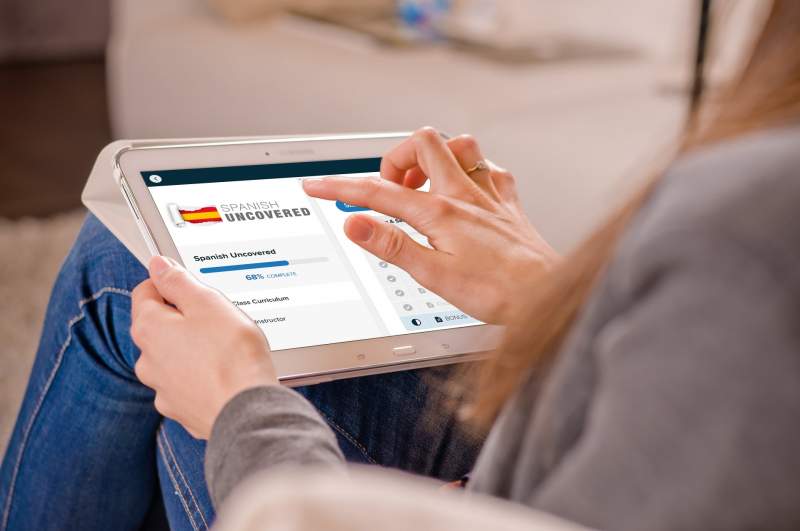
And if the tapping itself never sat right with you, StoryLearning's Spanish Uncovered teaches through stories instead, which is the method I built precisely because of gaps like this one.
We don't link to or earn from any of them. There are no affiliate links on this page.
Table of Contents
Why Two Years Of Duolingo Still Isn't Enough
Spanish is the language most people take seriously on Duolingo.
Roughly 18% of all Duolingo learners are studying it, and Spanish learners rank among the platform's most committed by average study time.
So if you feel like you've put in real effort, you have. The problem isn't effort. It's what the effort was spent on.
I call it the Parrot Method: repeat after me, tap the right tile, get the green tick. It's how most of us were taught languages at school, and it's exactly what Duolingo has rebuilt as a game. It rewards recognising the right answer among four options.
It never once requires you to produce a sentence of your own, not even under zero pressure sitting alone with your phone, let alone across a table from your daughter-in-law's family with everyone waiting.
Recognising a word and retrieving it are two different skills. Duolingo only trains the first one properly.
On the StoryLearning Podcast, I say this constantly: if you're not going to base your study on reading real Spanish, tell me what you're going to do instead. Because tile-tapping isn't it. It gets you a green streak, not a conversation.
And there's a real conversation waiting for you. Spanish has somewhere between 485 and 519 million native speakers, more than any language except Mandarin, spread from Mexico (the largest Spanish-speaking country by native speakers) through Colombia, Spain, and Argentina.
So the question isn't which app has the nicest graphics. It's whether what you're using actually builds two things: real comprehension of Spanish as it's spoken, and the nerve to produce it out loud.
Below, I've scored seven real options against Duolingo, our own StoryLearning Spanish Uncovered course included, on the same eight criteria, so you can see plainly who each one suits and who it doesn't.
Best Alternative To Duolingo: Comparison Table
| Provider | Best-for CEFR | Primary skill | Speaking support | Structure | Study load | Method | Price (as of July 2026) | Track record |
|---|---|---|---|---|---|---|---|---|
| Duolingo (baseline) | A0 to A2/low-B1 | Mixed (recognition) | Scripted | Fully sequenced | Light (5–15 min) | Gamified SRS | Freemium; Super $12.99/mo | Market leader; praised for habit, criticised for depth |
| StoryLearning (Spanish Uncovered) | Uncovered line runs A0 to C2 across separate courses | Reading (+ listening) | Guided | Fully sequenced | Medium–Deep (20–45 min) | Comprehensible-input story reading | One-time $297 (3 instalments; 7-day trial; 365-day guarantee) | Established indie brand; strong on method, some note the price |
| Busuu | A0 to B1/B2 | Mixed | Feedback (async human) | Fully sequenced, CEFR-mapped | Light–Medium (10–20 min) | Lessons + SRS + native-speaker correction | From $5.25/mo (annual) to $10.50/mo (monthly) | Established (Chegg-owned); solid reviews |
| Babbel | A0 to B1 | Mixed (grammar + dialogue) | Scripted | Fully sequenced | Light–Medium (10–20 min) | Structured dialogue lessons | Lifetime $299 | Long-established, EdTech-credible |
| Pimsleur | A0 to A2/B1 for speaking | Listening / Speaking | Scripted | Fully sequenced (30-min audio) | Medium (~30 min) | Audio-immersion, graduated recall | Premium $19.95/mo; Lifetime All Access ~$475 | Long-established audio brand |
| italki | Any level, tutor-dependent | Speaking (tutor-led) | Live human | Freeform | Deep (30–60 min) | Live 1-to-1 tutoring | Pay-per-lesson, ~$5–40/hr | Large established marketplace |
| Langua | A2 to C1 (practice) | Speaking (AI) | Feedback (AI) | Loose path | Flexible | AI conversation + SRS content | Standard $19.99/mo; Unlimited $29.99/mo ($199.99/yr) | Newer (2024+), widely reviewed |
| Language Transfer | A0 to A2/low-B1 | Listening / Speaking (grammar intuition) | Scripted | Fully sequenced (audio) | Light–Medium | Audio “thinking method” | Free, no sign-up, no ads | Small indie project; very positive reviews |
1. Babbel: What Duolingo Would Be If It Respected You
Babbel is what you get when someone designs a language app for an adult rather than a teenager chasing a badge.
Every lesson is a dialogue with the grammar explained next to it, not hidden behind a green tick. You're told why a sentence is built the way it is, which is the part Duolingo skips entirely.
On the CEFR scoring, it covers Spanish from A0 to B1, and gets noticeably thinner past that point, so treat B1 as the ceiling.
Speaking support is scripted, through speech recognition drills; Babbel Live, actual classes with a teacher, is a separate paid product I haven't folded into this score.
Structure is fully sequenced. Study load is light to medium, 10 to 20 minutes, realistic for someone fitting this around work.
On price, the standard plan is a subscription for Spanish alone, while the Lifetime option covers all 14 languages and costs $299.
The limit: you'll finish knowing your grammar, but Babbel still won't put a real person in front of you.
Best for: the learner who wants Duolingo's habit-forming structure but with actual grammar explanations, building a genuine foundation to B1.
Not for: anyone who's already past that point and needs conversation, not more polished exercises.
2. Busuu: Someone Actually Reads What You Write
Type a paragraph of Spanish and submit it, and an actual person, a native speaker, tells you what's wrong with it.
That single feature puts Busuu in a different category from almost everything else on this list.
It runs from A0 through to B2 content, which very few apps bother building.
As for speaking support, here it's feedback: async correction of your written Spanish by the Busuu community, not a live conversation, but a real human response to real mistakes.
It's not instant and the quality depends on who picks it up, since correctors are volunteers, but it's the only feedback of its kind under $10 a month on this list.
The curriculum is fully sequenced and mapped cleanly to CEFR levels, so you always know exactly where you stand. The study load is light to medium, 10 to 20 minutes a day.
On price, the annual plan works out to roughly $5.25 a month, the monthly plan is $10.50, with several tiers in between depending on commitment length (as of July 2026).
The limit: the correction is real, but the core lessons underneath it are fairly standard app fare, and none of it is spoken.
Best for: the learner who wants an affordable app that actually reaches B2 and puts a real Spanish speaker's eyes on their writing.
Not for: anyone whose actual problem is opening their mouth. Written feedback helps your Spanish; it won't get you through Sunday lunch.
3. StoryLearning: For The Learner The Tapping Never Suited

This one is mine, so here's the deal: I'll hold it to its own weaknesses harder than I would for anyone else's product.
If Duolingo's real problem for you was the exercises themselves, tile after tile, never actually reading a real sentence, this is worth a proper look.
The whole course is built around a single story you follow chapter by chapter, pitched at exactly the level where you can follow along without a dictionary.
You pick up Spanish verb conjugations because you've now met them in context many times, not because someone made you memorise a verb table.
That's comprehensible input, the acquisition research behind it goes back decades to Stephen Krashen, and it's the opposite of a green-tick exercise loop.
The Spanish Uncovered line runs the full range, A0 through C2, across separate courses per level. Any single course, including the beginner course this comparison is scored against, takes you to roughly its own level, currently through intermediate.
On speaking, and be honest with yourself about this one, it's guided only. You'll get prompts to speak, but no human on the other end and no recognition software checking you. It will not, by itself, get you through that Sunday lunch table discussion.
Price is one-time: $297, three instalments available, a 7-day full-access trial, a 365-day guarantee (as of July 2026). One payment rather than a recurring one, which some people prefer and others don't.
Best for: the learner who wants to actually enjoy Spanish by reading and listening to real stories, and doesn't need a game to keep showing up.
Not for: anyone who needs live speaking drilled in from day one, or who wants the cheapest possible option. It's priced as a course, not an app subscription.
4. Pimsleur: Built For The Car, Not The Couch
Pimsleur doesn't want you looking at a screen at all.
Thirty minutes of audio, and you've got to answer out loud, on the spot, on a schedule designed to make you retrieve the word right when you're about to forget it.
It's the same core method that's been going since the 1960s, and it does the one thing Duolingo's interface never forces: producing Spanish from memory instead of picking it from a list.
As for CEFR scoring, it covers Spanish from A0 to A2, stretching toward B1 for speaking and listening specifically, with almost nothing for reading.
Speaking support is scripted: you repeat and produce out loud, with basic speech recognition, but no human on the line.
The structure is fully sequenced, 30-minute lessons in strict order. The study load is medium, taking about half an hour each time.
On price, Premium costs $19.95 a month, with a Lifetime All Access option around $475 (as of July 2026).
The limit: it's slow, the vocabulary stays narrow, and it won't teach you to read a menu, let alone a text message.
Best for: the learner who can follow Spanish but goes silent out loud, wanting to learn Spanish while driving.
Not for: anyone who wants reading, writing, or grammar depth alongside the speaking.
5. italki: The Only One With An Actual Person On The Other End
Every method on this list eventually hits the same wall.
At some point, a real Spanish speaker has to be involved, or you never find out if you can actually do this.
italki is where you go to hire one, and Spanish has one of the largest tutor pools on the platform.
It works at any level, entirely dependent on the tutor you pick. This is the only live human option in this whole comparison: someone responding to you and correcting you as you go, not a script and not an AI voice.
Its weakness is exactly what you'd expect from hiring rather than enrolling: there's no built-in curriculum. You or your tutor have to decide what happens each session.
Study load is deep, sessions run 30 to 60 minutes. On price, community tutors charge roughly $5 to $15 an hour, certified teachers roughly $20 to $40 (as of July 2026), and most offer a cheap trial lesson before you commit to a regular one.
Best for: anyone who understands more Spanish than they can produce, which describes most people leaving Duolingo, and needs a real person to practise on.
Not for: anyone who wants to be handed a syllabus, or for whom a stranger on day one feels like too much. Build a little confidence elsewhere first.
6. Langua: Practice Talking Before You Have To

Not ready for a real person to hear you fumble through Spanish yet? Fair enough. Langua's whole pitch is that you don't need to be.
You have an actual spoken conversation with an AI voice that's disconcertingly human, as many times as you want, with nobody actually judging you at the other end.
It suits A2 to C1, since it's a practice tool rather than a curriculum. It'll fit you if you already have some Spanish and just need the rehearsal.
Speaking support is AI feedback: free-form conversation with corrections in real time, plus a hands-free “Call Mode” for when you'd rather not even look at a screen.
It's the most realistic speaking practice on this list that isn't a human, but that's the honest caveat too: there's no actual social stakes, because there's no actual person.
The curriculum structure is a loose path rather than a sequenced course. And the study load is entirely up to you.
On price, Standard runs $19.99 a month ($149.99 a year), Unlimited $29.99 a month ($199.99 a year), with a short free trial and a 30-day guarantee if you subscribe through the website (as of July 2026).
Best for: anyone who wants to burn off the nerves in private, as many times as it takes, before they'll consider booking a real tutor.
Not for: anyone who actually needs a person expecting them to show up. An AI has infinite patience and, not coincidentally, zero stakes.
7. Language Transfer: The Free One That Actually Explains Spanish

Here's a surprising fact: a free, donation-funded audio course, run by essentially one person, teaches Spanish grammar better than most paid apps.
The Complete Spanish course is 150 hour-long audio lessons built entirely on the “thinking method”: you're walked through logic and asked questions, working the answer out yourself rather than being handed a rule to memorise.
No account, no ads, nothing to pay.
On the CEFR scoring, it goes from A0 to A2, stretching to low-B1, with a real ceiling past that. Speaking support is scripted: you answer out loud along with the audio, with nobody checking you.
Structure is fully sequenced, linear audio in order. Study load is light to medium, about 20 minutes a day.
Worth knowing specifically for Spanish: it's the full Complete Spanish course, not the partial coverage Language Transfer offers for some other languages.
Best for: the learner who wants Spanish grammar to genuinely click, for nothing, before spending money anywhere else.
Not for: anyone expecting it to carry them past low-intermediate on its own.
How I Scored This
Every provider above, StoryLearning included, was scored on the same eight criteria: CEFR range, primary skill, speaking support, structure, study load, actual pedagogy, current price, and track record.
We earn nothing from any product named here. No affiliate links, no sponsorships, no reason to rank anything other than honestly.
The Bottom Line: Two Different Jobs

Back to that Sunday lunch table.
The reason Duolingo hasn't closed that gap isn't that you need a better app. It's that following a fast family conversation and passing a tile-matching exercise are two completely different skills. And Duolingo only trains one of them.
Pick one for depth. Busuu if you want an affordable app that gets you to B2 with a human checking your writing. StoryLearning if the tapping itself was the problem and you'd rather read your way into Spanish. Babbel if you just want the clearest grammar explanations available.
Pick one for speaking. Treat it as a ladder: italki for an actual person, which is the real thing; Langua for unlimited rehearsal first if a live tutor feels like too much right now; Pimsleur for hands-free production practice in the car.
On a budget. Language Transfer's free Complete Spanish course, paired with a handful of cheap italki lessons, gets a disciplined learner a long way for very little.
If you do only one thing. Book time with an actual Spanish speaker, regularly. Every method here that skips that step leaves the same gap Duolingo did.
For the thinking behind the story-based approach, see comprehensible input, and for everything else on learning Spanish, the Spanish hub. If you're comparing across languages rather than Spanish specifically, there's also a broader Duolingo alternatives guide.
There are no affiliate links on this page. Our own product was scored on the same yardstick as everyone else's, weaknesses included.
Best Alternative To Duolingo For Spanish: FAQ
Is There A Better App Than Duolingo For Spanish?
It depends on which half of the problem you're missing.
If it's comprehension and grammar, Busuu takes you to B2 with human feedback, and StoryLearning's Spanish Uncovered teaches through stories rather than drills.
If it's speaking, italki puts a real tutor in front of you, and Langua gives unlimited AI conversation practice if that feels like a smaller first step.
Is There A Free Way To Get Better At Spanish Other Than Duolingo?
Yes. Language Transfer's Complete Spanish course costs nothing, requires no account, and is widely regarded as one of the best free introductions to how Spanish grammar actually fits together.
It won't take you past low-intermediate alone, but it's a strong free starting point.
Why Can't I Understand Spanish Speakers After Years On Duolingo?
Because Duolingo trains recognition, choosing the right answer from a few options, much more than production, where you have to generate your own sentences under real conditions.
Roughly 18% of Duolingo's learners study Spanish, often more seriously than learners of other languages by time invested, and still hit this same wall.
Closing it needs deliberate speaking practice, which the app itself doesn't provide.
What's The Fastest Way From Duolingo-Level Spanish To Actually Holding A Conversation?
Pair two things rather than looking for one app to do both.
Add a course that goes deeper than Duolingo – Busuu or StoryLearning both extend well past where Duolingo stalls. And add regular real speaking practice through italki or Langua.
Almost everyone who breaks through does some version of that combination.
Is Busuu Or Babbel The Better Upgrade From Duolingo?
They solve slightly different problems. Babbel is the clearer choice if you want grammar properly explained and a structured path to B1.
Busuu is the better choice if you want to actually reach B2 and get human eyes on your Spanish writing.
Neither replaces real speaking practice, and both are a step up from Duolingo either way.
Do I Need To Spend Money To Move Past Duolingo-Level Spanish?
Not necessarily. Language Transfer is free, and a handful of cheap italki lessons on top of it will take a self-disciplined learner a long way.
If you do spend money anywhere, the research consistently points to real speaking practice as the highest-value place to put it, more than another app subscription.

Olly Richards
Creator of the StoryLearning® Method


Olly Richards is a renowned polyglot and language learning expert with over 15 years of experience teaching millions through his innovative StoryLearning® method. He is the creator of StoryLearning, one of the world's largest language learning blogs with 500,000+ monthly readers.
Olly has authored 30+ language learning books and courses, including the bestselling "Short Stories" series published by Teach Yourself.
When not developing new teaching methods, Richards practices what he preaches—he speaks 8 languages fluently and continues learning new ones through his own methodology.