
When I started learning Cantonese, there was so little available that television became my main study tool.
I watched a long series called Triumph in the Skies. It was 48 episodes or something, and way over my head at the time.
I still came away with an absolute ton of vocabulary. My teachers told me my pronunciation had improved by a mile.
That's the same idea Lingopie now sells: a subscription service for learning a language by watching television and films made for native speakers. The question is whether it delivers.
Lingopie is worth paying for if you already know a few hundred words and want hours of real, native-speed listening with click-to-translate subtitles as a safety net.
It's not where to start from zero, it won't get you speaking without paid extras, and the billing needs reading carefully before you enter a card.
A subscription costs $83.88 a year for every language, as of September 2026.
Lingopie's own guide says the platform works best when you already know basic pronunciation and a few hundred common words, so that condition isn't a marketing line.
There's a seven-day free trial, but it asks for a payment method, and that's exactly where the careful reading matters.
I haven't used Lingopie, and it's better you know that now rather than discover it later.
This Lingopie review is built from Lingopie's own pricing pages, help centre, terms and app-store listings, all checked on 19 September 2026, and from what customers say on Trustpilot and the App Store. Where a claim belongs to Lingopie or to a customer, it's labelled as such rather than folded into the review's own voice.
At a glance
- Who it suits: learners who, in Lingopie's own words, already know basic pronunciation and a few hundred common words, and who want a lot of native-speed listening. Deepest in Spanish, French and Italian, which Lingopie says are its biggest libraries.
- Who should skip it: complete beginners, anyone who mainly wants speaking or writing practice, or anyone who wants a course that tells them what to do next.
- Price, as of September 2026: US$83.88 a year for every language, US$41.97 every three months for one language, or US$229 once for every language.
- Free trial: seven days, card required.
- Languages: 17, according to Lingopie's help centre.
- Runs on: web, iPhone, iPad, Android and four TV platforms.
Table of Contents
What Lingopie Is, And How It Works

Lingopie is a subscription streaming service built for language learners. Lingopie's pitch is that the shows are made for native speakers rather than watered-down educational material.
The catalogue also includes Lingopie's own original productions, which it calls Lingopie Exclusives.
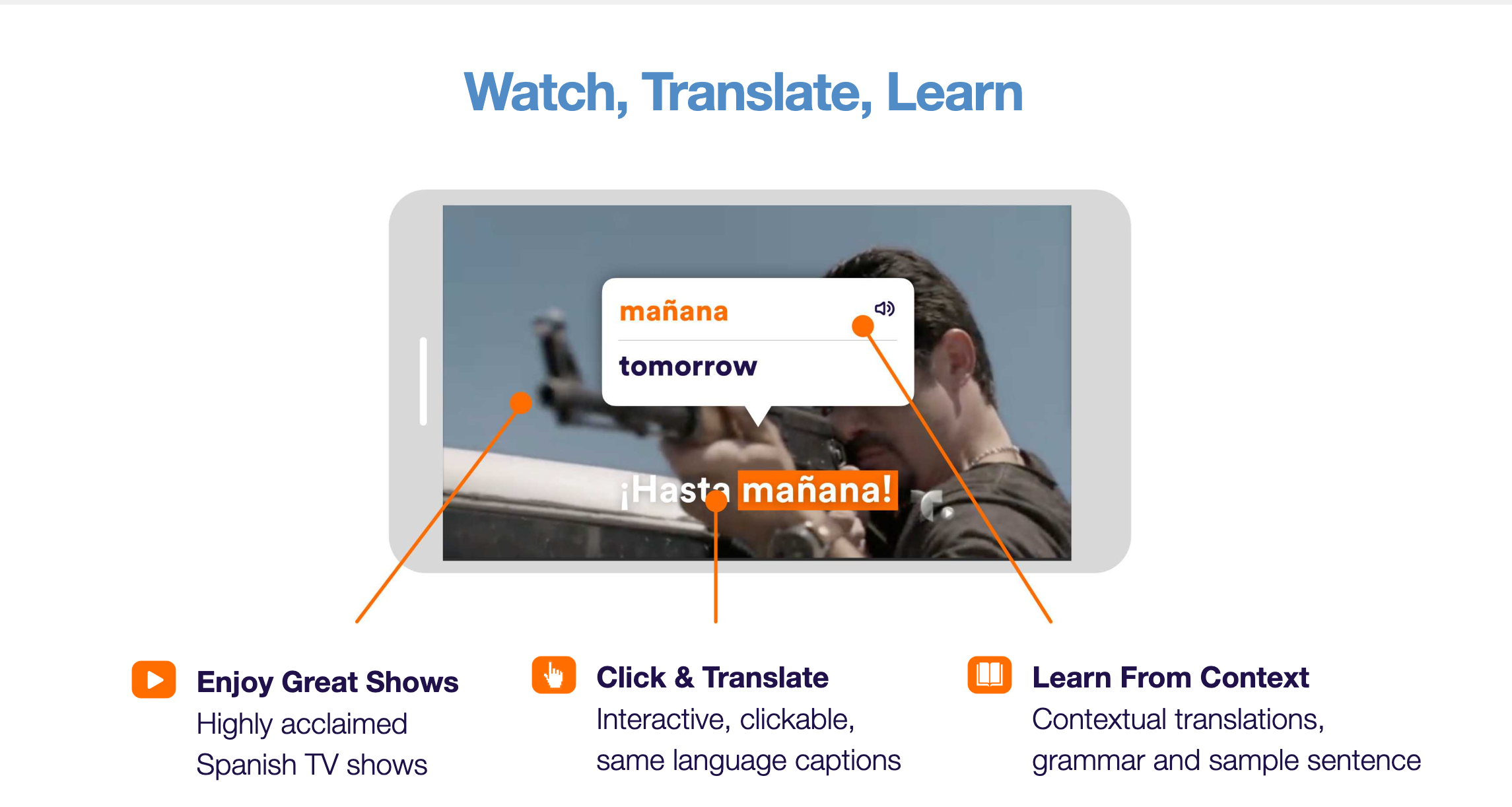
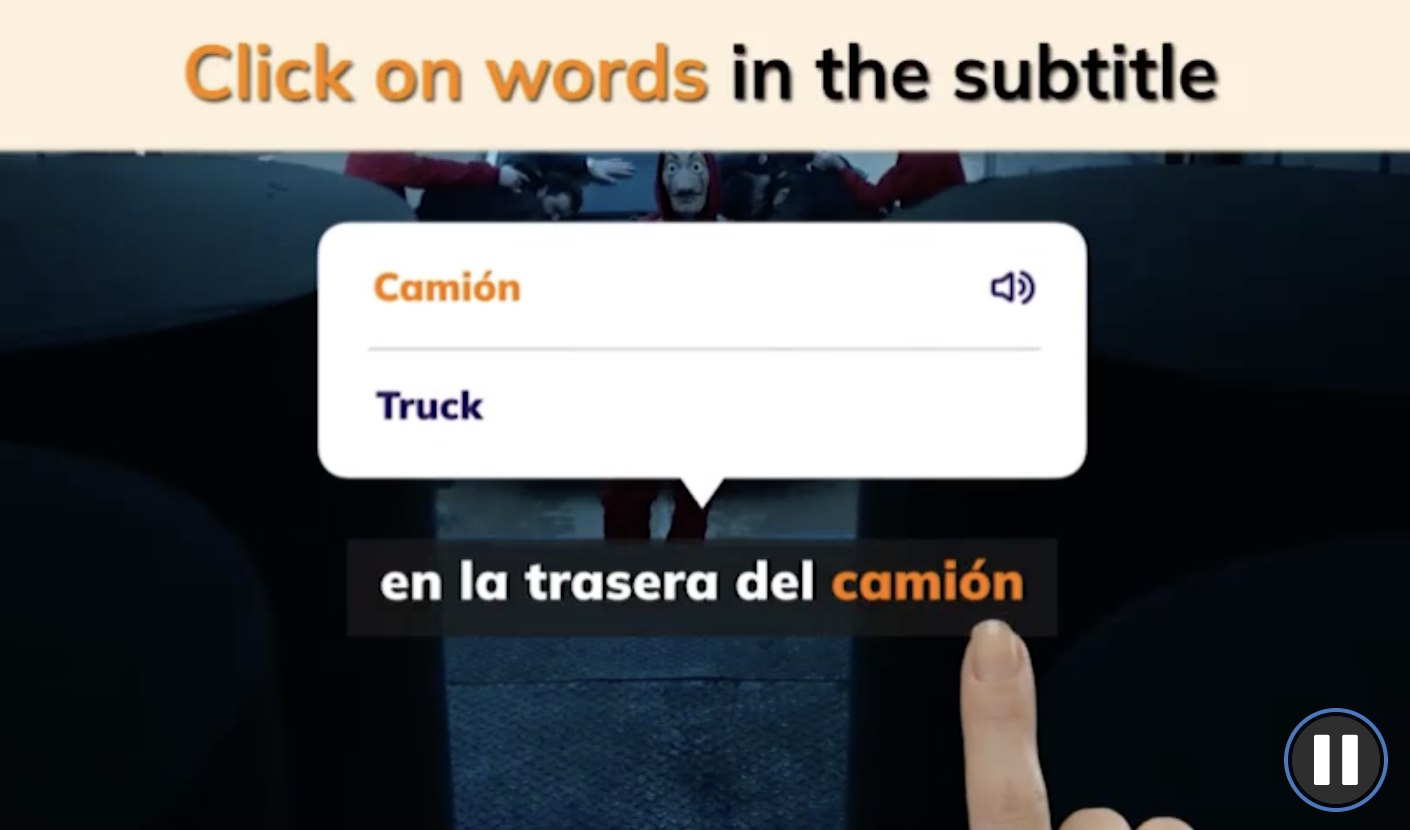
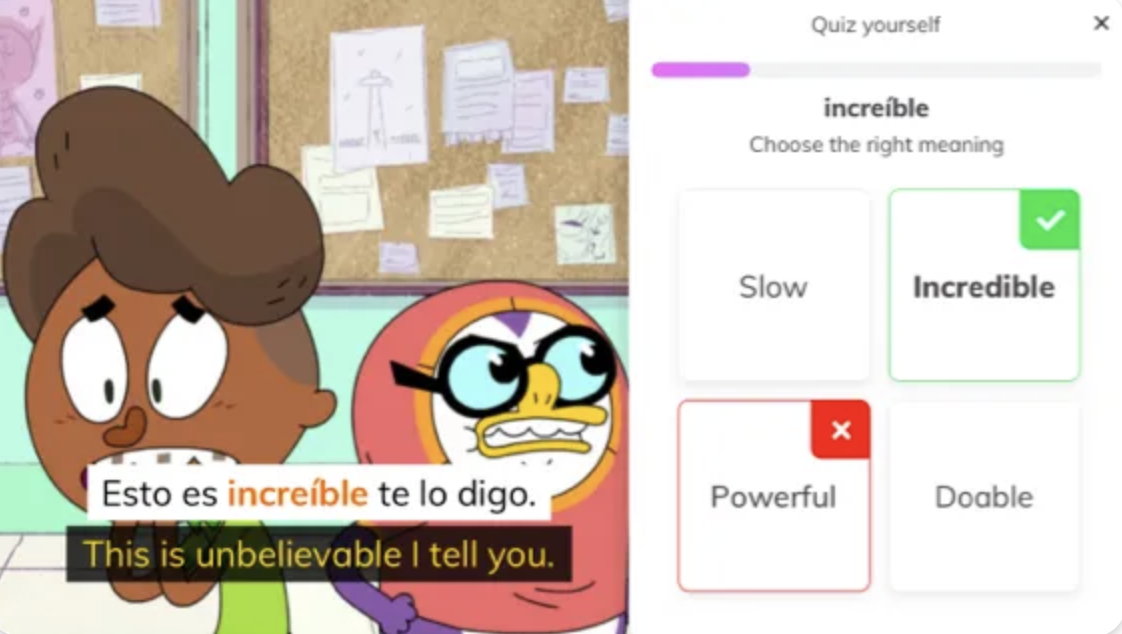
Watch any of those shows and you get two lines of subtitles at once, the language you're learning and your own. Hover over a word and you get an instant translation without stopping the scene. Click the word and it's saved to your vocabulary list.
That means you don't have to pause, switch apps, and lose the thread of the story just to check a phrase. The translation is already there, and the word is saved without breaking the scene at all.
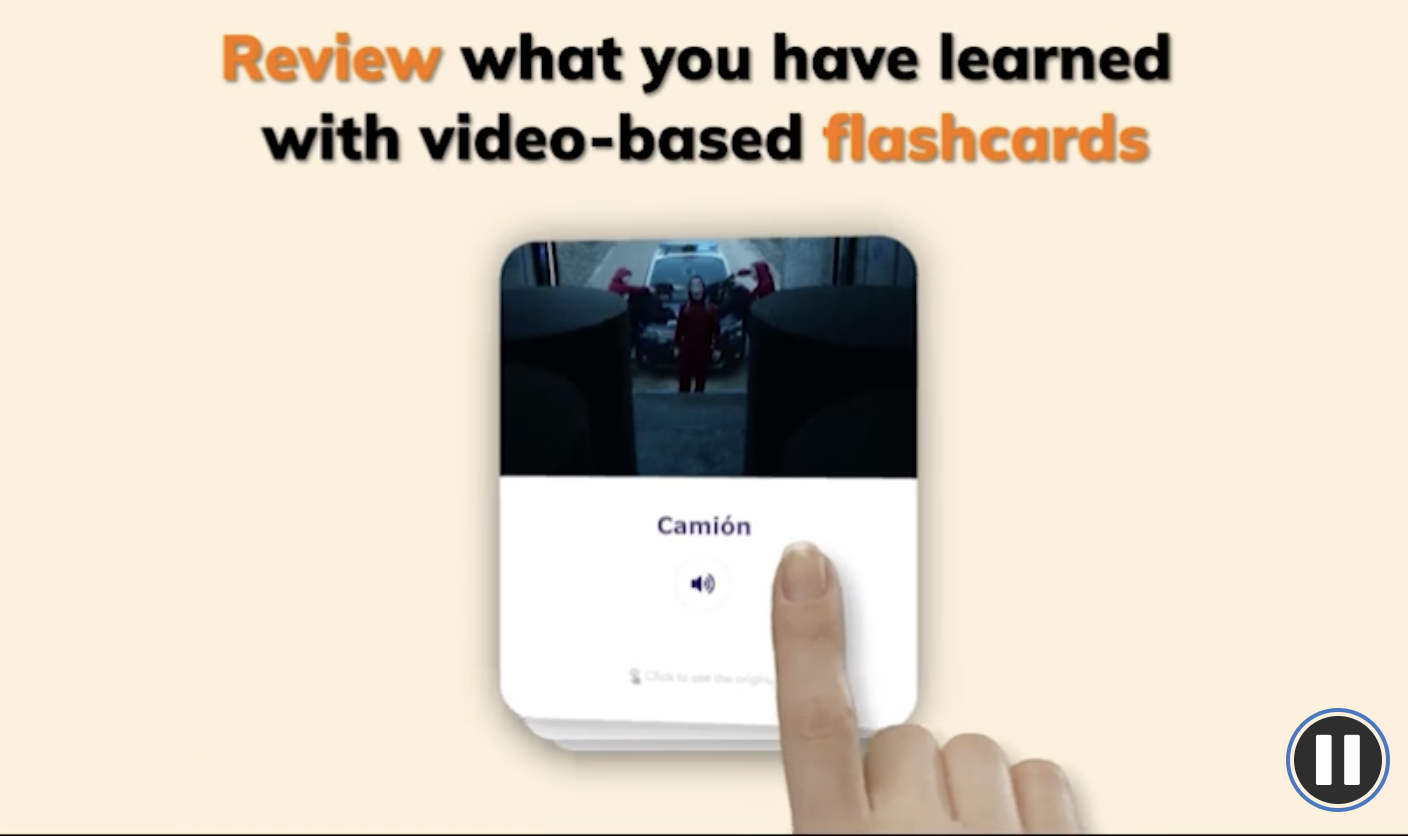
Later, that saved word comes back as a flashcard built from the clip it came from. Lingopie says its flashcards use spaced repetition, and there are four practice games: Flashcards, Pop Quiz, Word Master and Sentence Wizard.
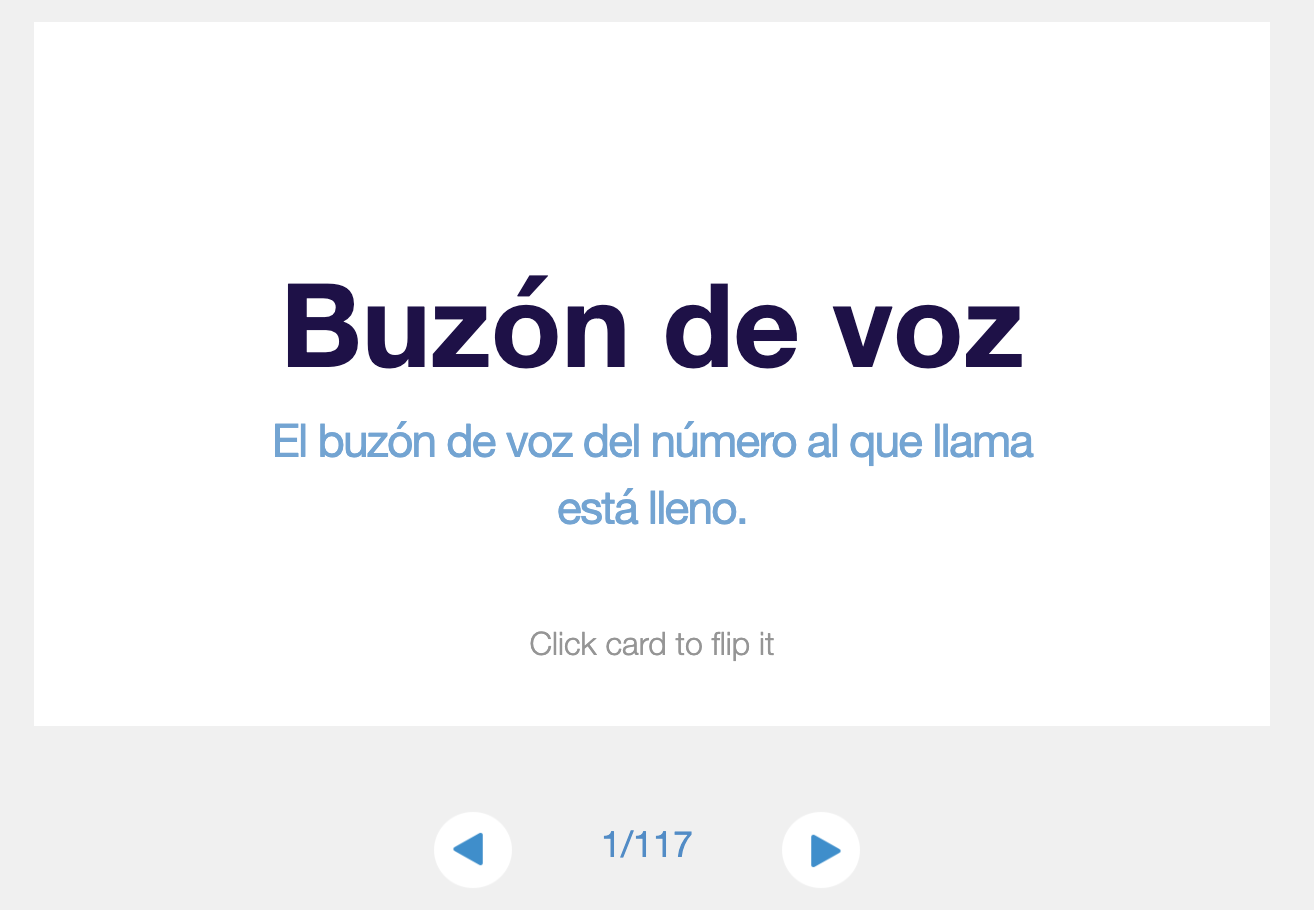
So the viewing turns into a study routine as you go. You watch, you save, and the word comes back attached to the exact scene.
The player behaves more like a study tool than a video app. It pauses automatically after each subtitle and can loop a single line. You can slow everything down to one of four playback speeds, the slowest being 0.65x.
Grammar is colour-coded on screen, and if a sentence still doesn't make sense, there's an Explain Sentence button that breaks it down. Say It! records you repeating a line from the video and gives you a score.
Beyond television and films, the catalogue also includes kids' programmes, music videos, podcasts, audiobooks, slowed-down news and a set of beginner short stories.
The idea is sound, so the real questions are how much of it works at your level and what it costs.
What Lingopie Does Well, And Where It Stops
You can read the dialogues and sail through the exercises, but the moment a character on screen speaks at full speed, the words slide past before you can grab them. That's the exact gap Lingopie aims at.
You get hours of television and film made for native speakers, with a safety net under every line. Two sets of subtitles run together, and you can click any word for a translation. Four playback speeds go down to 0.65x, and the player can pause after each subtitle.
Every word you click is saved as a flashcard built from the clip it came from. That's the detail people mention most on Trustpilot and the App Store: the word stays attached to the scene, not floating in a bare deck. Lingopie says the flashcards use spaced repetition.
One yearly or lifetime plan covers every language Lingopie offers, with no extra charge per language. Its help centre counted 17 in August 2026, among them Japanese, Korean, Chinese, Russian, Turkish, Greek, Polish and Hebrew. You don't pay again when you switch from Spanish to Japanese.
And it runs on a television rather than in another browser tab. There are apps for Google TV, Amazon Fire TV, Roku TV and Apple TV, and you can pick out words with the remote.
None of that makes it a full course, and Lingopie's own writing is candid about that.
It's not where to start from zero. Lingopie's own guide says the platform works best when you already know basic pronunciation and a few hundred common words.
As I mentioned, I once picked up a great deal of vocabulary from a Cantonese series far above my level, so I know it can work, but it's slow going.
There's no course, no path and no syllabus. You set your level once, and that changes the playback speed and the recommendations you see.
Changing it afterwards means contacting Lingopie's support team, and there's no record of what you've covered. You're left to steer yourself.
Speaking's thin unless you pay extra. The one tool in the subscription is Say It!, which has you repeat a line from the video and scores you.
Lingopie's own blog says Say It! is not perfect. Live lessons are a paid add-on, not included in the subscription, and their prices aren't published.
Group lessons run in seven languages and private lessons in six. The first group lesson is free.
None of Lingopie's help pages or store listings describes any writing practice. If writing matters to you, you won't find it here.
There's a short stories reader with audio in 14 languages, but Lingopie's help centre says the stories are only available at beginner level. Past that, you're watching native material.
Best for: you if you're lower intermediate in Spanish, French or Italian, where the catalogues are deepest, and you want hours of real listening with a safety net rather than a set course.
Not for: a complete beginner, anyone who wants a syllabus handed to them, or someone whose main need is speaking or writing. If that's you, Lingopie would be the wrong first tool.
How Much Does Lingopie Cost?
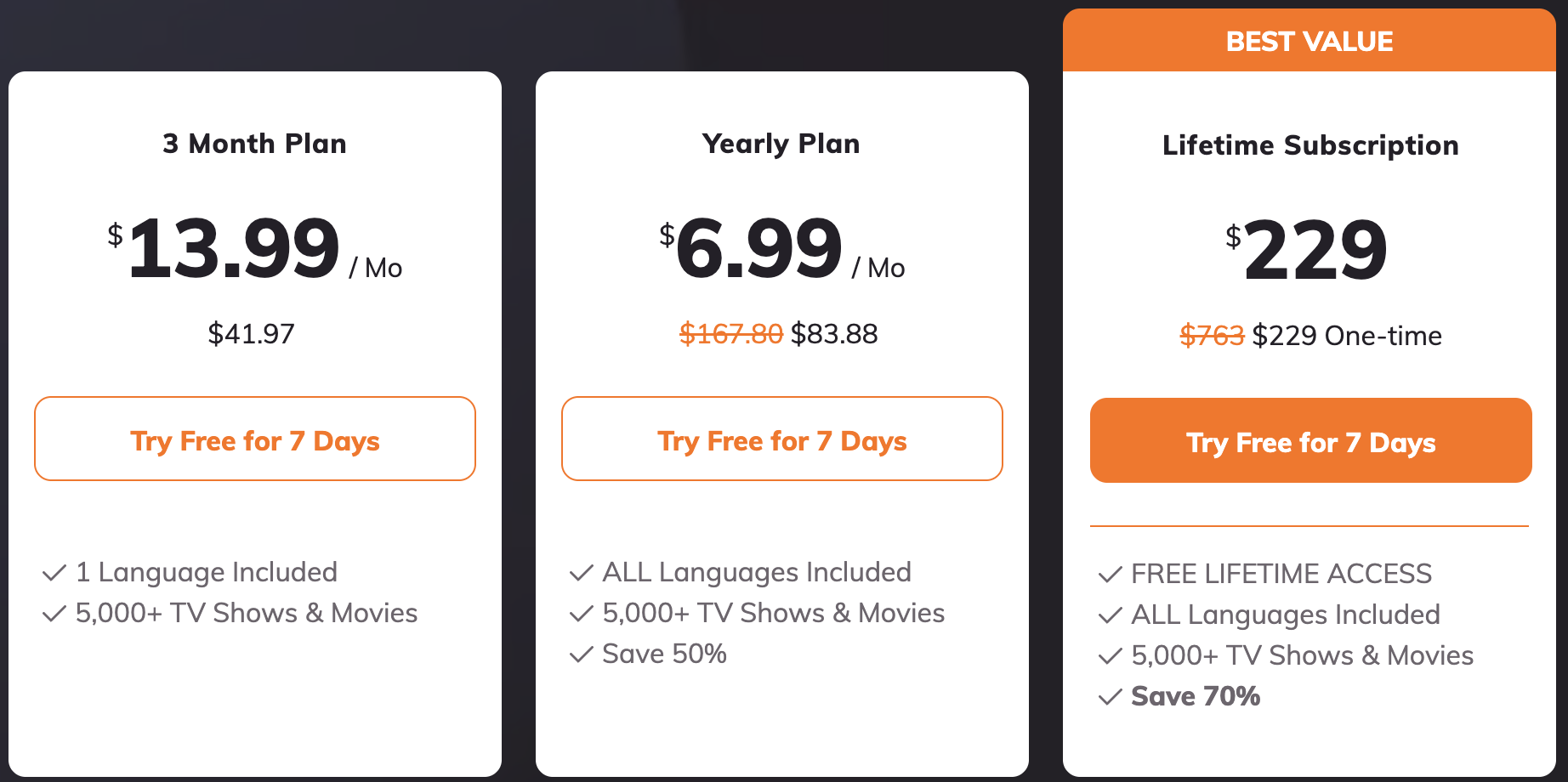
As of September 2026, Lingopie costs $83.88 a year for all languages, $41.97 every three months for one language, or $229 once for lifetime access.
That yearly plan is the one worth reading closely. The pricing page shows it as $6.99 a month, and the three-month plan as $13.99 a month.
Those are descriptions of the total, not separate monthly plans. The yearly plan is charged as $83.88 in one payment, and the three-month plan as $41.97.
If you want a true monthly plan, it lives only inside the mobile apps. It comes with no free trial and covers a single language. The US App Store lists a monthly in-app purchase at $13.99.
Now the part that catches people. The three-month plan looks like a cheaper way in, but it isn't. It works out at roughly twice as much per month as the yearly plan, and for that you get one language, while the yearly and lifetime plans include every language Lingopie offers.
Then there's the sale. On 19 September 2026, the pricing page carried an Autumn Sale banner promising 70% off. The yearly price sat beside a struck-through $167.80, and lifetime beside a struck-through $763.
Nothing on the page shows those higher figures have ever been charged. Treat the lower figures as the prices, and don't let a banner set your deadline.
Prices also move around depending on how you get to them. The pricing address sends you to a different page depending on your country.
In-app prices on the US App Store differ again, and one of Lingopie's own blog posts still quoted older figures of $36, $71.88 and $199 on the same day.
The rule is simple: trust the checkout page on the day you buy, not an old blog post or an app store listing.
The family plan is an add-on to the yearly subscription covering up to three extra members. Its price isn't published, and Lingopie's help centre says to contact support for it.
Lingopie pricing, read on Lingopie's US and UK pricing pages on 19 September 2026.
| Plan | US price | UK price | Languages | Free trial |
|---|---|---|---|---|
| Yearly | $83.88 a year (shown as $6.99 a month) | £59.88 a year (£4.99 a month) | All | 7 days |
| 3 month | $41.97 every 3 months (shown as $13.99 a month) | £35.97 (£11.99 a month) | One | 7 days |
| Lifetime | $229 once | £189 once | All | 7 days |
| Monthly (mobile apps only) | $13.99 listed on the US App Store | not checked | One | None |
Every plan's button on the pricing page offered the seven-day trial on the day this was read. The App Store lists every in-app purchase an app has ever offered, so its monthly figure is a listing rather than a confirmed current price.
The Free Trial, Cancelling And Refunds
If you're reading the small print before you enter your card, you're asking the right question. The product isn't where people get caught out. The billing is.
Here are Lingopie's rules. You need a payment method to start, and a small verification charge may appear on your card.
Lingopie says it doesn't collect those funds, and most banks reverse the temporary charge quickly, though some take longer because the timing depends on the bank or card issuer, not on Lingopie.
After seven days, the subscription renews automatically and charges your payment method on day eight. The yearly plan can't be refunded once the trial is over. Lingopie's help centre says that, in most cases, it doesn't issue refunds for unused time.
Refunds may be available in two cases only. You were either charged after cancelling during the trial and reported it within the trial period, or there was a billing error.
Card payment requests go to support by email within 14 days of the charge. The terms also allow price changes at each renewal.
A trial can only be cancelled on the website, never in the phone app. Purchases through the App Store, Google Play or PayPal are cancelled with those platforms, and they don't come with the trial.
Both pricing pages show a round MONEY BACK GUARANTEE seal. Beside it, the promise is that you can cancel within seven days and won't be charged anything at all. That describes the trial, not a refund after payment.
On 19 September 2026, Trustpilot showed a score of 4.5 from 3,807 reviews for Lingopie, while Lingopie's own homepage quoted 4.8. Most of the Trustpilot reviews are positive.
The one-star reviews cluster on billing: charges after the trial they didn't expect, no reminder before renewal, and a partial refund or cheaper plan instead of a refund.
Similar accounts appear in App Store reviews going back to 2022. These are customers' accounts, and nothing here was tested.
Here's what I'd do. Sign up on the website, not the app, so the trial exists and the cancel button is reachable. Set a reminder for day five of seven, so you decide before the charge lands.
To cancel, open Profile, then Settings, then Account, then under Plan choose Update Membership, then Cancel Subscription. Access continues until the period already paid for ends.
If a week isn't long enough, Lingopie's help centre says support can extend the trial on request.
Languages And Catalogue: Check Yours Before You Pay
Lingopie's own pages don't agree on how many languages it teaches. The help centre said in August 2026 you can learn 17 languages, while the homepage says 15. Work from the help centre, because it's the newer count.
The 17 are Spanish, French, Italian, Portuguese, German, Russian, Japanese, Chinese, Korean, Dutch, Turkish, Greek, Polish, Hebrew, Norwegian, Swedish and English. Welsh is listed as coming soon, which is Lingopie's label, not a date.
That sounds generous, and the overall catalogue is big: 5,000+ shows and films across all languages together. But the libraries aren't spread evenly.
Lingopie's own guide says Spanish, French and Italian have the largest libraries, with content running to hundreds of hours. Turkish, Polish, Greek and Hebrew are newer and still growing.
Here's the gap that matters. Lingopie publishes no count of shows for any one language. It does give a rough hours range, but that tells you little about how much you'd actually want to watch in your language.
Customer reports are thin either way. Recent Trustpilot reviews praise the French, Russian and Chinese content.
One App Store reviewer wrote in February 2022 that the German shows were watchable but not particularly entertaining, and one Spanish learner wrote in January 2025 that hardly any new titles had been added in about a year. Those are single-reviewer opinions, so weigh them accordingly.
Subtitles are another check. Lingopie says a team of native speakers checks its subtitles, and some independent reviewers dispute how accurate the translations are. Nothing here was tested.
Pick a show you already know well and see whether the English line matches what you know is being said.
Then, inside the trial, go straight to your language and open the Beginner category. Count the shows you would honestly sit down and watch. If that number is small, the catalogue isn't deep enough to be worth a year.
Devices, Offline Viewing And The Chrome Extension
Lingopie runs in a web browser, on iPhone and iPad with iOS 15 or later, and on Android, with television apps for Google TV, Amazon Fire TV, Roku TV and Apple TV, and your progress syncs across all of them.
There's one gap worth knowing before you get too far in. Lingopie has no Samsung television app.
Samsung runs Tizen, and Lingopie's own guide says it doesn't have a Tizen app. Its suggestion is an HDMI cable from a laptop or AirPlay instead.
Offline viewing is iPhone and iPad only, and it's capped at 10 videos. Nothing downloads on Android or on the television apps. If your study time is a commute with no signal and an Android phone, that's a real problem.
The Chrome extension is where things get murkier. What's established is that it brings Lingopie's subtitles and word-saving to selected titles on other streaming services.
It's Google Chrome only, computer only, and it needs a Lingopie subscription plus your own subscription to whatever streaming service you're watching.
What's not established is which services those are. Lingopie's own pages don't name them, and its older help articles on the subject now return a not found error. None of this could be verified for this Lingopie review.
If a particular service, Netflix for example, is your reason for buying, test it inside the free trial. That's the only way to be sure before you commit.
One last thing: Drama Rizz, Lingopie's short-drama app, runs as its own app with its own account and subscription, and it isn't included in a Lingopie subscription.
If Finding Material At Your Level Is The Hard Part
The StoryLearning App is my own product, and it's a reading app too. I'm not neutral here, and I'll lean harder on the StoryLearning App's weaknesses than I did on Lingopie's, because the StoryLearning App wants the same slot in your day as Lingopie.
You probably want to learn from something you actually enjoy. The hard part is keeping the level right.
Too hard and the evening goes on looking words up. Too easy and you're back in children's books.
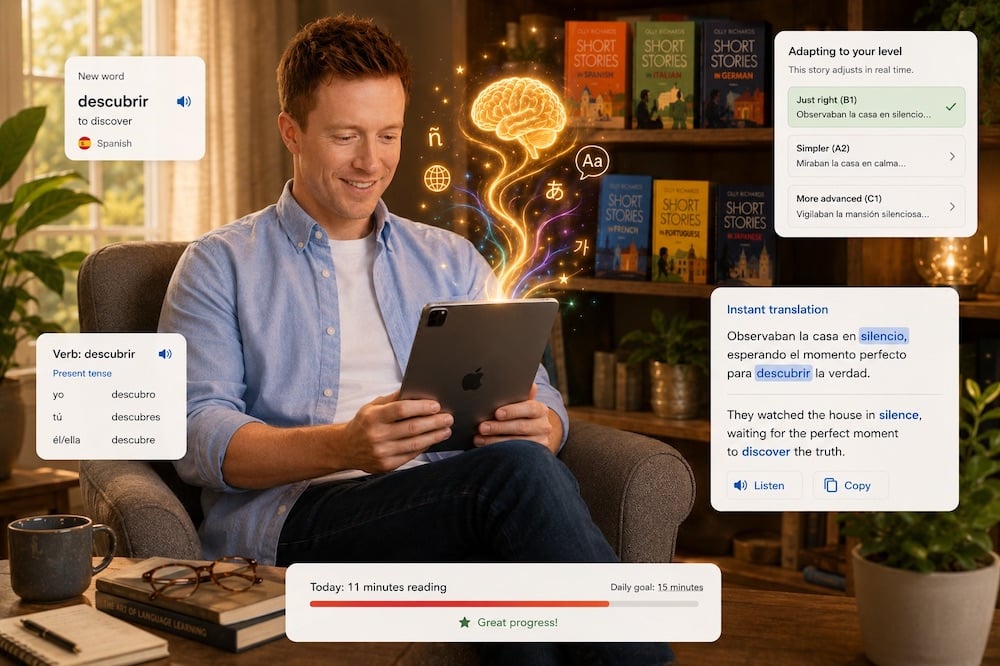
The app writes short stories for you, by AI, for your level and in the genres you pick from a list of eight. As you read, you save words. Those saved words come back in later stories at growing intervals.
That's spaced repetition, and it happens inside new stories rather than on flashcards. The approach is usually called comprehensible input, which just means learning from material you can mostly understand.
When you want to hear a word, you can tap it and the app says it aloud. You can trial the audio narration with a free audio each month, and full narration for every story is available on a separate plan.
Lingopie is watching and listening to television and film made for native speakers, with every line subtitled in two languages and playback you can slow down. The StoryLearning App is reading, and the app writes everything you read.
You give up picking your own material, and in return the stories are written for your level. If choosing your own material is half the fun, Lingopie will suit you more.
The StoryLearning App costs $15 a month, or $135 a year, as of September 2026. That buys up to 20 new stories a month across all your languages together. There's no free trial.
It runs in a web browser on a phone, tablet or computer, with nothing to install. It's not in the App Store or Google Play, and you can't read offline. It launched in 2026.
It has no speaking practice of any kind. It's not for complete beginners. You need an elementary (A2) foundation before the stories work.
The StoryLearning App covers ten languages, all European. If you're learning Japanese, Korean, Chinese, Russian, Turkish, Greek, Polish or Hebrew, you cannot use the StoryLearning App at all.
Best for: the reader who wants a daily reading habit with stories written for their level.
Not for: the reader learning Japanese, Korean, Chinese, Russian, Turkish, Greek, Polish or Hebrew, or anyone who wants speaking practice, offline reading, or an app in the App Store or Google Play.
The StoryLearning App
Price: $15 a month, or $135 a year (US dollars), as of September 2026
Free trial: none
New stories: up to 20 a month, across all your languages (re-reads not counted)
Audio: a free audio each month to trial the narration; full narration for every story on a separate plan
Languages: Danish, Dutch, English, French, German, Italian, Norwegian, Portuguese, Spanish and Swedish, with separate Spain and Latin American Spanish, and European and Brazilian Portuguese
Level: from about A2 (elementary) to advanced; not for complete beginners
Where it runs: web browser on a phone, tablet or computer; not in the App Store or Google Play
The Bottom Line: Is Lingopie Worth It?
For the learner who's already got the basics and whose real problem is understanding people at full speed, Lingopie at $83.88 a year is good value as of September 2026.
You're getting hours of real speech in front of you with a safety net under every line, and those hours are the work. The one condition is a deep library in your language, or the money is wasted.
Buy it if you've already got basic pronunciation and a few hundred common words, and you want daily contact with native-speed television. The two-language subtitles and the click-on-any-word translation mean you'll actually keep up instead of guessing.
Skip it if you're in a language with a thin catalogue, or if what you're really missing is speaking and writing. Lingopie's own guide says Spanish, French and Italian have the largest libraries, and there's no writing practice described anywhere in its documentation.
Take the seven-day trial on the website, and check the catalogue in your language on day one rather than day six. Set a reminder for day five. Lingopie says you won't be charged if you cancel inside the seven days.
I'd say television trains the ear, and reading at your own level builds the vocabulary that makes television followable.
Lingopie FAQ
How Much Does Lingopie Cost?
Lingopie costs $83.88 a year for every language, as of September 2026. You can pay $41.97 every three months for one language, or $229 once for lifetime access to all of them.
The $6.99 and $13.99 a month figures on the pricing page are just those plans divided into months, not monthly billing.
The only true monthly plan is in the mobile apps, where the US App Store lists it at $13.99, and what you'll actually pay depends on your country and the promotion running.
Is Lingopie Free?
No, Lingopie isn't free, Lingopie's own blog says. You can get a seven-day free trial with full access on the website, but as of September 2026 you'll need to enter a payment method to start it.
The mobile apps carry a small free preview, which the US App Store listing describes as eight minutes of language learning each week for free, and everything past that needs a paid subscription.
Does Lingopie Have A Free Trial?
Yes, as of September 2026, Lingopie offers a seven-day free trial with full access when you sign up on the website.
You still enter a payment method, and the subscription renews automatically unless you cancel, with Lingopie's blog saying the card is charged on day 8.
If you buy through the Apple App Store or Google Play there's no trial at all, and inside the mobile apps the trial is offered only to users in the USA, on the yearly plan, when paying with a credit or debit card.
Can I Get A Refund From Lingopie?
In most cases, no: Lingopie's help centre says there's no refund once the trial is over, with two exceptions: a charge after you cancelled during the trial and reported within it, or a billing error.
For card payments, requests have to go in by email within fourteen days of the charge, as of September 2026.
The Money Back Guarantee seal sits beside the free trial paragraph on the pricing pages, so it covers cancelling inside seven days, not a refund after payment, and the yearly plan can't be refunded.
How Do I Cancel Lingopie?
To cancel Lingopie on the website, open your Profile, then Settings, then Account, then under Plan choose Update Membership, then Cancel Subscription.
That stops future payments and keeps your access until the end of the period you've already paid for. If you bought Lingopie through the Apple App Store, Google Play or PayPal, cancel with that platform instead.
A free trial can only be cancelled on the website, not in the app, and lifetime subscriptions can't be cancelled at all.
Is Lingopie Good For Beginners?
Lingopie isn't for complete beginners, and its own guide says it “works best when you already know basic pronunciation and a few hundred common words”.
What softens that is a Beginner category in each language, playback at 0.65x, and a short stories reader that Lingopie's help centre says is only available at beginner level.
But if you're starting from nothing, television made for native speakers is slow, hard work, and subtitles don't change that.
What Languages Can You Learn On Lingopie?
In August 2026, Lingopie's help centre counted 17 languages, while the homepage says 15.
Spanish, French, Italian, Portuguese, German, Russian, Japanese, Chinese, Korean, Dutch, Turkish, Greek, Polish, Hebrew, Norwegian, Swedish and English, with Welsh coming soon; yearly and lifetime plans include all languages, while the three month and mobile app only monthly plans include one.
Libraries aren't equal: Lingopie says Spanish, French and Italian have the largest, with hundreds of hours, while Turkish, Polish, Greek and Hebrew are newer and growing, and there's no published count of shows per language.
Does Lingopie Work With Netflix?
Lingopie doesn't say whether it works with Netflix. Its Chrome extension adds its subtitles and word saving to selected titles on services you already pay for, but its blog post and help centre article neither mention Netflix nor name a single streaming service.
The extension is Chrome only and computer only, and needs a Lingopie subscription plus your own subscription to the service you watch, so if that's what you're paying for, test it during the seven day free trial before it turns into a bill.
Can I Watch Lingopie On My TV?
Yes, Lingopie's TV app is available on four platforms: Google TV, Amazon Fire TV, Roku TV and Apple TV. You'll sign in with the account you already have, and progress syncs across devices.
There's no Samsung app, and Lingopie's guide points Samsung owners at an HDMI cable or AirPlay instead. Nothing downloads for offline viewing on the TV apps, because offline is an iPhone and iPad feature.

Olly Richards
Creator of the StoryLearning® Method


Olly Richards is a renowned polyglot and language learning expert with over 15 years of experience teaching millions through his innovative StoryLearning® method. He is the creator of StoryLearning, one of the world's largest language learning blogs with 500,000+ monthly readers.
Olly has authored 30+ language learning books and courses, including the bestselling "Short Stories" series published by Teach Yourself.
When not developing new teaching methods, Richards practices what he preaches—he speaks 8 languages fluently and continues learning new ones through his own methodology.