The German Cases Explained: A 5-Part Guide To Finally Understand The Cases In German
by Olly Richards
As you learn German, have you ever noticed how the German language doesn't have a one-word equivalent for “a,” or “the?”
Maybe you've noticed a variety of possibilities to translate “a” such as ein, eine, einer,einen, or einem. It gets even more complicated when translating “the”. When do you use der, die, das, den, or dem?
Learning German cases may seem intimidating at first. But there are a few rules that can help you along the way.
In this article you'll learn what the different cases are and when to use them. By the end of this post, you'll have a clear understanding of the German case system.
Pro Tip
By the way, if you want to learn German fast and have fun while doing it, my top recommendation is German Uncovered which teaches you through StoryLearning®.
With German Uncovered you’ll use my unique StoryLearning® method to learn German cases and other tricky grammar naturally through stories. It’s as fun as it is effective.
So let's dive into everything you'll ever need to know to understand the cases in German.
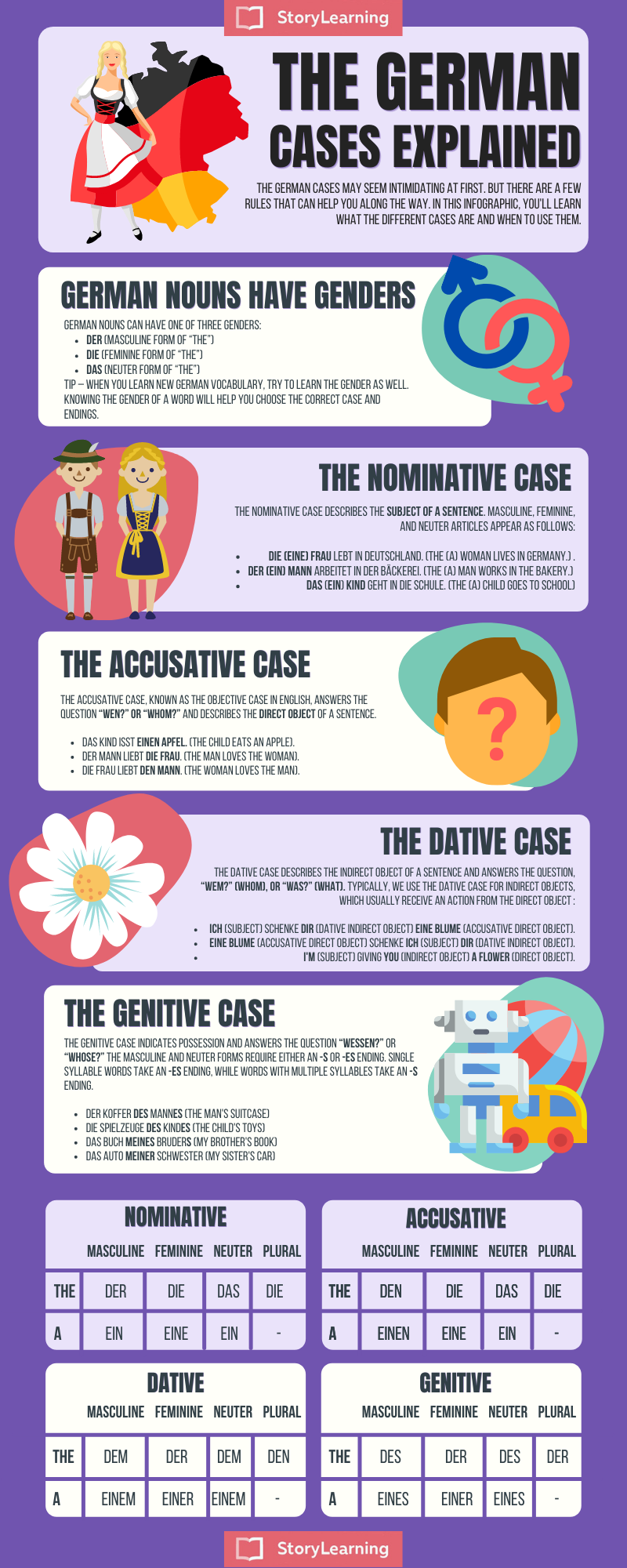
Check out the infographic below for a quick overview of what you'll learn in this post on German cases explained.
Table of Contents
1. German Nouns Have Genders
The first thing to know about German nouns is that they have genders. For native English speakers, this is an entirely new concept.
For example:
the dog:der Hund
the cat: die Katze
the horse: das Pferd
As you can see, German nouns can have one of three genders:
der (masculine form of “the”)
die (feminine form of “the”)
das (neuter form of “the”)
Tip – when you learn new German vocabulary, try to learn the gender as well. Knowing the gender of a word will help you choose the correct case and endings.
In addition to having a gender, a noun's article changes depending on if it's a subject, object, direct object, or indirect object. The four cases in German grammar are nominative, accusative, dative, and genitive.
The nominative case is used for sentence subjects. The subject is the person or thing that does the action. For example, in the sentence, “the girl kicks the ball”, “the girl” is the subject.
The accusative case is for direct objects. The direct object is the person or thing that receives the action. So in “the girl kicks the ball”, “the ball” is the direct object.
The dative case is for indirect objects. The indirect object is the person or thing who “gets” the direct object. So in the sentence “The girl kicks the ball to the boy”, “the boy” is the indirect object.
The genitive case is used to express possession. In English, we show possession with an apostrophe + s “the girl's ball”.
Let's look at each case in more detail.
2. The Nominative Case (Der Nominativ)
The nominative case answers the question,wer? or “who?”
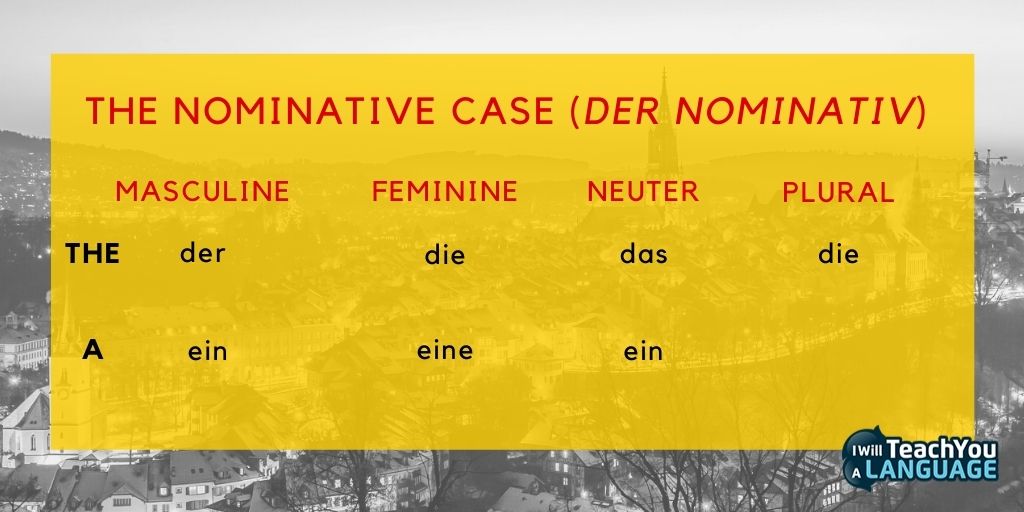
In both German and English, the nominative case describes the subject of a sentence. Masculine, feminine, and neuter articles appear as follows:
You can see the nominative in context in these examples:
Die (Eine)Frau lebt in Deutschland. (The (a) woman lives in Germany.) In this example, Die Frau, or the woman, is the subject of the sentence.
Der (Ein) Mann arbeitetin der Bäckerei. (The (a) man works in the bakery.) The man is the subject of this sentence and takes the nominative case.
Das (Ein) Kind geht in die Schule. (The (a) child goes to school.) The subject, the child, takes the nominative case.
3. The Accusative Case (Der Akkusativ)
The accusative case, known as the objective case in English, answers the questionwen? or “whom?” and describes the direct object of a sentence.
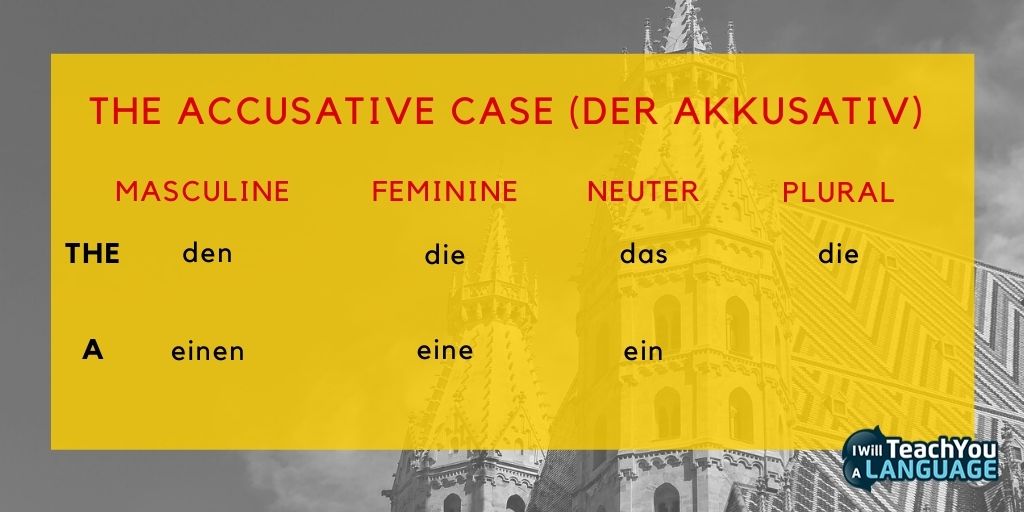
Let's see how the masculine, feminine, and neuter nouns change in the accusative case.
As you probably noticed, only the masculine articles change in the accusative case. Let's look at a few simple examples:
Das Kind isst einen Apfel. (The child eats an apple). In this sentence, einen Apfel is the direct object in the accusative case. Das Kind is the subject and takes the nominative case.
Der Mann liebt die Frau. (The man loves the woman). Here, die Frau is the direct object in the accusative case. Der Mann is the subject in the nominative case.
Die Frau liebt den Mann. (The woman loves the man). Den Mann is the direct object in this sentence and takes the accusative case. Die Frau is the subject and takes the nominative case.
There are also a few German prepositions that always take the accusative case:
durch (through)
bis (until)
für (for)
ohne (without)
entlang (along)
gegen (against)
um (around)
A Quick Note On Word Order
In English, we use word order to clarify which nouns are subjects, objects, and indirect objects. But German allows for more freedom of word placement, as long as we use the correct case.
Following are a few examples of the accusative case:
Der Mann streichelt denHund. (The man pets the dog.)
Er streichelt ihn. (He pets him, the dog.)
DenHund streichelt der Mann. (The man pets the dog.)
Streichelt der Mann denHund? (Is the man petting the dog?)
Streichelt denHund der Mann? (Is the man petting the dog?)
As you can see, the meaning of the sentence is derived from the case, rather than the word order. This concept is somewhat different in English, so it can take some practice to get used to.
4. The Dative Case (Der Dativ)
The dative case describes the indirect object of a sentence in German and English and answers the question,wem? (whom), orwas? (what).
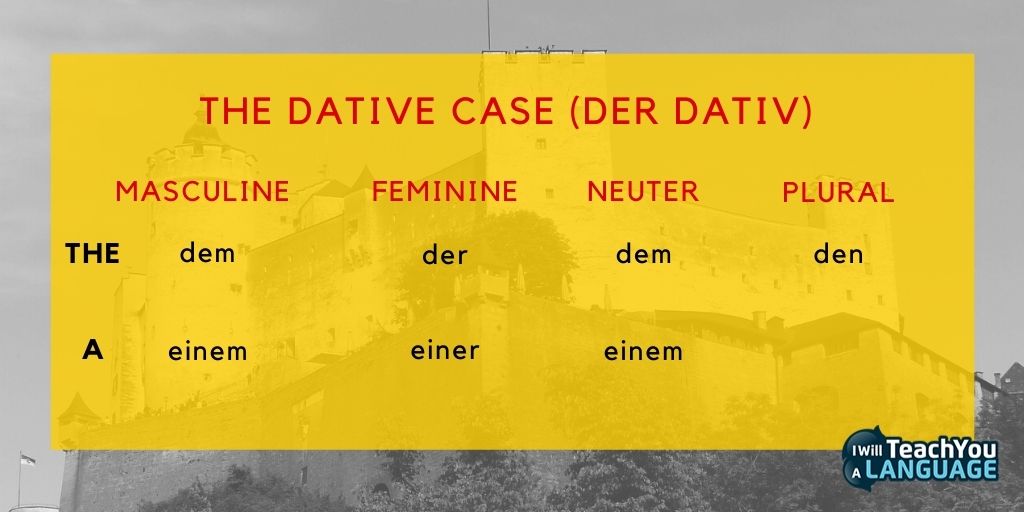
The dative case is slightly more complicated than the accusative. Take a look at the dative article forms to see if you can spot the differences:
Typically, we use the dative case for indirect objects, which usually receive an action from the direct object (in the accusative case). As with the other cases, word order is flexible, as long as you use the correct case. For example:
Ich (subject) schenkedir (dative indirect object) eineBlume (accusative direct object).
EineBlume (accusative direct object) schenke ich (subject) dir(dative indirect object).
I'm (subject) giving you (indirect object) aflower (direct object).
Several prepositions take the dative case:
aus (out)
auβer (besides)
bei (next to)
mit (with)
nach (after)
seit (since)
von (from)
zu (to)
gegenüber (opposite)
And some German verbs always take the dative case. These verbs are:
antworten (to answer)
danken (to thank)
glauben (to believe)
helfen (to help)
gehören (belong to)
gefallen (to like)
5. The Genitive Case (Der Genitiv)
The genitive case indicates possession and answers the question wessen? or “whose?” You'll see the genitive case most often in written German. In spoken German, you'll hear von (from)and the dative case instead of the genitive case.
For example:
Das Haus meines Vaters(My father's house). The genitive case is common in written German.
Das Haus von meinem Vater (My father's house). The dative case often replaces the genitive case in spoken German.
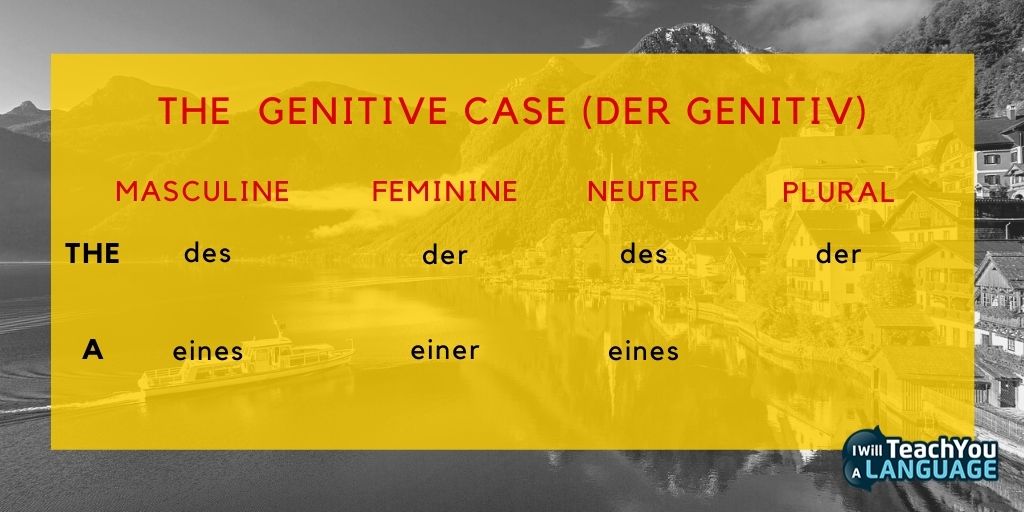
Below are the definite and indefinite article changes for the genitive case.
The masculine and neuter forms require either an -s or -es ending. Single syllable words take an -es ending, while words with multiple syllables take an -s ending. Here are a few examples.
Der Koffer des Mannes (The man's suitcase)
Die Spielzeuge des Kindes(The child's toys)
Das Buch meines Bruders (My brother's book)
Das Auto meiner Schwester(My sister's car)
Just as the dative case, certain prepositions always take the genitive case:
anstatt (instead of)
außerhalb (outside of)
innerhalb (inside of)
trotz (despite)
während (during)
wegen (because of)
But in spoken German, Germans sometimes use the dative case with these genitive prepositions.
Overview Of The German Cases
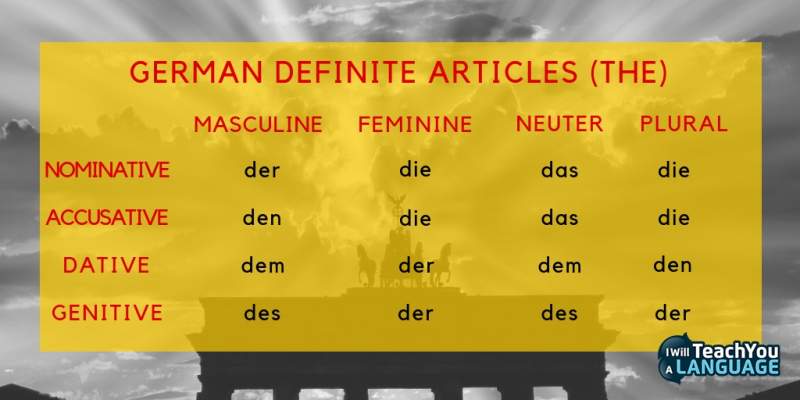
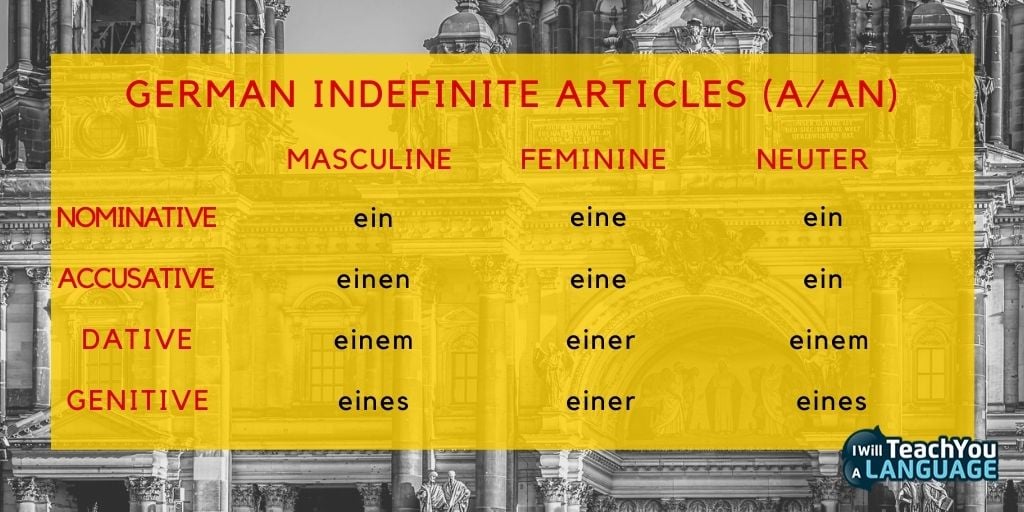
It's easier to choose the correct case when you're familiar with the changes of the definite (der, die, das) and indefinite articles (ein, eine, ein). I've created this German cases chart to remind you of the different changes you've seen so far.
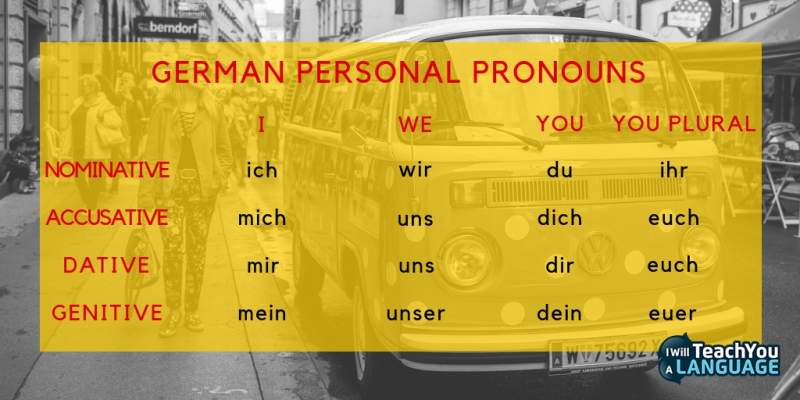
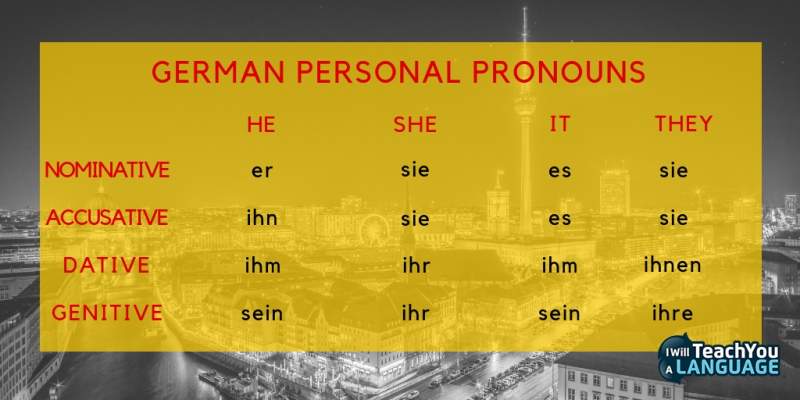
Just as the definite and indefinite articles change, so do personal pronouns. However, this is also the same in English, as “I” changes to “me” or “my”. For example:
Ich bin genervt (I am annoyed)
Das nervt mich (That annoys me)
The following chart makes it simple to decline German pronouns in all four cases.
Once you become familiar with the articles and noun endings of different cases, you'll be able to clearly identify the subject, object, and direct object of a sentence.
The flexibility of the German language allows you to change the word order in sentences without changing the meaning.
FAQs About German Cases
What Are The 4 German Cases?
The four German cases are the Nominativ (nominative), Akkusativ (accusative), Dativ (dative), and Genitiv (genitive) case. Each case is important to identify the subject, direct object, indirect object, and possessive object of a sentence, respectively. The cases are essential to learn if you want to use proper grammar in German.
Why Does German Have So Many Cases?
In German, all the nouns have cases that correspond to their roles in sentences. In contrast, English relies primarily on word order to indicate whether a noun is a direct or indirect object.
For example: Ich schenke ihm einen Kuchen. (I gift him a cake.) Ich schenke ihn ihm. (I gift it to him.)
In the first example, there’s only two personal pronouns, but in the second example, three nouns are pronouns. First, you have ich (I) as the subject completing an action in the sentence in the nominative case. Second is the indirect object “him” or ihm in the dative case. The direct object being given is “the cake” or ihn in the accusative case.
Remember that German nouns have one of three genders, masculine, feminine, or neuter and use the corresponding pronouns. The use of cases makes it clear who is receiving what.
Are German Cases Hard?
At first glance, the German cases may seem daunting to grasp. But as you learn them one-by-one, they start to get easier. Make sure you start with a solid understanding of how subjects, direct objects, and indirect objects function in sentences. It can help to review these topics in English before attempting to learn the cases in German. Then begin with the nominative and accusative cases. You can stick with short and simple sentences if you’re still learning the genders of German nouns. Once you feel confident, you can start learning the dative case. The genitive, or possessive case, is easier to understand and you can learn it last or first. In spoken German, the preposition von (from) and the dative case often replace the genitive.
When To Use German Cases?
Here’s when to use each of the four German cases:
1. Nominative – The subject of the sentence performs the action (verb) and answers the question Wer? (Who?) or Was? (What?).
Example: Ich koche. (I cook.) The subject of the sentence is ich (I).
2.Accusative – The direct object receives an action from the subject and answers the question Wen? (Who/Whom?) or Was (What?).
Example: Ich koche Abendessen. (I cook dinner.) The subject is ich (I) and the direct object is Abendessen (dinner). It answers the question, “what” am I cooking?
3. Dative – The indirect object receives the action from the direct object and answers the question Wem? (Whom?) or Was? (What?).
Example: Ich koche uns Abendessen. (I cook us dinner.) Now, there’s an indirect object, uns (us) that answers the question “for whom” the subject is cooking dinner.
4. Genitive – The genitive expresses ownership and answers the question Wessen (Whose?).
Example: Ich koche mein Abendessen. (I’m cooking my dinner.) Here, the possessive mein answers the question “Whose?.”
Most German learners find the accusative and dative cases difficult to differentiate between. The key is to understand the roles of direct and indirect objects in sentences.
German Cases Explained: The Not So Strange Case Of The German Cases
A few final tips will make it easy to remember all the German case rules. Ask yourself the following questions to figure out which case to use:
What gender does the noun have? Is it masculine, feminine, or neuter?
Is the noun part of a prepositional phrase? If so, is the preposition accusative, dative, or genitive? If not, examine the function of the noun. Which noun is the subject, object, direct object, and indirect object?
Which article corresponds to the case in question? If you're not sure in the beginning, use a case table like the ones in this post to choose the correct article form.
You don't need to memorise all the different article forms for each case or each specific preposition in the beginning.
Begin with the basics and gradually build up your understanding through practice and exposure. And make sure you're listening to or reading lots of German to expose yourself to the different cases in context.
But, with practice, you'll find it becomes second nature in no time at all.
Master German Grammar The Natural Way
If you like the idea of reading lots of German material to master the grammar, then German Grammar Hero is for you.
In this programme, instead of pouring over verb tables and memorising grammar rules, you read and immerse yourself in a compelling story.
The grammar emerges naturally as you read, instead of the traditional school method where you learn the rules out of context and struggle to use them in real life.
That way you can actually speak German with accuracy and confidence, rather than translating in your head from English every time you open your mouth.
Grammar Hero is perfect for low intermediate to intermediate learners. If that's you then click here to find out more and become a grammar hero!
Olly Richards
Creator of the StoryLearning® Method
Olly Richards is a renowned polyglot and language learning expert with over 15 years of experience teaching millions through his innovative StoryLearning® method. He is the creator of StoryLearning, one of the world's largest language learning blogs with 500,000+ monthly readers.
Olly has authored 30+ language learning books and courses, including the bestselling "Short Stories" series published by Teach Yourself.
When not developing new teaching methods, Richards practices what he preaches—he speaks 8 languages fluently and continues learning new ones through his own methodology.
Which language are you learning?
What is your current level in [language]?
Which language are you learning?
What is your current level in [language]?
Which language are you learning?
What is your current level in [language]?
Which language are you learning?
What is your current level in [language]?
Which language are you learning?
What is your current level in [language]?
Which language are you learning?
What is your current level in [language]?
Which language are you learning?
What is your current level in [language]?
Which language are you learning?
What is your current level in [language]?
Download Your Free StoryLearning Fluency Blueprint!
Discover the world famous story-based method that 1,023,037 people have used to learn a language quickly…
Which language are you learning?
What is your current level in [language]?
Which language are you learning?
What is your current level in [language]?
Which language are you learning?
What is your current level in [language]?
Download this article as a FREE PDF?
What is your current level in Latin?
Download this article as a FREE PDF?
What is your current level in Norwegian?
Download Your Free StoryLearning Fluency Blueprint!
Discover the world famous story-based method that 1,023,037 people have used to learn a language quickly…
Which language are you learning?
What is your current level in [language]?
Download this article as a FREE PDF?
What is your current level in Swedish?
Download this article as a FREE PDF?
What is your current level in Danish?
Which language are you learning?
What is your current level in [language]?
Download this article as a FREE PDF?
Download this article as a FREE PDF?
What is your current level in Arabic?
FREE StoryLearning Fluency Blueprint!
Join my email newsletter and get FREE access to your StoryLearning Fluency Blueprint. Discover how to learn languages through the power of story!
Which language are you learning?
What is your current level in [language]?
Download a FREE Story in Japanese!
Enter your email address below to get a FREE short story in Japanese and start learning Japanese quickly and naturally with my StoryLearning® method!
What is your current level in Japanese?
Download Your FREENatural Japanese Grammar Pack
Enter your email address below to get free access to my Natural Japanese Grammar Pack and learn to internalise Japanese grammar quickly and naturally through stories.
What is your current level in Japanese?
What is your current level in Portuguese?
What is your current level in German?
Train as an Online Language Teacher and Earn from Home
The next cohort of my Certificate of Online Language Teaching will open soon. Join the waiting list, and we’ll notify you as soon as enrolment is open!
Train as an Online Language Teacher and Earn from Home
The next cohort of my Certificate of Online Language Teaching will open soon. Join the waiting list, and we’ll notify you as soon as enrolment is open!
Download this article as a FREE PDF?
What is your current level in Portuguese?
Download this article as a FREE PDF?
What is your current level in Portuguese?
Download this article as a FREE PDF?
What is your current level in Turkish?
What is your current level in French?
What is your current level in Italian?
What is your current level in German?
What is your current level in Japanese?
Download Your FREEJapanese Vocab Power Pack
Enter your email address below to get free access to my Japanese Vocab Power Pack and learn essential Japanese words and phrases quickly and naturally. (ALL levels!)
What is your current level in Japanese?
Download Your FREE German Vocab Power Pack
Enter your email address below to get free access to my German Vocab Power Pack and learn essential German words and phrases quickly and naturally. (ALL levels!)
What is your current level in German?
Download Your FREE Italian Vocab Power Pack
Enter your email address below to get free access to my Italian Vocab Power Pack and learn essential Italian words and phrases quickly and naturally. (ALL levels!)
What is your current level in Italian?
Download Your FREEFrench Vocab Power Pack
Enter your email address below to get free access to my French Vocab Power Pack and learn essential French words and phrases quickly and naturally. (ALL levels!)
What is your current level in French?
What is your current level in Portuguese?
What is your current level in Russian?
What is your current level in Russian?
What is your current level in Italian?
What is your current level in Italian?
What is your current level in French?
What is your current level in French?
What is your current level in Spanish?
What is your current level in Spanish?
What is your current level in Spanish?
What is your current level in Arabic?
What is your current level in Portuguese?
What is your current level in Turkish?
What is your current level in Korean?
What is your current level in Russian?
What is your current level in Japanese?
What is your current level in Chinese?
What is your current level in Spanish?
What is your current level in Italian?
What is your current level in French?
What is your current level in German?
Download Your FREENatural Portuguese Grammar Pack
Enter your email address below to get free access to my Natural Portuguese Grammar Pack and learn to internalise Portuguese grammar quickly and naturally through stories.
What is your current level in Portuguese?
Download Your FREENatural Russian Grammar Pack
Enter your email address below to get free access to my Natural Russian Grammar Pack and learn to internalise Russian grammar quickly and naturally through stories.
What is your current level in Russian?
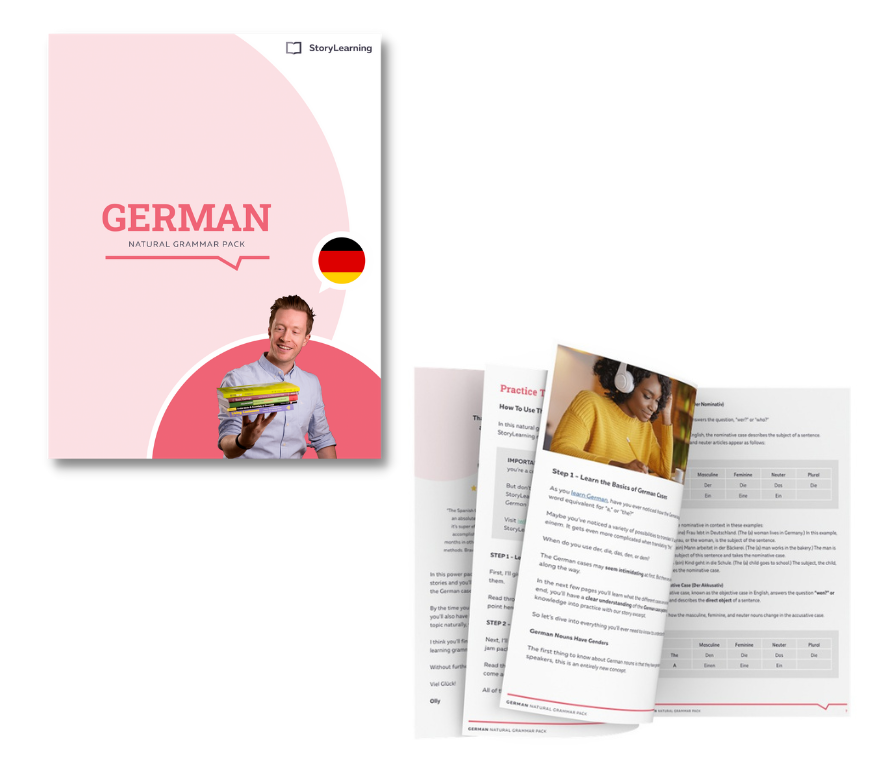
Download Your FREENatural German Grammar Pack
Enter your email address below to get free access to my Natural German Grammar Pack and learn to internalise German grammar quickly and naturally through stories.
What is your current level in German?
Download Your FREENatural French Grammar Pack
Enter your email address below to get free access to my Natural French Grammar Pack and learn to internalise French grammar quickly and naturally through stories.
What is your current level in French?
Download Your FREENatural Italian Grammar Pack
Enter your email address below to get free access to my Natural Italian Grammar Pack and learn to internalise Italian grammar quickly and naturally through stories.
What is your current level in Italian?
Download a FREE Story in Portuguese!
Enter your email address below to get a FREE short story in Brazilian Portuguese and start learning Portuguese quickly and naturally with my StoryLearning® method!
What is your current level in Portuguese?
Download a FREE Story in Russian!
Enter your email address below to get a FREE short story in Russian and start learning Russian quickly and naturally with my StoryLearning® method!
What is your current level in Russian?
Download a FREE Story in German!
Enter your email address below to get a FREE short story in German and start learning German quickly and naturally with my StoryLearning® method!
What is your current level in German?
Download a FREE Story in Italian!
Enter your email address below to get a FREE short story in Italian and start learning Italian quickly and naturally with my StoryLearning® method!
What is your current level in Italian?
Download a FREE Story in French!
Enter your email address below to get a FREE short story in French and start learning French quickly and naturally with my StoryLearning® method!
What is your current level in French?
Download a FREE Story in Spanish!
Enter your email address below to get a FREE short story in Spanish and start learning Spanish quickly and naturally with my StoryLearning® method!
What is your current level in Spanish?
FREE Download:
The Rules of Language Learning
Enter your email address below to get free access to my Rules of Language Learning and discover 25 “rules” to learn a new language quickly and naturally through stories.
Which language are you learning?
What is your current level in [language]?
Download Your FREESpanish Vocab Power Pack
Enter your email address below to get free access to my Spanish Vocab Power Pack and learn essential Spanish words and phrases quickly and naturally. (ALL levels!)
What is your current level in Spanish?
Download Your FREENatural Spanish Grammar Pack
Enter your email address below to get free access to my Natural Spanish Grammar Pack and learn to internalise Spanish grammar quickly and naturally through stories.
What is your current level in Spanish?
Free Step-By-Step Guide:
How to generate a full-time income from home with your English… even with ZERO previous teaching experience.
Download this article as a FREE PDF?
What is your current level in Thai?
Download this article as a FREE PDF?
What is your current level in Spanish?
Download this article as a FREE PDF?
What is your current level in Cantonese?
Download this article as a FREE PDF?
What is your current level in Russian?
Download this article as a FREE PDF?
What is your current level in Korean?
Download this article as a FREE PDF?
What is your current level in Japanese?
Download this article as a FREE PDF?
What is your current level in Italian?
Download this article as a FREE PDF?
What is your current level in German?
Download this article as a FREE PDF?
What is your current level in French?
Steal My Method?
I’ve written some simple emails explaining the techniques I’ve used to learn 8 languages…
Which language are you learning?
What is your current level in [language]?
Which language are you learning?
What is your current level in [language]?
I want to be skipped!
Join 84,574 other language learners getting StoryLearning tips by email…
“After I started to use your ideas, I learn better, for longer, with more passion. Thanks for the life-change!” – Dallas Nesbit
Which language are you learning?
What is your current level in [language]?
Download this article as a FREE PDF?
What is your current level in Chinese?
Which language are you learning?
What is your current level in [language]?
Join 122,238 other language learners getting StoryLearning tips by email…
“After I started to use your ideas, I learn better, for longer, with more passion. Thanks for the life-change!” – Dallas Nesbit
Which language are you learning?
What is your current level in [language]?
Find The Perfect Language Course For You!
Looking for a breakthrough in your language learning?
Complete this short survey to find the perfect course for you!