
Remember the worksheet where the sentence was already printed for you, with a blank waiting in the middle.
You weren't asked to match words or recite a rule. You had to supply the missing word yourself.
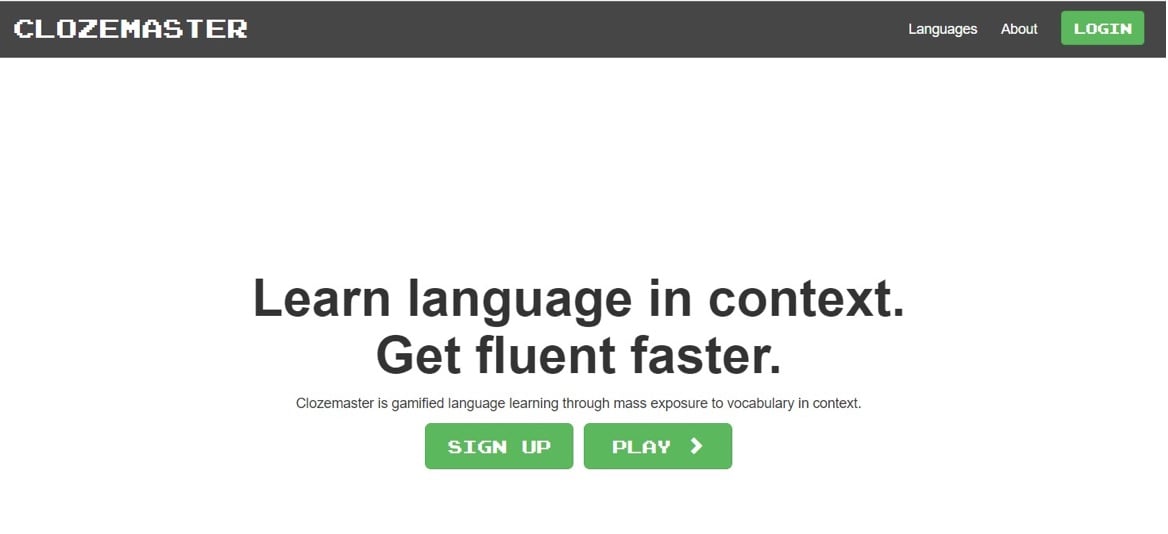
That exercise, online, in a language you're learning, again and again, is Clozemaster.
A cloze is simple: a word is removed from a sentence, and you fill the gap. Clozemaster shows you the sentence, then asks you to choose the missing word or type it.
Filling the gap yourself is a harder job than picking a word off a vocabulary list. You meet the word inside a real sentence, and you're responsible for it.
Yes, at one job, and for one kind of learner. That job is widening your vocabulary by making you supply a missing word inside a whole sentence. Clozemaster itself says it's best once you already know the alphabet, pronunciation and some basic grammar.
If you're still working out how the letters sound, it'll frustrate you more than it helps. That's not a verdict on you, it's the product telling you where it starts.
The money is straightforward. It's free to sign up and play, and its FAQ says it always will be, though the free plan is capped. Pro costs USD 12.99 a month or USD 79.99 a year as of September 2026.
Just don't mistake it for a course. It teaches nothing from scratch. In most collections the sentences have no relationship to each other.
The context stops at one sentence, so you're building word knowledge rather than following a thread. Nothing ties one sentence to the next.
The rest of this page settles what the free plan really gives you, whether Pro earns its money, and who shouldn't bother.
| Clozemaster at a glance | |
|---|---|
| Our rating | 3.5 out of 5 |
| What it is | A fill-in-the-blank vocabulary drill. You supply the missing word in a real sentence |
| Price | Free to sign up and play, capped. Pro is USD 12.99 a month or USD 79.99 a year |
| Refunds | 30 days on the yearly plan. None on the monthly plan. No free trial of Pro |
| Languages | More than 50, with 233 language pairings listed and 71 taught from English |
| Where it runs | Website, iOS and Android. Offline play on mobile is a Pro feature |
| Sentences from | Tatoeba, a volunteer-built open database |
| Best for | Learners from about A2 upwards who want to widen vocabulary and enjoy drilling |
| Not for | Complete beginners, and anyone who wants a course, a teacher or conversation practice |
| Verdict | Good at one job. It isn't a complete package, whatever the app villain tells you |
Prices checked on Clozemaster's own checkout, as of September 2026.
Table of Contents
What Is Clozemaster?
Most people assume Clozemaster writes its own sentences. It doesn't.
Every sentence and translation comes from Tatoeba, a volunteer-built open database released under a Creative Commons licence. That's the part almost nobody explains.
Open Clozemaster and you're shown a sentence in the language you're learning with one word missing, the translation underneath. The word always appears in a full sentence, never on its own.
The exercise never asks you to build a sentence from nothing; it asks you to supply the one word that's been taken out. That's the entire task.
You either pick that word from four options or type it yourself. Typing earns eight points, double the four you get for multiple choice. That's a small but real difference: recognition gets half credit, production gets the full score.
The missing word isn't chosen by a person. Clozemaster deletes the least common word in the sentence, among the ten thousand most common words in that language.
That rule is clever, because it skips the words you'll meet constantly anyway and brings up the ones frequent enough to matter but rare enough to trip you up. It's also blunt. The rule doesn't know whether a word is awkward or ambiguous in context; it only counts frequency.
It is a frequency rule, not a human judgement call.
Sentences are ordered by how common the missing word is. That means the most useful vocabulary comes first. You're not dropped into a random jumble of advanced terms on day one.
The source is open, which has a consequence Clozemaster is upfront about. Its FAQ says there will probably be a few errors here and there.
A sentence might be slightly odd, or a translation might not quite line up, and the game has a button to report one. That's the trade-off of a volunteer-built source.
The range is wide. Clozemaster claims more than fifty languages, and when its languages page was checked in September 2026 it listed 233 language pairings and 73 languages to learn. Seventy-one of those can be learned from English.
You choose the language you speak as well as the one you're learning, so the pairings multiply. You can learn Arabic from French or Italian from Spanish. The pairings matter, because Italian from Spanish is a very different route from Italian from English.
Clozemaster runs as a website and as an iOS and Android app. Its FAQ says it aims to answer the question of what to do after Duolingo. It calls itself a complement to textbooks, classes, tutors and other resources, not a replacement for them.
It knows its place.
A Look Inside Clozemaster
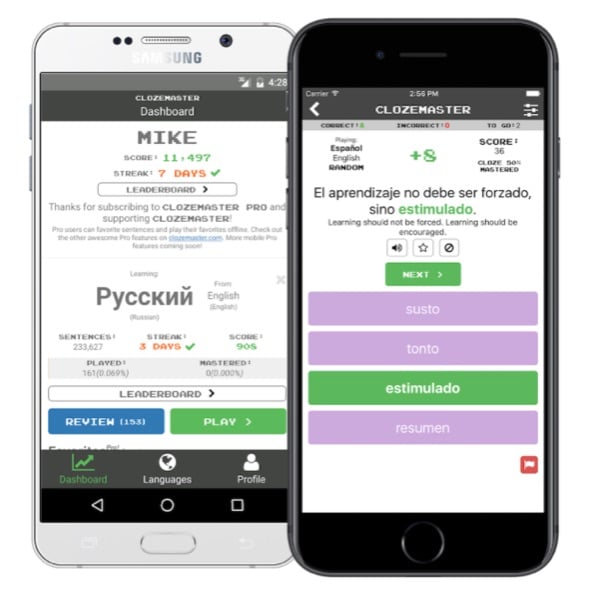
I haven't worked through the app myself. So what follows is what Clozemaster says it does, read from its own pages, help documents and app-store listings in September 2026.
So if you want a first-hand account of using it daily, this section won't pretend to give you one. What it can give you is a clear map of what sits under the hood.
Clozemaster's backbone is something called Fast Track. It's built on word frequency, which means you meet useful material early. There are ten Fast Track levels.
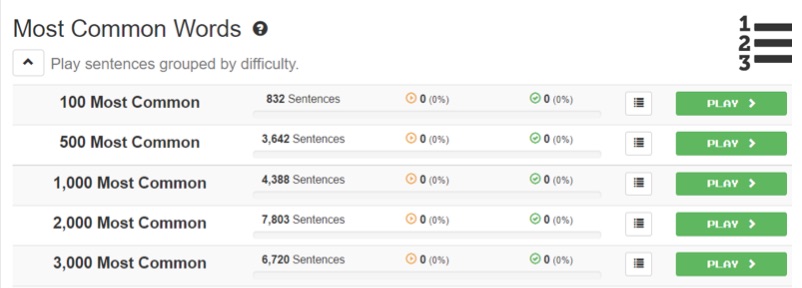
The wider collections run from the 100 most common words all the way up to the 50,000 most common.
That's a genuinely long ladder, and you can see the logic: the words are ranked by how often they appear, not by a textbook's opinion of what you should learn next. The idea is that you spend your time on words that actually show up, in the order they show up most.
Grammar collections drill one pattern at a time rather than mixing everything together. In Spanish, for example, you work through ser against estar, or por against para. Those are the pairs that keep tripping people up years after they start.
The CEFR collections are worth a close look, because they're not everywhere. Spanish and German get ladders from A1 up to B2. French doesn't: it has exactly two collections of that kind, C1-C2 Connectors and DALF C1 Exam Prep, and no A1 to B2 path.
Italian has none at all. Japanese takes a different route, with JLPT collections from N5 to N1 instead.
There are three modes: Vocabulary, Listening and Speaking. Vocabulary is the one most people picture. In Listening you hear the sentence before you see it.
Transcribe, which is part of Listening, has you type the whole sentence rather than one word. It's the difference between recognising something and actually producing it.
Listening is available for over 30 courses, but only inside the Fast Track, Most Common Words and Grammar Challenge collections.
Speaking mode arrived in the iOS app in July 2026 and lets you say your answer out loud. Clozemaster doesn't document what it does with your answer, so that part is a black box.
Another caveat: the audio is synthetic speech. How natural it sounds depends on what you're studying and what you're listening on.
There's an Explain button. Its answers are written by ChatGPT. Since August 2026, each explanation is split into word by word, a literal translation and grammar notes.
You can report a wrong one for review, which helps. But a machine-written explanation is a hint, not a ruling.
On Pro you can build your own collections, upload them by file, and share them. A Quick Capture widget saves words as you meet them during the day.
One fair mention before I close. Clozemaster also publishes a free section called Comprehensible Input, with short connected texts and a translation under every sentence. It covers just three: 24 texts in Brazilian Portuguese, 21 in French and 17 in Spanish.
The Spanish texts are five short factual explainers rewritten at A1, A2, B1 and B2 rather than stories. The section sits beside the drill rather than feeding it. You can dip into it, but it won't turn the single-sentence exercises into a connected reading path.
Then there's the look. It reminded me of nineties Space Invaders at first, and it was a real turn-off. I got used to it eventually, but I still find it odd.
Clozemaster's own blog calls the design reminiscent of retro video games. The iOS app added a gentler high-contrast theme in July 2026.
How Clozemaster's Spaced Repetition Works
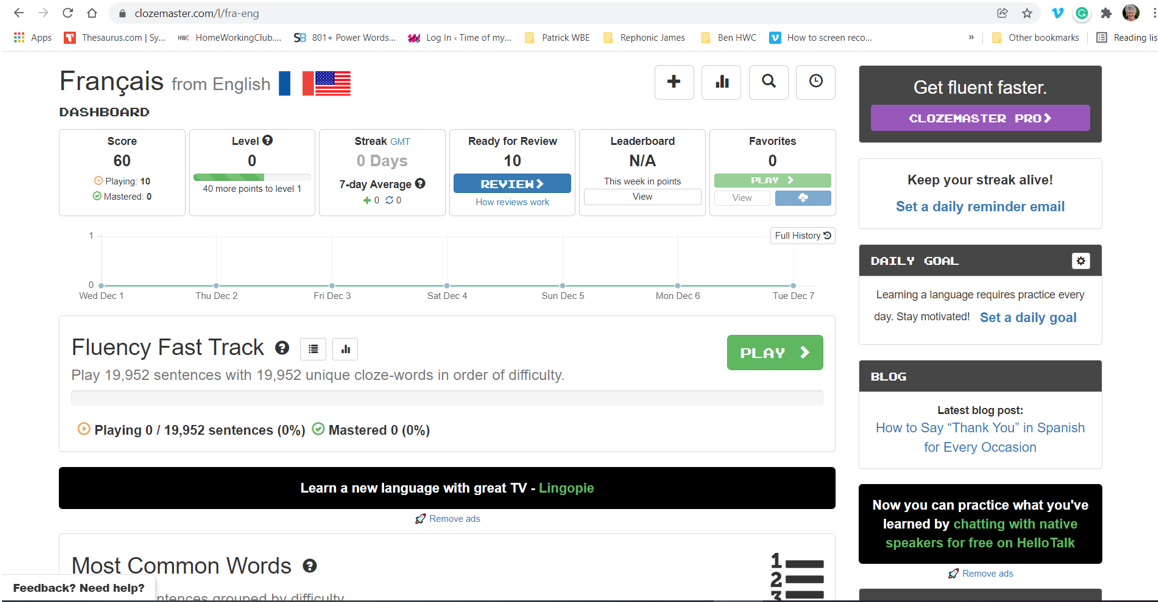
Plenty of apps say they use spaced repetition and leave it there. Clozemaster doesn't. It publishes the actual schedule in its help documents and FAQ, so you can check the mechanics before you pay.
Every sentence starts at 0 per cent mastered. Answer it correctly once, and it moves to 25 per cent and comes back the next day.
Correct again: 50 per cent, and it returns in 10 days. Correct a third time: 75 per cent, and it returns in 30 days. Correct a fourth time: 100 per cent mastered, and from then on it returns every 180 days.
That last line is where nearly every other review gets it wrong. 100 per cent is reached at the fourth correct answer, about day 41. The 180 days is the interval that follows it, not a wait before mastery.
Four correct answers in a row take a sentence to 100 per cent. If you never miss a day, that is about six weeks. One wrong answer at any point puts it straight back to 0.
That reset is the bluntest part of the design. There's no partial credit for a sentence you half know. It either climbs the schedule or starts over, and you can be one careless tap away from seeing it again tomorrow.
It's the thing most worth understanding before you commit.
Clozemaster Pro lets you change those intervals to something gentler or stricter. It also lets you set how many due reviews land in each round. By default, up to five due sentences are mixed into a round of new ones.
Points work in one line: four for multiple choice, eight for typing, halved if you take a hint or review early, nothing for a wrong answer. Streaks, daily goals and leaderboards sit on top, but the schedule underneath is the part worth reading.
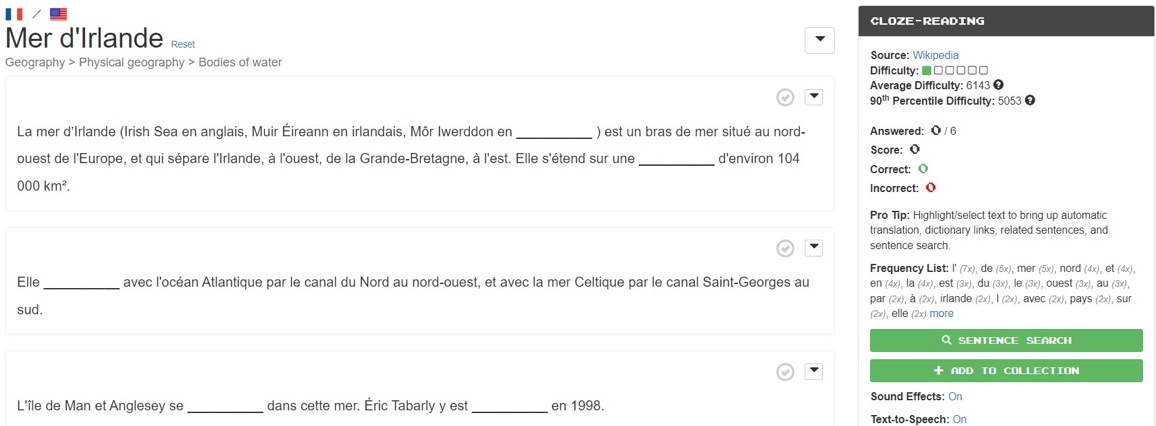
Clozemaster doesn’t create their sentences out of thin air. Instead, their AI algorithms select sentences and translations from Tatoeba, a massive dataset, released under a Creative Commons License.
They use these, plus articles from Wikipedia and translations from Google Translate to create thousands of different fill-in-the blank sentences and paragraphs.
The mobile app and desktop versions offer several different learning categories.
How Much Does Clozemaster Cost, And Is Pro Worth It?
This is the part of Clozemaster that gets misquoted most often in print. Several current reviews still quote prices Clozemaster stopped charging years ago, and some of the numbers look plausible enough to pass as current.
Of five current reviews checked, four print at least one wrong price, and the two most recently published are among them.
As of September 2026, the figures below were taken from Clozemaster's own checkout. Clozemaster is free to sign up and play, and its FAQ says it always will be. Pro costs USD 12.99 a month or USD 79.99 a year.
Twelve monthly payments come to USD 155.88, so the yearly plan at USD 79.99 is roughly half the cost of paying month by month. Spread over twelve months, that works out to about USD 6.67 a month.
Put another way, the yearly plan costs about the same as six months of monthly payments, so it pays for itself if you're still using Clozemaster after about six months.
The refund rule decides which plan to pick. The yearly plan carries a 30-day money-back guarantee. The monthly plan carries no refund at all.
There's no free trial of Pro. The free plan is the trial. You can cancel at any time from the Account page, and Pro runs to the end of the period you paid for.
What the free plan gives you is harder to answer than it should be, because Clozemaster's own pages contradict each other. One of its blog posts says the free plan allows up to 30 sentences a day. Another says the free tier includes unlimited sentences in most languages, in those words.
Its Pro page sells unlimited play as a Pro feature. All three can't be true at the same time. The safe assumption is that the free plan is capped.
Pro adds unlimited play and unlimited listening. It also adds custom review intervals and round sizes, word lookups and sentence search, more statistics, offline downloads in the mobile app, your own collections, a vast library of grammar challenges as the App Store puts it, and no ads.
People search for a lifetime plan, so it's worth stating plainly: there's none on Clozemaster's public Pro page right now. Only monthly and yearly are shown.
Clozemaster's team said on its own forum in October 2023 that the lifetime option might stop being offered to new buyers, and that anyone who already had it would keep Pro for life.
So monthly suits a short burst. Yearly suits a daily habit, and it's the only plan you can get your money back on. Try the free plan first and let it tell you which one you are.
What Clozemaster Gets Right, And Where It Stops
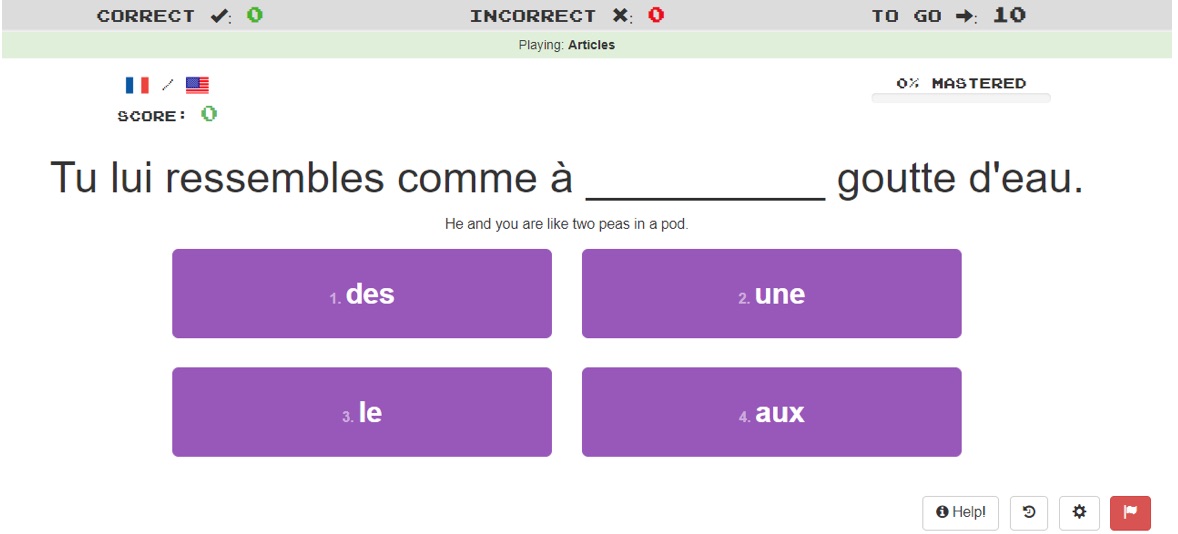
Words learned from a list have a way of vanishing within days. Clozemaster is built against exactly that. The design choice that matters is that you supply the word rather than recognise it.
Frequency ordering puts the work on the words you'll actually meet. Typing the answer is recall, not recognition, and it earns double the points. You control the difficulty too: switch the hints off, hide the translations, slow the audio, and type instead of choosing.
Then there's the pairing system. You choose the tongue you speak as well as the one you're studying, so a Spanish speaker can learn Italian, and someone juggling two at once can work between them rather than always through English. In my opinion, that flexibility is one of the best things about Clozemaster.
The catalogue runs to 73 in all, and it includes Welsh, Irish, Icelandic and Basque. Those four names make the depth clear on their own.
Speaking mode is practice saying an answer out loud, and Clozemaster doesn't publish what feedback it gives.
Here's where it stops. Clozemaster doesn't teach: it tests, and it says so itself. It isn't meant for the complete beginner.
You'll need the alphabet, some pronunciation and a little grammar before the sentences are useful.
The sentences are also unrelated to one another, so you meet a word in a line and never in a real situation. Some are written by volunteers, which means a few errors get through, and some aren't anything a person would actually say.
There's no tutor, no lesson and no conversation with a person. And there's a writing-system catch: Clozemaster's own blog says it gives no romanisation or transcription for a different writing system, so if you're learning Arabic, Japanese, Russian or Korean, you need to read the script before any of this is usable.
Best for: the learner who can already read the script and has enough basics to make sense of a sentence, and who wants to drill the words they'll actually meet.
Not for: a complete beginner, or anyone who needs a live person to explain, correct and push them past the single sentence.
From Single Sentences To Whole Stories
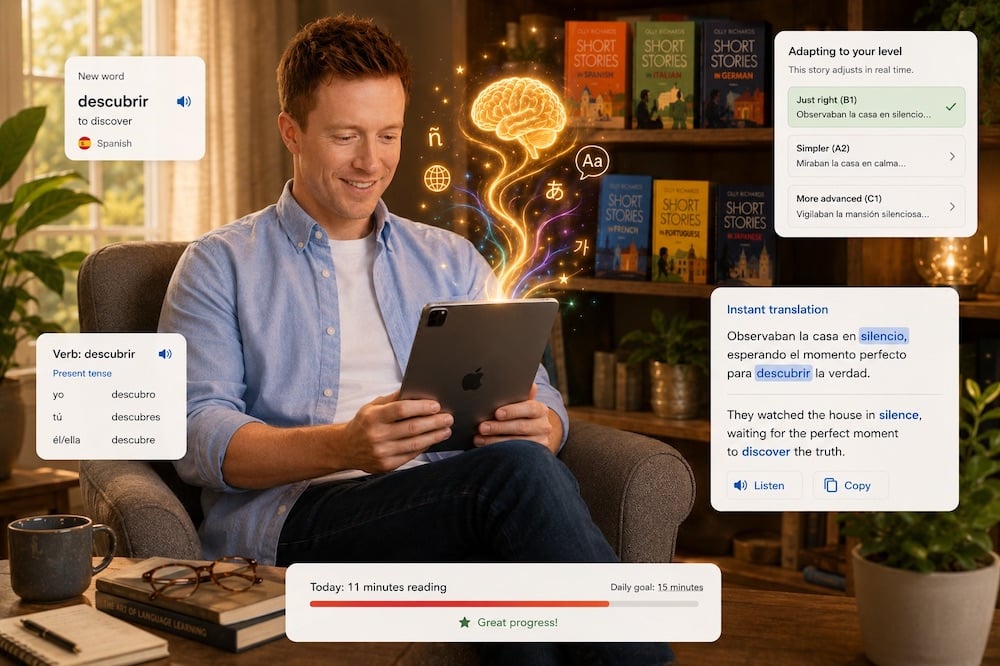
The StoryLearning App is my own product, a reading app, and not a replacement for Clozemaster. I'll lean harder on the StoryLearning App's weaknesses than I did on Clozemaster's, because the StoryLearning App is mine.
Clozemaster gives you something the StoryLearning App cannot: a sentence with one word removed, which you supply by choosing from four options or typing it, ordered so the most useful words come first. It's also free to sign up and play.
What that leaves uncovered isn't reading itself. It's the moment after the sentence ends. A word you met on Monday in one sentence and never met again hasn't gone anywhere, just hasn't turned up since.
In a story, the same people and the same situation are still there on the next page, and the word keeps turning up in sentences you can mostly understand. That's what 15 minutes a day of this kind of reading is for.
If you're not going to base your study on reading, tell me what you're going to do instead.
The stories are written for you, by AI, at your level, in the genres you pick from a list of eight. As you read, you save words, and those saved words come back in later stories, days and weeks apart. That's spaced repetition, and it happens inside new stories rather than on cards.
The approach is called comprehensible input, which just means reading language you can mostly follow. You can trial the audio narration with a free audio each month, and full narration for every story is available on a separate plan.
The StoryLearning App costs $15 a month or $135 a year, as of September 2026. There's one public price, with a monthly and a yearly way to pay.
A subscription gives you up to 20 new stories a month, across all your languages together. There's no free trial.
The StoryLearning App has no speaking practice of any kind, and no conversation with an AI or a tutor. It is not for complete beginners. You need an elementary (A2) foundation before the stories work.
It runs in a web browser on a phone, tablet or computer, with nothing to install. It is not in the App Store or Google Play, and you cannot read offline. It launched in 2026.
It covers ten languages, all European. If you're learning Welsh, Irish, Icelandic, Basque, Arabic, Japanese, Korean, Russian, Chinese or Latin, you can't use the StoryLearning App at all.
Best for: the reader who wants a daily reading habit and will save words as they go.
Not for: the complete beginner who can't start yet, anyone who wants speaking practice, or someone learning a language outside the ten European ones.
The StoryLearning App
Price: $15 a month, or $135 a year (US dollars), as of September 2026
Free trial: none
New stories: up to 20 a month, across all your languages (re-reads not counted)
Audio: a free audio each month to trial the narration; full narration for every story on a separate plan
Languages: Danish, Dutch, English, French, German, Italian, Norwegian, Portuguese, Spanish and Swedish, with separate Spain and Latin American Spanish, and European and Brazilian Portuguese
Level: from about A2 (elementary) to advanced; not for complete beginners
Where it runs: web browser on a phone, tablet or computer; not in the App Store or Google Play
If You're A Complete Beginner: Uncovered
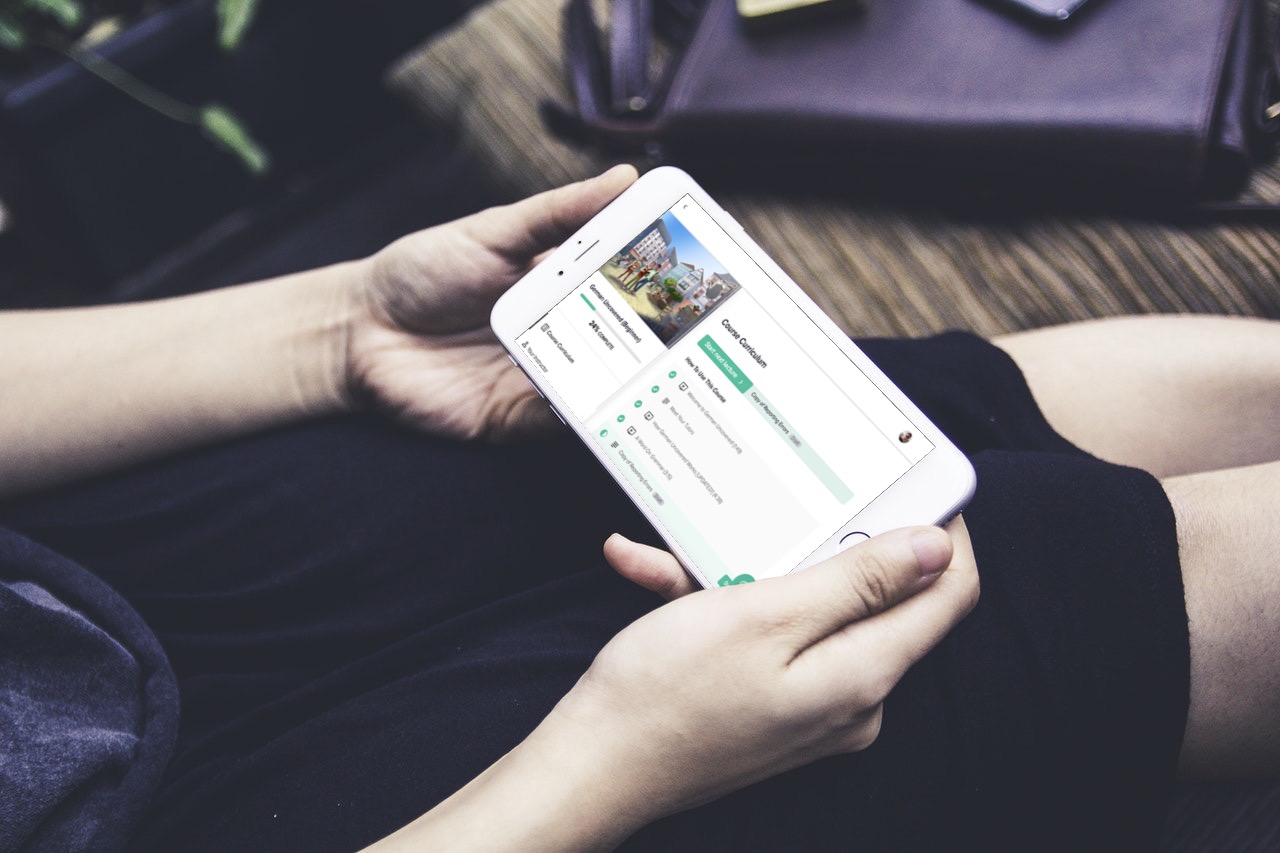
Clozemaster starts at about A2, and it tests sentences rather than teaches the language. If you're beginning from nothing, that's the wrong first move. What a complete beginner actually needs is someone to explain the language to you.
Let me declare the interest without apology. Uncovered is my own course, sold by StoryLearning. Weigh this section accordingly.
Uncovered does share Clozemaster's core idea: you learn from context rather than rules. But instead of thousands of unrelated sentences, you work through one continuous story.
A teacher explains what's happening in English as you go. It's a course, not a drill.
The Beginner course is built for someone starting from nothing. It covers CEFR A1 to A2.
We also sell an Intermediate course covering B1 to B2 and an Advanced course covering C1 to C2 in the bigger languages. Spanish, French, Italian and German offer all three levels.
Japanese, Korean, Chinese and Russian offer two. The rest are Beginner only.
The price is a seven-day free trial, then USD 297 once for lifetime access to that course. There's no recurring fee, and it carries a 365-day money-back guarantee.
Now the honest limits. USD 297 buys one language, not all fifteen.
It's a far bigger up-front payment than a vocabulary subscription. And if what you want is drilling rather than teaching, this is the wrong purchase.
If you're past the basics, Clozemaster is the cheaper experiment.
Find out more and start your free trial.
The Bottom Line Of This Clozemaster Review

So here's the honest version.
Clozemaster comes out at 3.5 out of 5. It's a genuinely useful vocabulary trainer from about A2 upwards, and it isn't worth much if you're starting from zero.
The missing point and a half goes to what the app doesn't do. It tests rather than teaches, and in most collections the sentences have no relationship to one another.
You get good at picking the missing word, but the words never become a connected whole.
That doesn't make it useless. It makes it a drill, and drills have a place.
Clozemaster is free to sign up and play, so start there. Pick one you already know a little of, and let two weeks tell you the truth. If you're opening it daily without being pushed, that's your answer.
Two weeks is enough. You'll know by the second Wednesday whether you're reaching for it or forcing it.
If you're not, no feature list will change it. That's not a failure on you. It just means this particular drill isn't yours, and you can walk away.
If you're still using it after a fortnight, take the yearly plan. At USD 79.99 a year it's roughly half of the USD 155.88 you'd pay through twelve monthly payments of USD 12.99. The yearly plan is also the only one with a 30-day money-back guarantee.
Monthly suits a short burst, but it refunds nothing. That's the maths, as of September 2026.
Once the plan is sorted, put two things beside Clozemaster. You need something that actually teaches you, not just tests you. And you need connected reading and listening, real stretches of it, not isolated sentences.
Clozemaster holds words in place. The other two give them somewhere to live. Without them, it's just a streak with a score attached.
That's the whole judgement. It's a good drill, not a teacher.
Still weighing up vocabulary apps? My Drops review looks at the other big name in the category.
Clozemaster FAQ
Is Clozemaster free?
Clozemaster is free to sign up and play, and its FAQ says it always will be.
But the free plan is capped, and as of September 2026, Clozemaster's own pages disagree about how. One blog post says up to 30 sentences a day. Another says unlimited sentences in most languages, while Clozemaster's Pro page sells unlimited play as a Pro feature.
Assume it's capped. Treat the free plan as the way to find out whether you like the exercise.
How much does Clozemaster Pro cost?
Clozemaster Pro costs USD 12.99 a month or USD 79.99 a year, as of September 2026.
Twelve monthly payments come to USD 155.88, so the yearly plan is roughly half the cost, about USD 6.67 a month.
Prices vary by country and may include local tax. There's no free trial of Pro.
Does Clozemaster still have a lifetime subscription?
It's not on Clozemaster's Pro page. As of September 2026, that page shows just two plans: monthly and yearly.
Clozemaster's team said on its own forum in October 2023 that the lifetime option might stop being offered to new buyers. Anyone who had already bought it keeps Pro for life.
I can't quote a lifetime price because there isn't one on the page to quote.
Is Clozemaster Pro worth it?
Clozemaster Pro is worth it if you're hitting the free plan's cap and opening Clozemaster most days. It isn't worth it if you dip in now and then.
What Pro really buys is unlimited play and control: custom review intervals, round sizes and offline downloads.
If Clozemaster has become a habit, take the yearly plan at USD 79.99 as of September 2026. Twelve monthly payments would cost USD 155.88, and only yearly includes a 30-day money-back guarantee.
Is Clozemaster good for beginners?
No, and Clozemaster says so itself. It's best once you already know the alphabet, pronunciation and some basic grammar, and its App Store listing describes it as for A2 to C1 learners.
There are A1 collections for Spanish and German, as of September 2026. But the exercise still only tests you, so a complete beginner has nothing to draw on.
Learn the basics elsewhere first.
Does Clozemaster use AI?
Yes, for explanations. Tap Explain on a Clozemaster sentence and the explanation is written by ChatGPT, according to Clozemaster's FAQ as of September 2026.
The rest isn't AI. The sentences and translations come from Tatoeba, a volunteer-built database. The missing word is chosen by a frequency rule: the least common word among the ten thousand most common words in that language.
A machine-written explanation is a hint. Clozemaster lets you report one that's wrong.
Is Clozemaster legit?
Yes, Clozemaster is legit, on the evidence you can check from outside. It's made by Language Innovation LLC, has been on Google Play since January 2017, and has passed more than 500,000 downloads there.
As of September 2026, the listings rated 4.8 on the App Store and 4.6 on Google Play. Payments go through the app stores or Clozemaster's payment provider. The yearly plan is refundable within 30 days, and the monthly plan is not.

Olly Richards
Creator of the StoryLearning® Method


Olly Richards is a renowned polyglot and language learning expert with over 15 years of experience teaching millions through his innovative StoryLearning® method. He is the creator of StoryLearning, one of the world's largest language learning blogs with 500,000+ monthly readers.
Olly has authored 30+ language learning books and courses, including the bestselling "Short Stories" series published by Teach Yourself.
When not developing new teaching methods, Richards practices what he preaches—he speaks 8 languages fluently and continues learning new ones through his own methodology.