
It's Sunday evening, and you're at the kitchen table, your laptop open with a dozen browser tabs waiting. Each one is a Spanish course for beginners. Each one promises you'll be speaking in weeks.
You've booked a spring trip to Seville.
What you actually want is smaller and more concrete. You want to walk into a bar and say, Una mesa para dos, por favor. A table for two, please.
Then understand when the waiter asks, ¿Dentro o fuera? Inside or outside?
You scroll. You compare. You close a tab, open another, close that one too.
The hard part of starting Spanish isn't the Spanish yet. It's choosing, and then sticking with what you chose.
The short version comes next. You can stop after it.
If it has to be free, Language Transfer‘s Complete Spanish is a free audio course built for beginners, and for a structured app with feedback from fluent speakers, Busuu‘s Complete Spanish runs from A1 to C1.
If you want a live teacher from your first week, Lingoda runs small live classes from A1 to B2. And if you'd rather learn through a story than through drills, StoryLearning's Spanish Uncovered is built around one story.
This page scores nine options on the same eight criteria, including my own course. The other five are Duolingo, Babbel, Pimsleur, italki and Langua.
The best online Spanish course for beginners is the one you finish. Pick one course, work through it from start to finish, and start speaking within the first few months.
The first half matters because you've probably already tried starting two or three apps at once and your motivation fade. The second half matters because speaking is where the fear shows up.
There are no affiliate links on this page, and apart from my own course, I don't earn from anything here.
Table of Contents
Why So Many Spanish Beginners Stall In The First Month

Most beginners don't fail at Spanish. They fail at choosing.
They try one app for a week, read about another, start again somewhere else, and never get past the first few lessons of anything. You might know the feeling. You're three lessons into one course, a friend mentions another, and by Friday the first one sits unopened.
Every switch feels like a fresh start, but the result is that nothing gets finished. I understand why it happens. A new course looks like a clean slate.
The problem isn't usually the course. It's that the course never gets a chance to work.
When I started Greek, I bought Teach Yourself Complete Greek and went through it from cover to cover.
A beginner programme like that might take a month, two months, three months. That's the first job.
A good beginner course does the choosing for you. Someone has already picked the beginner material, so you meet the main vocabulary, the basics of the grammar, and the pronunciation in a sensible order.
The basic words come back again and again, so you pick them up without ever memorising lists. The early lessons build a solid foundation.
It doesn't have to be my own course. My advice is always the same: “Find a book or a textbook or a method or a course that speaks to you in some way. Make a choice and get started.”
At the start, everything feels foreign and overwhelming. You hear a sentence and it's a blur of sound. That feeling fades quite quickly once you actually get stuck into the language.
That's the moment the language starts to become familiar.
The options below differ in what they give a beginner and what they leave out. One thing none of them does is the speaking for you.
So let's look at what each one gives you.
Best Online Spanish Course For Beginners: The Comparison Table
| Provider | Best-for CEFR | Primary skill | Speaking support | Structure | Study load | Method | Price (as of November 2026) | Track record |
|---|---|---|---|---|---|---|---|---|
| Duolingo | A0 to B2 content (Duolingo, April 2026) | Vocabulary (recognition) | Scripted; Max adds AI conversation | Fully sequenced | Light, 5 to 15 min | Game-style drills with spaced review | Free (the whole course); Super and Max priced in the app | Market leader |
| Language Transfer (Complete Spanish) | A0 to about A2 or low B1 | Grammar intuition, listening and speaking | Guided (you answer aloud; nothing listens or responds) | Fully sequenced (linear audio) | Light to medium | Audio “thinking method” | Free (donation-supported) | Small independent project, one teacher |
| Babbel | European Spanish to C1; Mexican Spanish to B1 | Mixed (grammar and dialogue) | Scripted, plus Babbel Speak AI (live classes closed to individuals in July 2025) | Fully sequenced | Light to medium, 10 to 20 min | Dialogue lessons with explained grammar | About $8.95 a month on the 12-month plan ($107.40); lifetime $299.99, often discounted; all 14 languages | Long established |
| Busuu | A1 to C1 | Mixed | Feedback (community, not live); Premium Plus adds AI conversation | Fully sequenced, CEFR-mapped | Light to medium | Structured course plus community feedback | Free tier; Premium about $69.99 a year (about $5.83 a month); Premium Plus costs more | Established |
| StoryLearning (Spanish Uncovered) | Spanish Uncovered: complete beginners; the six-level line reaches C2, and Advanced (towards C1) is the highest sold to new buyers | Reading and listening | Guided (speaking packs built for use with a tutor you find and pay for separately) | Fully sequenced | Medium to deep, 20 to 45 min chapters | Comprehensible-input reading (one continuous story) | $297 per course, one-time (from $397); 7-day free trial; 365-day guarantee | Established indie brand |
| Pimsleur | A0 to about B1 (Level 5 is “intermediate”) | Listening and speaking | Scripted, plus AI pronunciation feedback | Fully sequenced | Medium, 30 min | Audio-immersion | $150 per level; $575 for all five levels; often discounted | Long established |
| Lingoda | A1 to B2 | Speaking (teacher-led) | Live human (small group or private) | Fully sequenced, CEFR-aligned | Deep, 60-min classes | Live online classes | Group classes about €8 to €12 per class by plan size (Lingoda prices in euros); private classes cost more; 7-day free trial | Established online school |
| italki | Any level | Speaking | Live human | Freeform | Deep, lesson length you choose | Live one-to-one tutoring | $5 to $50+ an hour, pay per lesson | Large, established marketplace |
| Langua | Guided course for A1/A2, practice to C1 | Speaking | AI conversation | Loose | Flexible | AI conversation with real-time correction | Free to try; Standard $19.99 a month or $149.99 a year (calls up to 30 minutes a day); Unlimited $29.99 a month or $199.99 a year | Newer (2024 onwards) |
1. Duolingo: Free, Friendly And Easy To Start
Chances are your first Spanish lesson was on Duolingo. As a free way to start the habit, that's reasonable.
It teaches through short, game-like lessons of 5 to 15 minutes. Streaks and rewards pull you back to the phone.
The whole course is free, and Super and Max are priced in the app. In April 2026, Duolingo announced Spanish is one of nine courses where you can now learn through B2 content, where the content previously stopped at A2. That's the picture as of November 2026.
But content reaching B2 isn't the same as you reaching B2. A 2019 study in the CALICO Journal found vocabulary and grammar gains from Duolingo but no significant gain in speaking or listening. Tapping the right answer on a phone is not talking to a person.
Best for: the complete beginner who wants a free, low-pressure way to start Spanish and doesn't expect to speak yet.
Not for: a learner whose goal is conversation, because tapping through lessons won't get you there on its own.
2. Language Transfer: A Free Audio Course
Complete Spanish costs nothing, and it's one man's project. That still surprises people.
It's an audio course. A teacher talks you through how Spanish is built and asks you to work out sentences in your head and say them aloud.
The site says the Complete courses are designed for beginners but get advanced quickly, and they cover the whole structure of the language and how its words are formed.
As of November 2026, everything is free. The course is sustained by learner donations and made by one person, Mihalis Eleftheriou.
You listen through its app, SoundCloud or YouTube, or download the files. Its own advice is not to read the transcripts while you do the course.
It's audio only, so there's no reading practice and no vocabulary tools, and nothing checks what you say aloud. It takes you to roughly A2 or the edge of B1, then you need something else.
Best for: a complete beginner who wants a first Spanish course that explains how the language fits together, without paying anything or signing up for anything.
Not for: the learner who wants reading practice, vocabulary tools, or any check on what they actually say aloud.
3. Babbel: Short Lessons, Grammar Explained
Babbel asks you one question before the first lesson: do you want Spanish from Spain or from Mexico?
Lessons are short, structured dialogues, about 10 to 20 minutes each.
The grammar is explained to you in English, so you're not left guessing. That matters for a complete beginner.
There are two Spanish courses. European Spanish goes up to C1, with additional topics up to B2, while Mexican Spanish goes up to B1. Mexican Spanish only appears if your display language is American English.
Both courses include speakers from several Spanish-speaking countries. One subscription covers all 14 languages. It costs about $8.95 a month on the 12-month plan, and lifetime access is $299.99, often discounted, as of November 2026.
The weak spot is speaking. The speaking practice is scripted, repeating set phrases. Babbel's live classes closed to individual learners in July 2025.
Individuals now get Babbel Speak, an AI speaking feature. That means there's no real person on the other end.
Best for: the complete beginner who wants a clear first course, short daily lessons, and the grammar explained plainly.
Not for: the learner who needs to speak off script and get corrected by a real person.
4. Busuu: A1 To C1, With Fluent Speakers Checking Your Work
The first time you write a sentence in Spanish, you'll wonder if it's actually right.
On Busuu, a real person can read what you wrote, or listen to what you said, and tell you what's wrong.
It's a structured, level-by-level course with short lessons. You can send written and spoken exercises to the Busuu community, and people who speak Spanish fluently will send back corrections.
The Complete Spanish course runs from A1 to C1 with 510+ lessons. There's a free tier. Premium is about $69.99 a year, about $5.83 a month, and Premium Plus costs more (as of November 2026).
The feedback arrives later, not live, because the people checking your work are volunteers, and some corrections are sharper than others. The lessons themselves are standard app lessons, nothing fancy, but it's the feedback that makes them worthwhile.
Best for: the complete beginner who wants a first Spanish course with a clear path from the first lesson, and doesn't mind waiting for a real person to look at their work.
Not for: if you need live conversation in your first week, this isn't it. The delayed feedback won't stand in for a speaking partner.
5. StoryLearning: My Beginner Course, Scored The Same Way

This one's my own beginner course, so it gets the same eight criteria as all the others and I'll name the weak spots as I go.
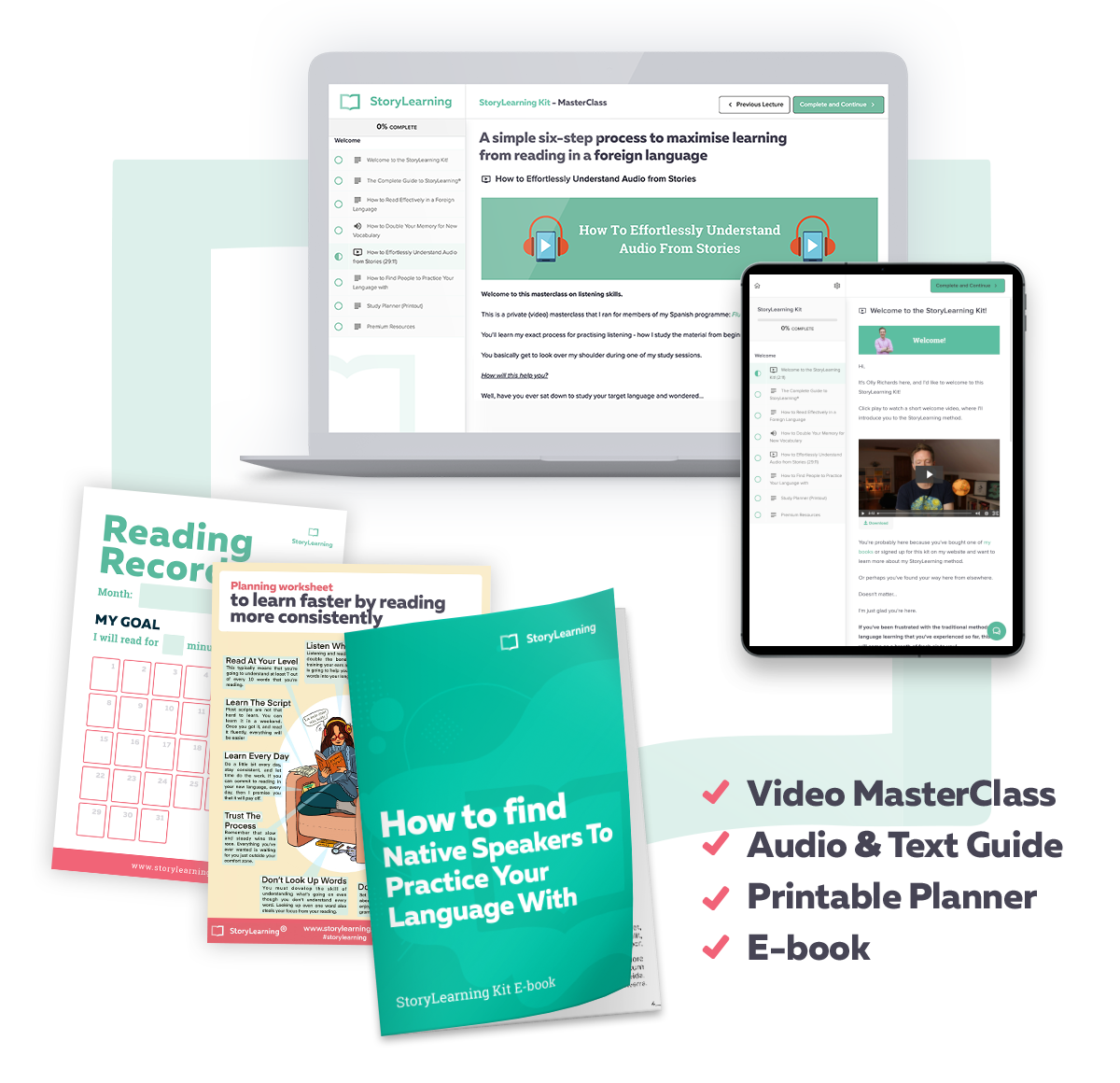
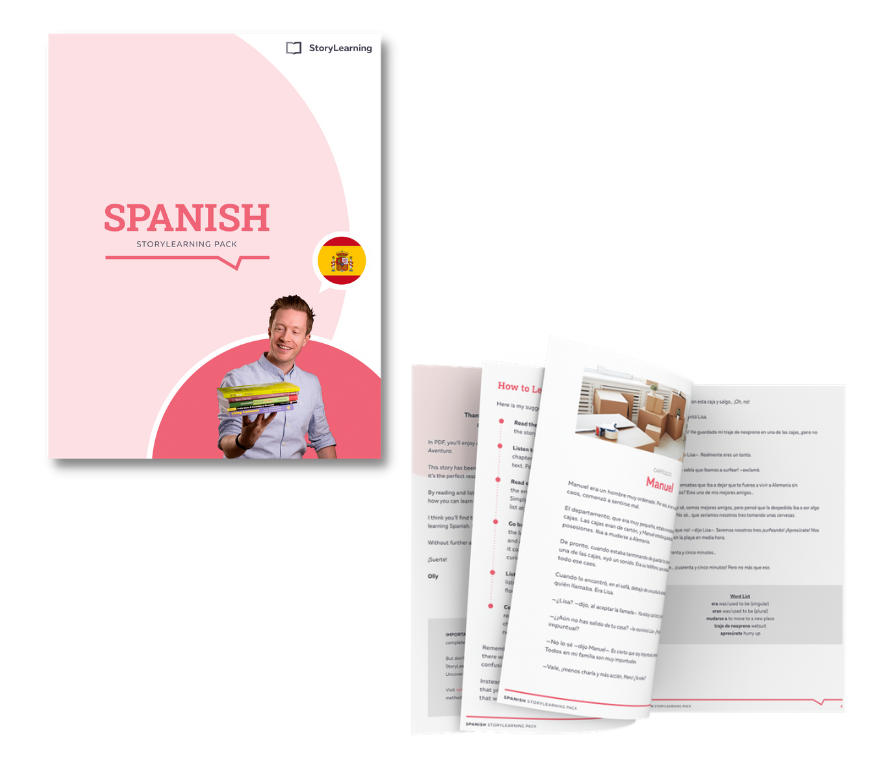
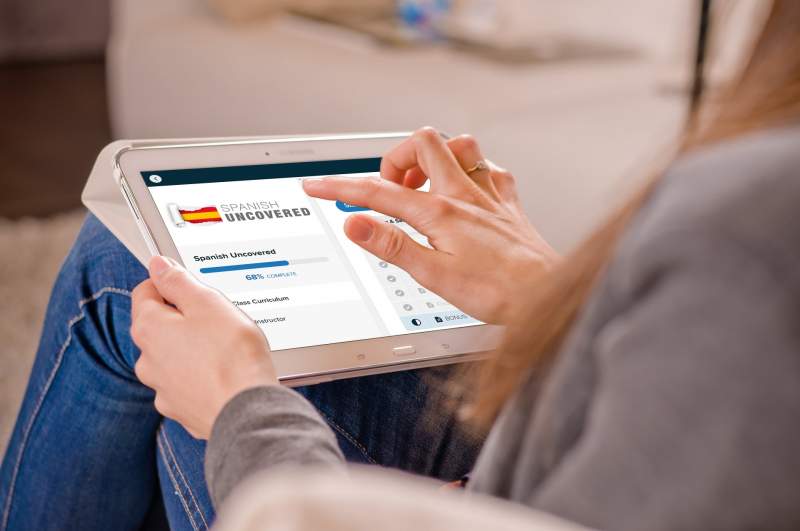
Spanish Uncovered is built around one story, El Hombre Del Sombrero, told over 10 chapters. You read and listen to a chapter, then I unpack the grammar, vocabulary and culture from what you just read in video lessons. You don't meet a rule until you've already seen it doing its job inside the chapter.
That's comprehensible input, which just means learning from Spanish you can mostly follow. The story keeps you reading because you want to know what happens next.
Here's a little extract from the story:
“Marta es científica. Tony es arqueólogo y David es lingüista.” (Marta is a scientist. Tony is an archaeologist and David is a linguist.)
Words like científica and arqueólogo look a lot like English, so a complete beginner follows more than they expect.
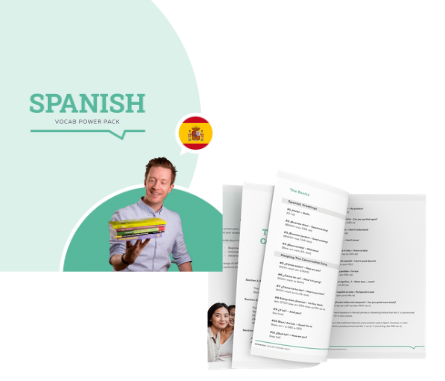
Beyond the story, there are 60+ video lessons, and every chapter comes with native audio in both Castilian and Latin American Spanish.
You also get pronunciation training with Angela, a native Spanish speaker, speaking activity packs and comprehension quizzes. Both accents are there, so you can listen to the one you prefer.
The Spanish Uncovered line has six levels from beginner to mastery and reaches C2 in Spanish. Three are on public sale, and levels 2, 4 and 6 open only after you finish the one before.
Spanish Uncovered is the first level, built for complete beginners. A single course gets you roughly to its own level, not up the whole ladder. If you want the full ladder, you'll need to work through it in order.
Price, in full: $297 one-time, reduced from $397. You get lifetime access, a 7-day free trial and a 365-day guarantee, as of November 2026.
Nothing in the course listens to you or answers back. The speaking packs are built for use with a tutor you find and pay for separately. If you want live correction, that tutor's fee is on you.
You'll finish understanding far more Spanish than you can say. That's the gap this course leaves open. If your goal is to chat on day one, this won't do that.
It's premium-priced and paid in one go after the trial. And nothing nags you back, so it needs some real self-discipline. You'll be the one deciding to sit down.
Best for: a complete beginner who wants their first Spanish course to feel like reading a story, not tapping tiles, and is content to do speaking practice on their own.
Not for: anyone who wants live speaking feedback, a low monthly subscription or a course that nags them back, because this is a premium one-time payment.
6. Pimsleur: Thirty Minutes Of Spoken Spanish A Day
From the first lesson, Pimsleur has you saying Spanish out loud.
You hear a phrase, you're asked to say it, and the course keeps bringing it back at spaced intervals.
Each lesson is a 30-minute audio session, so you can do it on a walk or in the car.
Voice Coach adds AI feedback on pronunciation. You speak, and it points out where you're off.
Pimsleur's main Spanish course teaches Latin American Spanish, with speakers from Colombia and Argentina in levels I to III and from Mexico in level IV. There's a separate Castilian Spanish course if you want that Spanish variety.
It runs to five levels. Each level costs $150, or all five together are $575, and it's often discounted (as of November 2026).
It's scripted, the vocabulary is narrow, and there's little reading or grammar explanation. If you want to read Spanish too, it'll feel slow.
Best for: the complete beginner who wants to start speaking Spanish out loud on day one and is happy to learn mainly through listening and repeating.
Not for: the beginner who wants to read and understand how Spanish works, not just produce set phrases. You'll need to add reading and grammar from another source.
7. Lingoda: A Live Class With A Teacher, From A1

A class that's in the diary does what no app can do. If you know you won't study unless someone is expecting you, that fixed hour gives you a reason to turn up.
Lingoda isn't an app. It's an online language school. You book live, 60-minute Spanish classes over Zoom, in groups of 3 to 5 or one to one, with certified, native-level teachers.
The classes run from A1 to B2, and you can book them 24/7. Plans renew every four weeks, and unused class credits roll over. There's a 7-day free trial: three group classes or one private class.
Cancel within 14 days and you get a refund, minus the classes you've taken. Group classes cost roughly €8 to €12 each at list price, depending on the plan size, as of November 2026. That's in euros on Lingoda's own page.
Private classes cost more. In a group of up to five, you share the hour, so you speak for only part of it. The teacher changes from class to class, and the subscription keeps billing every four weeks whether you go or not.
Best for: the complete beginner who knows they need a real class on the calendar and someone waiting for them, and is ready to pay for that structure.
Not for: the learner who wants to skip a month without paying, because the plan bills every four weeks whether they attend or not.
8. italki: One Tutor, One Hour, At Your Pace
For a nervous beginner, a patient tutor who speaks slowly is often a gentler introduction to the language than a group class.
italki is a marketplace of independent tutors. You choose someone, book a live one-to-one video lesson, and pay per lesson. There's no subscription.
The lesson itself is just you and the tutor on a video call. Prices run from about $5 to $50+ an hour, set by each tutor. Many offer cheaper trial lessons, as of November 2026, so you can test the tutor before you commit.
What you don't get is a built-in course. If you're a complete beginner, you have to find a tutor who brings a plan, or bring one yourself. And quality varies from tutor to tutor.
Best for: the complete beginner who wants a patient human to speak with from day one, and who'll actually book the lesson.
Not for: the learner who needs a ready-made course structure and who'd rather not choose a tutor on their own.
9. Langua: Practise Speaking With An AI Before A Person
Full disclosure: I liked Langua so much that I invested in the company behind it.
Langua gives you an AI conversation partner you can talk or type to in Spanish, and it corrects you as you go.
Its own page now lists a guided conversation course for A1 and A2, so you're not thrown straight into free conversation.
It's free to try. Standard is $19.99 a month or $149.99 a year, with calls capped at 30 minutes a day. Unlimited is $29.99 a month or $199.99 a year, as of November 2026.
What it isn't is a full course. It's an AI, not a person, and the transcription sometimes mishears you. It's also only been around since 2024.
Best for: the complete beginner who wants to start talking in Spanish early, mistakes and all.
Not for: anyone who needs a person's patience or a full curriculum that carries them through the first months.
How I Scored This
Every product above is scored on the same eight criteria: best-for CEFR range, primary skill developed, speaking and output support, structure and guidance, time commitment, method, price and value, and evidence and track record. StoryLearning included.
Speaking support, weakest to strongest:
- None. No spoken output at all.
- Guided. Prompts to speak, but nothing listens and nothing comes back.
- Scripted. You repeat set phrases and software scores you.
- AI conversation. Unscripted practice with software that responds in real time, but no person is there.
- Feedback. A person responds to what you produced, but not live.
- Live human. Real conversation, in real time, with a person.
On that scale, StoryLearning sits at Guided: Spanish Uncovered has speaking activity packs, built to be used with a tutor you find and pay for separately, and nothing in the course itself listens or responds.
Prices are stated as of November 2026. Duolingo doesn't publish its Super or Max prices, so none are given for them. Lingoda shows its prices in euros, so they are given in euros. Time estimates follow my guide to how long it takes to learn a language.
The same eight criteria are used on my guides to the best online Spanish course for intermediate learners, the best alternatives to Duolingo for Spanish and the best way to become conversational in Spanish.
There are no affiliate links on this page, and apart from my own course, I don't earn from anything here.
Full disclosure: I liked Langua so much that I invested in the company behind it.
The Bottom Line: Pick A Course, Finish It, Start Talking

Pick one course and finish it. Then add speaking. That's the whole strategy.
For the course itself, pick one of these and see it through. Don't keep switching.
- Duolingo suits a complete beginner who wants a free start and doesn't expect to speak yet.
- Language Transfer is a free audio course that shows how the language fits together.
- Babbel suits you if you want the grammar explained before you practise it.
- Busuu gives you a clear path and a community that checks what you produce.
- And my own Spanish Uncovered is for the beginner who wants the first course to feel like reading a story.
The goal isn't to try all five. It's to finish one.
If a beginner tells me they sit down with their course for an hour a day and keep that up for months, that tells me everything I need to know. In the gym, the longer a muscle works against a weight, the more it grows. Time in the language builds the same way.
What matters is that you're still showing up in three months, not just fired up for a week.
But reading alone won't do it. If all you do is read and never speak, you'll understand but never be able to speak. You can do every lesson, read for months, and still find conversation feels out of reach.
So once the course is done, add speaking. A live class with Lingoda or a tutor on italki gives you a real person. Langua gives you AI conversation practice, and Pimsleur gives you scripted audio to get your mouth moving.
On a budget, Language Transfer is free, and a few italki lessons add a real person, with tutors starting at $5 an hour. That's a cheap start, not a complete plan.
If you only do one thing, pick one course tonight and do the first lesson. Not tomorrow, not after a bit more research.
I scored my own course on the same eight criteria as every other course on this page.
FAQ Best Online Spanish Course For Beginners
What Is The Best Online Spanish Course For Beginners?
The best online Spanish course for beginners is the one you'll actually finish, and that depends on what you need.
If it has to be free, Language Transfer's Complete Spanish costs nothing. For a structured app with feedback from fluent speakers, Busuu runs from A1 to C1.
Lingoda runs live Spanish classes from A1. StoryLearning's Spanish Uncovered is a beginner course built around one story.
Whatever you pick, add speaking practice within the first few months.
Can I Learn Spanish Online For Free As A Beginner?
Yes, you can learn Spanish online for free as a beginner, and you can get further than most people think before spending anything.
Language Transfer's Complete Spanish is a free audio course, supported by donations. Duolingo's whole course is free, and Busuu has a free tier too.
The catch? None of these free options gives you a live person to talk to. So start free, and budget for some speaking practice later.
Should A Beginner Learn Spain Or Latin American Spanish?
Either one works.
European and Latin American Spanish are fully mutually intelligible, so pick the variety you'll actually hear: where you'll travel, who you'll talk to.
Babbel makes you choose before you start, with a separate European Spanish course and a Mexican Spanish course. Pimsleur's main course is Latin American, and its Castilian course is sold separately.
Spanish Uncovered gives every chapter in both Castilian and Latin American Spanish audio, so you don't have to lock yourself in.
Is Duolingo Enough To Learn Spanish As A Beginner?
No, Duolingo isn't enough on its own if your goal is speaking. It's a fine free start.
In April 2026, Duolingo said Spanish learners can now work through B2 content, where most could previously only finish up to A2.
A 2019 CALICO Journal study found vocabulary and grammar gains, but no significant gain in speaking or listening.
Pair it with a course that explains more, and with real speaking practice.
How Long Does It Take A Beginner To Learn Spanish?
For a beginner, it's about six months. Spanish is close to English, so an hour a day plus extra listening, reading or TV gets most people to a solid conversational level in that time.
A first beginner course alone takes roughly one to three months to work through.
When Should A Spanish Beginner Start Speaking?
Start sooner than feels comfortable, and within the first few months. Once your first course has given you the basics, start before you feel ready. You won't speak unless you practise speaking.
A patient tutor on italki can keep the pace gentle. A small live class on Lingoda starts from A1. Or use Langua's guided A1/A2 conversation course and make your first attempts with an AI rather than a person.

Olly Richards
Creator of the StoryLearning® Method


Olly Richards is a renowned polyglot and language learning expert with over 15 years of experience teaching millions through his innovative StoryLearning® method. He is the creator of StoryLearning, one of the world's largest language learning blogs with 500,000+ monthly readers.
Olly has authored 30+ language learning books and courses, including the bestselling "Short Stories" series published by Teach Yourself.
When not developing new teaching methods, Richards practices what he preaches—he speaks 8 languages fluently and continues learning new ones through his own methodology.