
I had been studying Spanish from textbooks in London for months.
Then I visited my friend Gabriella in Madrid.
At a busy bar, her friends started talking to me in Spanish.
They quickly realised I couldn't really speak it.
Gabriella ended up translating for me all night.
I felt crippling embarrassment.
I felt my whole body shutting down.
If you've learned Spanish and still frozen like that, you'll recognise the moment I'm describing. You're standing there, the words are gone, and someone is still talking to you.
This page is for you.
Here's the short version, and you can stop reading after it if you like.
The best way to become conversational in Spanish is to pair regular conversation with a real person, plus lots of Spanish you can follow.
For the conversation half, start with a tutor on italki or Preply, both marketplaces of independent tutors for one-to-one online lessons. Or book a live class at Lingoda, which runs small-group Spanish with certified teachers, or find a free exchange partner on Tandem.
For the other half, the input half, you want Spanish you can follow: stories, podcasts, videos, anything where you can keep the thread. A Spanish podcast on your walk counts.
StoryLearning's Spanish Uncovered, Busuu, Langua and Pimsleur help around the edges, and all eight are scored on the same eight criteria.
The thesis is simple: pair a regular speaking habit with lots of Spanish you can follow. The sections below run from the most live speaking to the least, so you can find the product that fits the half you're missing.
There are no affiliate links on this page and no commission on anything here. One thing to declare: I've invested in Langua, so weigh what I say about it with that in mind.
Table of Contents
Why Months Of Spanish Study Can Still Leave You Speechless

After Madrid, I went back to London and carried on studying, almost as like a kind of therapy. The feeling of not understanding and overthinking everything stayed with me for some time.
I kept opening the books and working through the exercises. The freezing didn't go away. I didn't know what else to do.
Then I met Tomás.
He was a friend from the Canary Islands who arrived in London speaking little English. We hung out almost every day for the best part of two years. On many days I spoke far more Spanish than English.
That meant my Spanish was getting a daily workout, not in a classroom but in real friendship. Tomás didn't give me a method. He gave me a reason to speak.
I didn't stop the reading and listening when Tomás appeared. I kept getting input. But now there was a place for it to go.
For two years, Spanish wasn't a subject. It was the way I talked to my friend.
And my Spanish went like a total rocket ship.
Looking back, the reason isn't mysterious. It was the combination of lots of reading and listening plus the chance to speak every day. Neither half alone would have done it.
The reading and listening were the raw material, not busywork. The daily speaking was where that raw material became mine.
Before Tomás, I had plenty of Spanish inside my head. What I didn't have was the daily practice of turning it into speech.
If you've ever studied and still struggled to say anything beyond prepared phrases, you know exactly what I mean. You probably know the gap I'm describing. You can often follow more Spanish than you can say.
Speaking is a separate skill. It only improves with a lot of speaking.
Maybe you can pass a written exercise. Maybe you can even understand a native speaker's question. But producing your own answer is a different task.
You can understand a story told slowly, but the words won't come out at normal speed. That's the gap the daily speaking closes.
That's why the two parts matter. One gives you the material. The other gives you the practice.
A course can give you one of these. A friendship gave me both. That difference matters.
My Spanish accent still sounds like a Canary Islands one because of Tomás. That's how deep those ordinary conversations went.
So when you compare the options below, sort them by how much real speaking they give you. From a person in front of you to practice on your own.
Best Way To Become Conversational In Spanish: The Comparison Table
| Provider | Best-for CEFR | Primary skill | Speaking support | Structure | Study load | Method | Price (as of October 2026) | Track record |
|---|---|---|---|---|---|---|---|---|
| italki | Any level | Speaking | Live human | Freeform | Deep, lesson length you choose | Live one-to-one tutoring | $5 to $50+ an hour, pay per lesson | Large, established marketplace |
| Preply | Any level | Speaking | Live human | Freeform | Deep, usually 50-minute lessons | Live one-to-one tutoring | Set by each tutor; Spanish tutors about $15 to $50 an hour (Preply's own guide); trial lessons often discounted | Large, established marketplace |
| Lingoda | A1 to B2 | Speaking and listening | Live human (small group of 3 to 5, or private) | Fully sequenced, CEFR-aligned, fixed class times | Medium to deep, 60-minute classes | Live online classes with a teacher | Group classes from €9.99 to €15.99 per class by plan size; private classes cost more (Lingoda prices in euros) | Established online language school |
| Tandem | Any level | Speaking | Live human (a peer, not a teacher) | Freeform | Flexible | Language exchange | Free; Tandem Pro about $14 to $15 a month | Established app |
| Busuu | A1 to B2 | Mixed | Feedback (community, not live); Premium Plus adds AI conversation | Fully sequenced, CEFR-mapped | Light to medium | Structured course plus community feedback | Free tier; Premium about $69.99 a year (about $5.83 a month); Premium Plus costs more | Established |
| Langua | A2 to C1 (practice tool) | Speaking | AI conversation | Loose | Flexible | AI conversation with real-time correction | Free account to try; Standard $19.99 a month or $149.99 a year; Unlimited $29.99 a month or $199.99 a year | Newer (2024 onwards). Olly has invested in Langua |
| Pimsleur (Latin American Spanish) | A0 to about B1 (full course is “intermediate”) | Listening and speaking | Scripted, plus AI pronunciation feedback | Fully sequenced | Medium, 30 min | Audio-immersion | $150 per level; $575 for all five levels; often discounted | Long established |
| StoryLearning (Spanish Uncovered) | Beginner towards C1, across separate levels (Intermediate: B1 to B2) | Reading and listening | Guided (each course has a speaking section, built for use with a tutor you find and pay for separately) | Fully sequenced | Medium to deep | Comprehensible-input reading (one continuous story) | $297 per course, one-time (from $397); 7-day free trial; 365-day guarantee | Established indie brand; no independent outcome research |
italki: Pick Your Own Tutor, Pay By The Lesson
You can follow a Spanish podcast, but when a real person asks what you want, the words don't come.
That gap between what you understand and what you can say is the one italki narrows.
italki is a marketplace of independent tutors. You book live one-to-one video lessons and pay per lesson, no subscription. You pick a tutor, and the lesson is live conversation from the start.
Teachers charge from $5 to $50+ an hour, as of October 2026. Many offer discounted trial lessons, so you can test the fit before you commit.
The trade-off is that italki is not a course. There's no built-in curriculum, so you or your tutor have to supply the shape.
Quality varies from tutor to tutor. That's a real drawback if you want a plan handed to you.
Best for: the Spanish learner who understands more than they can say and wants to turn that understanding into real conversation with a tutor who corrects them.
Not for: the learner who wants a ready-made curriculum or finds talking to a stranger too much on day one. Build a little confidence first, then come back.
Preply: The Other Big Tutor Marketplace
You finally book a live Spanish lesson, and within minutes you're fairly sure the tutor isn't for you. The price didn't warn you about that.
Preply is a marketplace for one-to-one online lessons, usually 50 minutes, where each tutor sets their own price. You choose a tutor and pay per lesson.
Preply's own guide puts Spanish tutors at about $15 to $50 an hour, as of October 2026. Trial lessons are often discounted, and if a tutor isn't right, Preply offers a free tutor replacement until you're satisfied.
The drawback is that flexibility. There's no fixed curriculum, so what you get depends on the tutor you choose, not on Preply.
Best for: the learner who wants to become conversational and likes choosing a live Spanish tutor to practise with.
Not for: the learner who wants a set curriculum that works the same way every time, because the shape of each lesson sits with the tutor you choose.
Lingoda: A Live Class, With A Teacher And A Timetable

There's a difference between recognising quisiera in a grammar exercise and producing it when a teacher looks at you in front of three strangers.
Lingoda sells itself as an online language school, not a language learning app, and the difference is what it's built around.
It runs live Spanish classes from A1 to B2 with certified, native-level teachers over Zoom. Classes last 60 minutes, in groups of 3 to 5 students or as private classes.
Plans renew every four weeks, unused credits roll over, and there's a 7-day free trial plus a 14-day money-back guarantee minus classes taken.
As of October 2026, Lingoda shows its prices in euros: group classes cost from €9.99 to €15.99 per class depending on the plan, and private classes cost more.
A group class means sharing the hour. Three to five students, sixty minutes, one teacher: the amount you actually speak is a fraction of the lesson. You're committing to a timetable.
Best for: the learner who wants a live, scheduled Spanish class with a real teacher, a set level, and a reason to show up every week.
Not for: the learner who needs to speak a lot in each lesson and isn't ready to pay private-class money, or who can't commit to a fixed time.
Tandem: Free Practice With People Learning Your Language

I met Marcelo by walking around central London listening for Spanish.
Back then, before apps like this existed, I'd hear someone speaking it in a shop and ask if they wanted a language exchange.
Marcelo was Colombian and worked in a pub. We met a couple of times a week to swap English and Spanish.
Tandem does that searching for you. It's a language exchange app: you find native Spanish speakers who are learning your language, and you practise together by text, voice or video.
The core app is free. Tandem Pro adds unlimited translations and a few extras for about $14 to $15 a month, as of October 2026.
But there's no teacher and no plan. How useful it is depends on the partner you find, and half of each exchange is in your language.
Best for: someone happy to trade time and patience instead of cash, and who doesn't mind real conversation being a bit untidy.
Not for: anyone who already understands a lot but freezes when it's their turn to speak, and needs a structured push to get those words out.
Busuu: Structured Spanish To B2, With Feedback
There's a strange stage in Spanish where your reading and listening outpace your speaking by a long way.
You can get the gist of a menu or a podcast, but the moment you have to produce the sentence, it's gone.
Busuu gives you a path through that stage. The Spanish course is structured and mapped to the CEFR, from A1 to B2, so you always know what you're working on next.
You can send written and spoken exercises to fluent speakers in the Busuu community, and they send corrections back.
There's a free tier, so you can look around before paying. Premium for Spanish costs about $69.99 a year, as of October 2026. There's also Premium Plus, which costs more and adds AI conversations and pronunciation practice.
The community feedback is from volunteers, and it isn't live. You hand in an exercise and then you wait, and the quality depends on who picks it up. It's feedback on your writing and recordings, not a real conversation, so it won't unfreeze your mouth by itself.
Best for: the Spanish learner who wants a structured A1 to B2 course and is happy to let volunteers correct their writing and recordings.
Not for: the learner whose main problem is speaking under pressure. Written and recorded corrections help accuracy, but they don't replace live conversation.
Langua: AI Conversation, Any Hour Of The Day
I've invested in Langua, so weigh this section with that in mind.
My advice for anyone who understands more than they can say is simple: people first, AI practice on top.
Find tutors or language exchange partners and speak with them regularly. Then add AI chat practice, say 30 minutes to an hour a day, for months.
Langua is an AI conversation partner. You talk or type in Spanish and it corrects you in real time.
On price, Standard costs $19.99 a month or $149.99 a year, with calls capped at 30 minutes a day. Unlimited is $29.99 a month or $199.99 a year, and a free account lets you try it. That's as of October 2026.
What it isn't is a course. There's no curriculum, and it's built as a practice tool for learners from about A2 to C1.
An AI is not a person. The transcription occasionally mishears you, and it's been around only since 2024, so it's the newest product here.
Best for: the Spanish learner from about A2 to C1 who wants daily speaking reps at any hour and will use Langua alongside real people.
Not for: the Spanish learner who needs a curriculum and a clear path, or who would let an AI chat become a substitute for actual conversation.
Pimsleur: Getting Your Mouth Around Spanish Sounds
When I started Spanish, I couldn't roll my R.
A word like perro came out with an L instead, and I was embarrassed by it.
Pimsleur is built around getting you to say Spanish out loud.
Each lesson is about 30 minutes of audio: a voice prompts you to answer, then gives the answer, and phrases come back at spaced intervals.
Voice Coach gives AI feedback on your pronunciation.
Pimsleur's Spanish is Latin American Spanish, in five levels. The full 80-hour course reaches what Pimsleur calls an intermediate level. Each level lists at $150 and the complete course at $575, both often discounted, as of October 2026.
The speaking practice is scripted, not free conversation, and the vocabulary is narrow. You learn to produce the phrases the lesson teaches, not to improvise with a real person.
Best for: the Spanish learner who wants to build the habit of saying the sounds out loud and will actually do the lessons.
Not for: the learner who already understands a fair bit and needs to cope when a real conversation goes off script.
StoryLearning Spanish Uncovered: My Own Course

This is my own course, so I'll lean harder on its weaknesses than on anyone else's.
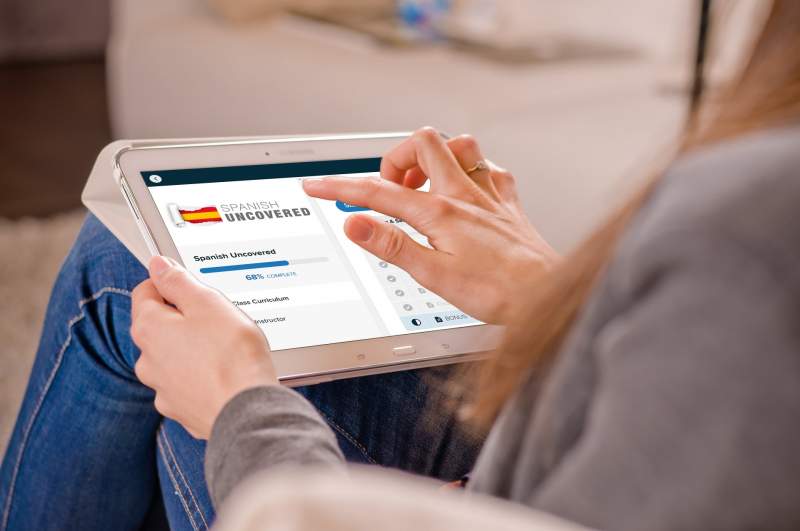
Spanish Uncovered teaches through one continuous story in Spanish. You read it and listen to it, and the grammar gets unpacked from the story as it appears rather than drilled at you cold. There's no separate grammar textbook.
The story is the lesson. That's comprehensible input, plain and simple: learning from Spanish you can mostly follow.
It earns its place on a speaking page for that reason. It supplies the Spanish you can follow, the half of the work that isn't speaking.
It won't make you conversational by itself. It won't unfreeze your mouth by itself either.
If your goal is to understand spoken Spanish better, it will help. If your goal is to speak it back, the course alone won't get you there.
The line has six levels, with three on public sale: Spanish Uncovered, Intermediate and Advanced.
Intermediate is built for learners at roughly B1 and aims to take them to B2. The highest public course, Advanced, works from B2 towards C1.
The other three levels aren't on public sale, so the full path isn't something you can buy directly.
Each course is $297 one-time, reduced from $397, with lifetime access, a 7-day free trial and a 365-day guarantee, as of October 2026. That's a single payment for a full level, not a monthly subscription.
The speaking section is built for use with a Spanish tutor you find and pay for separately. Nothing in the course listens to you or responds.
The course won't catch a bad Spanish pronunciation or tell you when your sentence is wrong. The tutor is the person who listens, and you arrange that yourself. That's an extra cost and an extra person to manage.
You can finish the whole thing and still understand far more than you can say. That's the trade-off.
There is no independent research on outcomes for Spanish Uncovered. That doesn't mean it can't work, but the evidence isn't there. It's premium, and you pay up front.
Best for: the learner who wants to read and listen their way into real Spanish, and is happy to pay once for a structured course rather than dip in and out.
Not for: anyone who needs live speaking practice as the main thing, because you have to find and pay for a tutor separately. If you want something that gets you talking fast, skip it.
How I Scored This

Every product above is scored on the same eight criteria: best-for CEFR range, primary skill developed, speaking and output support, structure and guidance, time commitment, method, price and value, and evidence and track record. StoryLearning included.
Speaking support, weakest to strongest:
- None. No spoken output at all.
- Guided. Prompts to speak, but nothing listens and nothing comes back.
- Scripted. You repeat set phrases and software scores you.
- AI conversation. Unscripted practice with software that responds in real time, but no person is there.
- Feedback. A person responds to what you produced, but not live.
- Live human. Real conversation, in real time, with a person.
On that scale, StoryLearning sits at Guided: each Uncovered course has a speaking section, built to be used with a tutor you find and pay for separately, and nothing in the course itself listens or responds.
Prices are stated as of October 2026. Lingoda shows its prices in euros, so they are given in euros.
There are no affiliate links on this page and no commission on anything here. One thing to declare: I've invested in Langua, so weigh what I say about it with that in mind.
The Bottom Line: Speak Every Week, Read Every Day
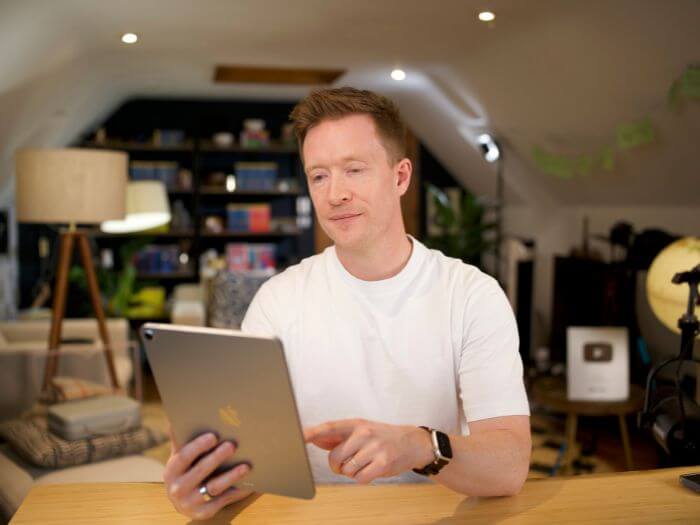
You've made it this far, so let me skip the explanations and give you the short version. If you're tired of collecting resources, this is the version I'd give a friend over coffee.
There are two habits that matter. You speak with a real person every week, and you read or listen to Spanish you can follow every day.
Book regular conversation with a real person, and alongside it get lots of Spanish you can follow. Not one or the other. Both, together, every week.
That's the shape of a normal week, not a dramatic overhaul.
The hard part isn't choosing another app. It's booking the conversation. Once that's in your calendar, the input has somewhere to go.
Everything else is supporting detail.
For the speaking side, start with a tutor on italki or Preply.
If one-to-many classes suit you better, Lingoda gives you a scheduled small group with a real teacher.
Tandem is the free route, offering the chance to find a language exchange partner who wants your English as much as you want their Spanish.
Then there are two ways to practise on your own.
Langua, which I've invested in, gives you conversation practice without booking a lesson with a person.
Pimsleur gives you scripted drills to say out loud.
That's speaking sorted. For input, the aim is simpler: Spanish you can follow, most days.
Busuu gives you a structured course from A1 to B2. If you want more course options, you can take a look at my top online course picks for intermediate Spanish learners.
StoryLearning's Spanish Uncovered teaches through stories you can follow.
On a budget, Tandem is free, and italki tutors start at $5 an hour. You don't need a big budget to start.
If you only do one thing, book that regular conversation this week. Not next month. Not when you feel ready.
For me, Spanish has always been a vehicle for relationships with people from other cultures. Once you're living in the language, the mistakes stop mattering. The conversation becomes the point.
There are no affiliate links on this page at all, full stop.
Best Way To Become Conversational In Spanish: Your Questions
What is the best way to become conversational in Spanish?
You'll get conversational in Spanish through regular conversation with a real person, plus plenty of Spanish you can follow.
For that real person, choose one-to-one tutors on italki or Preply, live small-group classes with Lingoda, or a free exchange on Tandem.
The early conversations will feel messy. That's the work.
How long does it take to become conversational in Spanish?
My estimate: for a language close to English like Spanish, an hour a day of study plus extra listening, reading or TV can get you to a solid conversational level in about 6 months.
It's not a guarantee. It assumes you actually turn up most days.
What speeds that up is regular speaking practice with real people. That's the part that gets the Spanish out of your head and into a conversation.
Can I learn conversational Spanish with an app?
No, not with a self-study app alone. You can build the base with a course app, but conversational Spanish comes from live talk with people.
Some apps are a way to reach real people. Tandem is a free app that connects you with native speakers for language exchanges, and the tutor marketplaces run through apps too.
Course apps such as Busuu build the base. Busuu's Spanish course runs to B2. But becoming conversational means live talk, not more screens.
Is a tutor or a group class better for Spanish conversation practice?
A one-to-one tutor is better for Spanish conversation practice if you want to speak as much as possible. With italki or Preply, the hour is all yours.
A group class gives you a teacher, a timetable and a structure, but you share the talking. Lingoda runs groups of 3 to 5 students, so that sharing is real.
If you need speaking volume, choose a tutor. If you need a class to keep you showing up, choose the group.
Are language exchanges like Tandem worth it for Spanish?
Yes, for Spanish it's worth it if you find a good partner. Tandem is free, and you can find native Spanish speakers to exchange with.
But there's no teacher, and only half of each exchange is in the partner's language. That's the trade-off: conversation practice, not a planned course.
It suits the learner who will offer half the help, and it won't suit someone who needs a clear route.
How do I stop freezing when I speak Spanish?
You stop freezing by speaking more, starting somewhere low-pressure.
Practise with an AI partner or a patient tutor first, where nobody's waiting and the stakes are low. Then build up to exchanges and small groups.
The more you speak, the easier it gets to keep going.

Olly Richards
Creator of the StoryLearning® Method


Olly Richards is a renowned polyglot and language learning expert with over 15 years of experience teaching millions through his innovative StoryLearning® method. He is the creator of StoryLearning, one of the world's largest language learning blogs with 500,000+ monthly readers.
Olly has authored 30+ language learning books and courses, including the bestselling "Short Stories" series published by Teach Yourself.
When not developing new teaching methods, Richards practices what he preaches—he speaks 8 languages fluently and continues learning new ones through his own methodology.