Stefano Suigo: How A Polyglot Keeps 10 Languages Alive
by Olly Richards
I don't get to sit across from many people who genuinely humble me when it comes to languages, but Stefano Suigo is one of them.
Italian by birth, Brussels-based by choice, and fluent in ten languages — including Finnish, Romanian and Japanese — Stefano has spent his entire adult life working with, thinking about and living inside foreign languages.
We sat down for a long conversation about everything from why he quit a 20-year translation career to what it actually looks like to maintain a collection of languages that most people would find impossible to name, let alone speak.
Pro Tip
By the way, if you’re serious about improving your language skills, online language courses for fluency can make a huge difference.
I'm offering top-rated online language courses for beginners to advanced learners, covering Mandarin, Spanish, French, Italian, German, Japanese and more.
Stefano trained as a translator and spent two decades working in the field — translating books, manuals and websites, always in written form. By most measures, it was a fulfilling career. But after 20 years, something shifted.
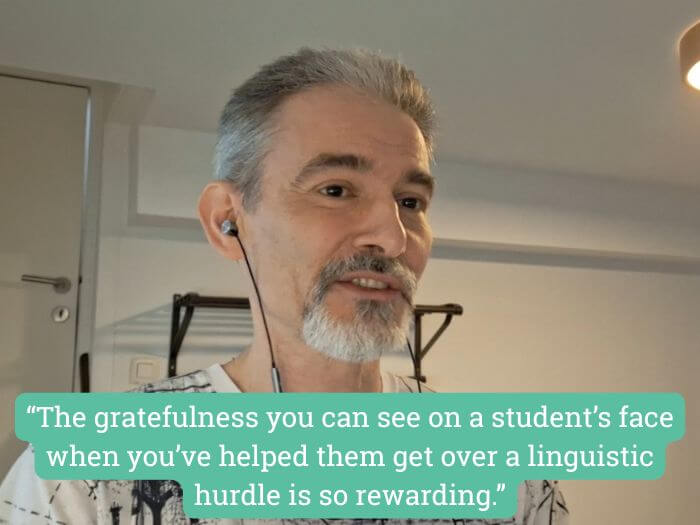
“After a while I started to feel the need to feel more in contact with actual people,” he told me. “The gratefulness you can see on a student’s face when you’ve helped them get over a linguistic hurdle — that was so rewarding.”
It’s worth noting the distinction he drew early in our conversation: a translator works in writing, whilst an interpreter works by talking.
These are two quite different professions, even if they’re often conflated. Stefano was always the former — and it was precisely the solitary nature of written translation that eventually made him crave something more human.
Stefano’s wife is an interpreter — the spoken counterpart to his written translation career — and she hasn’t hit the same wall, at least not yet.
His theory is that interpreting, because it involves constant contact with people, never generates the same sense of isolation. The work itself supplies the human connection that he eventually had to go looking for elsewhere.
There’s also an elephant in the room when it comes to the translation industry: AI. Stefano is candid about it.
For literary translation, not much has changed. But for technical work — instruction manuals, compliance documents, product localisation — the job has become largely about checking and confirming what machine translation produces, rather than creating from scratch.
As I understand it, when accuracy matters more than style, that’s a task AI can handle perfectly well.
A Revelation At Age Eight
Like many polyglots, Stefano’s story begins in childhood — though his origin is unusually precise.
He grew up in Milan in a completely monolingual family. Nobody spoke anything other than Italian. Then, in his third year at elementary school, aged around eight, he had his first English lesson.
“I discovered that you can express the same idea in two completely different ways,” he said. “This was a revelation. I was fascinated.”
English became his favourite subject. By the time he reached high school and picked up German, he already knew what he wanted to do with his life. He was, he reckons, probably the only person in his class who could say that with any conviction.
What strikes me about this is the nature of the attraction. For Stefano, it was never primarily about people — it was about language itself. The way it sounds, the way it works, what it can do.
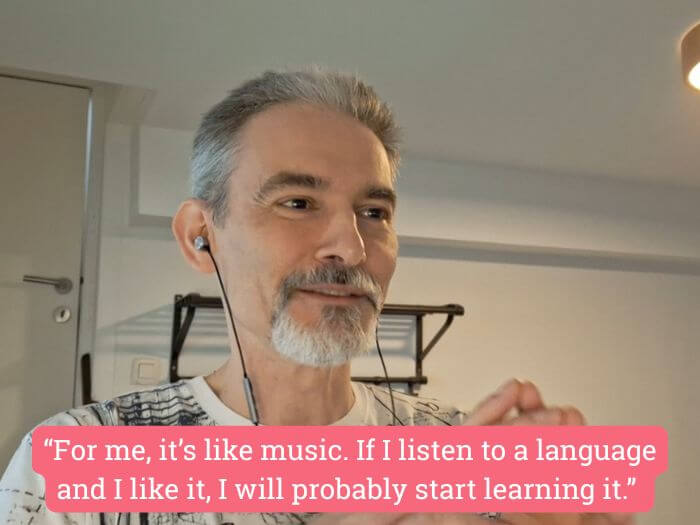
“For me, it’s like music,” he said. “If I listen to a language and I like it, I will probably start learning it.”
My own motivation has always been the reverse — I learn languages to connect with specific people, which means my interest tends to fade when those people are no longer in my life.
Stefano’s attachment is to the language itself, which changes everything about how he maintains what he’s built.
How Do You Actually Maintain Ten Languages?
This is the question I imagine most people want answered. The honest response, at least in Stefano’s case, is that it’s not as heroic as it sounds — but it does require structure and intention.
He divides his languages into two groups. The first group — Italian, Finnish, French, English and German — he encounters naturally every day.
He lives in Brussels, one of the most linguistically diverse cities in Europe, and these languages are woven into his family life and his work. They maintain themselves, more or less.
The second group — Portuguese, Romanian, Icelandic, Japanese and a handful of others he can get by in — requires active effort.
For those, he has a toolkit:
a weekly language exchange with an Icelandic friend (they swap Italian and Icelandic),
paid conversation tutors for languages like Japanese,
and perhaps most inventively, a regular ping-pong group in Brussels that draws players from all over the world. Last week, he was keeping score in Turkish.
The key distinction he makes is between maintenance and study. He is not sitting down to review Finnish grammar cases. He is using Finnish.
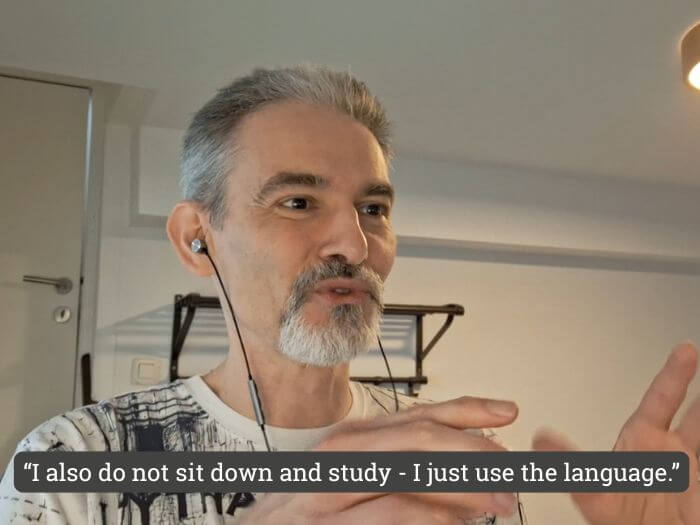
“I also do not sit down and study,” he said. “I just use the language.” That, he argues, is all language maintenance ever really needs to be.
Why Your Environment Isn’t Everything
Brussels makes Stefano’s situation easier than most. But he’s quick to push back on the idea that environment alone explains it. He’s right to.
I lived in London for years, one of the most cosmopolitan cities on Earth, and I know perfectly well how easy it is to live in a diverse city without ever actually speaking to anyone in their language.
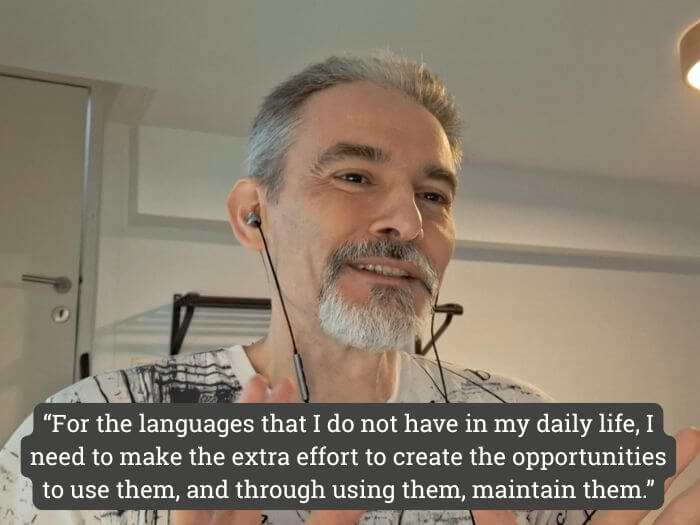
“For the languages that I do not have in my daily life, I need to make the extra effort to create the opportunities to use them, and through using them, maintain them.” Stefano said. Environment helps, but it doesn’t do the work for you. You still have to show up.
His approach to finding those opportunities is practical: he uses Meetup to find groups built around shared interests, not language practice.
His preference is to use a language whilst doing something else — sport, games, socialising around a shared activity — rather than attending a language exchange where the sole purpose is practicing.
This echoes something I discovered myself when I lived in Japan. At Japanese–English language exchanges, I was constantly fighting native speakers who wanted to practice their English.
The moment I joined a salsa class in Tokyo, everything changed. The language became a byproduct of the activity, and suddenly it was natural.
Does Language Distance Change How You Learn?
Stefano has no single method. His approach varies with every language, depending on two key factors: his motivation for learning it, and how far the language sits from the ones he already knows.
On language distance, his thinking is worth unpacking carefully. For a language that is close to one you already speak — say, Portuguese if you already know Italian or French — you can use comprehensible input early and effectively.
You already share a vast amount of vocabulary, grammar logic and phonological intuition with the target language. You can absorb authentic material almost from the beginning and make rapid progress.
When Stefano learned Portuguese, he was reading magazines in the language very early on, essentially learning by soaking up a shared foundation he already had.
For a distant language — Finnish, Japanese, Mandarin — the same approach applied too early produces very little. There is simply too much distance between what you know and what you’re hearing.
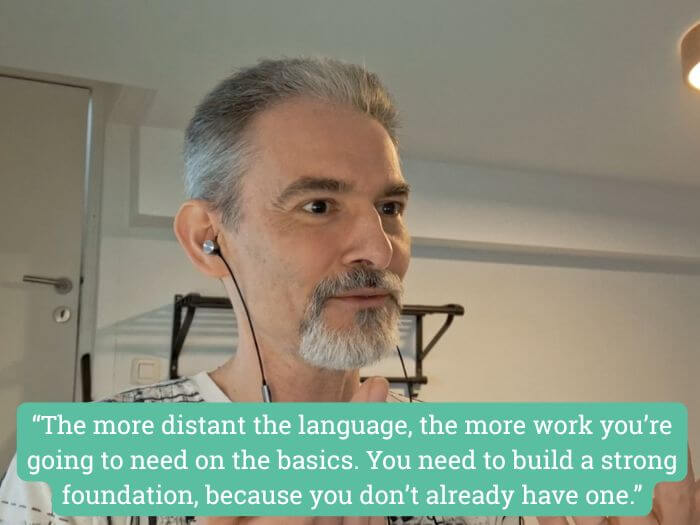
“The more distant the language, the more work you’re going to need on the basics,” he said. “You need to build a strong foundation, because you don’t already have one.”
In practice, that means leaning on a good textbook early — but one oriented around everyday dialogue rather than formal or academic language.
He’s wary of textbook Japanese, for instance, because it bears so little resemblance to how people actually speak. The goal is to build a genuinely strong foundation first, using lots of repetition, before reaching for immersion materials.
And when the gap between beginner and native-speaker content is too wide — which it often is for harder languages — he turns to conversation tutors to bridge it.
What Is Stefano Suigo’s Take On AI In Language Learning?
Stefano hasn’t used AI much in his own language learning — largely because he hasn’t been in active acquisition mode during the period when these tools have become powerful. But he can see where it would be useful.
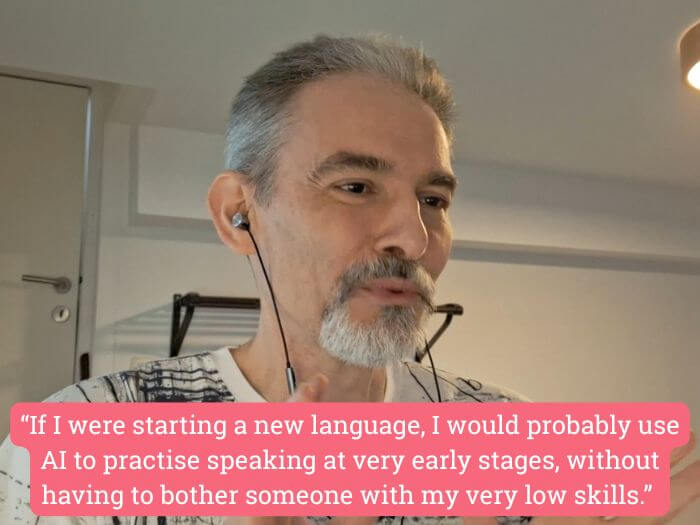
“If I were starting a new language, I would probably use AI to practise speaking at very early stages,” he said, “without having to bother someone with my very low skills.” That feels right to me.
The value of AI as a conversation partner is that it’s infinitely patient, available at any hour and unjudging — which removes the social anxiety that stops many learners from speaking early.
For maintenance, though, he sees less need for it. Once you’re at a level where the point is enjoyment — using the language to enrich your life, rather than to acquire it — authentic human content is what you want. AI doesn’t really fit into that picture.
The Takeaway From A Life In Languages
What I find most compelling about Stefano Suigo’s approach is precisely its lack of system. He has no single method, no definitive framework he’s selling. Each language has its own story, its own place in his life, its own logic.
Some he picked up through sheer proximity and linguistic kinship. Others — Finnish, Japanese — he built deliberately, case by case, conversation by conversation, with enormous patience and repetition.
The thread running through everything is his relationship with language itself. Not with the countries, not with specific people, but with the thing that language is — its music, its structure, its particular way of carving up the world.
That depth of attachment is what makes maintenance feel natural rather than effortful, and what keeps him finding ways to use his languages even when life doesn’t hand them to him on a plate.
You can follow Stefano’s work and his reflections on language on his YouTube channel, linguaEpassione, where he talks about different languages in different languages.
It’s well worth a look, especially if the love of language itself — not just the utility of it — is something that resonates with you.
Olly Richards
Creator of the StoryLearning® Method
Olly Richards is a renowned polyglot and language learning expert with over 15 years of experience teaching millions through his innovative StoryLearning® method. He is the creator of StoryLearning, one of the world's largest language learning blogs with 500,000+ monthly readers.
Olly has authored 30+ language learning books and courses, including the bestselling "Short Stories" series published by Teach Yourself.
When not developing new teaching methods, Richards practices what he preaches—he speaks 8 languages fluently and continues learning new ones through his own methodology.
FREE
Get Your Free Guide:Best Binge-Worthy Resources for Fluency
All the best movies, TV shows, and podcasts hand-picked so you can learn your language just by watching what you already love.
Which language are you learning?
What is your current level in [language]?
Which language are you learning?
What is your current level in [language]?
Which language are you learning?
What is your current level in [language]?
Which language are you learning?
What is your current level in [language]?
Which language are you learning?
What is your current level in [language]?
Which language are you learning?
What is your current level in [language]?
Which language are you learning?
What is your current level in [language]?
Which language are you learning?
What is your current level in [language]?
Which language are you learning?
What is your current level in [language]?
Which language are you learning?
What is your current level in [language]?
Which language are you learning?
What is your current level in [language]?
Download this article as a FREE PDF?
What is your current level in Latin?
Download this article as a FREE PDF?
What is your current level in Norwegian?
Download this article as a FREE PDF?
What is your current level in Swedish?
Download this article as a FREE PDF?
What is your current level in Danish?
Which language are you learning?
What is your current level in [language]?
Download this article as a FREE PDF?
Download this article as a FREE PDF?
What is your current level in Arabic?
Download a FREE Story in Japanese!
Enter your email address below to get a FREE short story in Japanese and start learning Japanese quickly and naturally with my StoryLearning® method!
What is your current level in Japanese?
Download Your FREENatural Japanese Grammar Pack
Enter your email address below to get free access to my Natural Japanese Grammar Pack and learn to internalise Japanese grammar quickly and naturally through stories.
What is your current level in Japanese?
What is your current level in Portuguese?
What is your current level in German?
Train as an Online Language Teacher and Earn from Home
The next cohort of my Certificate of Online Language Teaching will open soon. Join the waiting list, and we’ll notify you as soon as enrolment is open!
Train as an Online Language Teacher and Earn from Home
The next cohort of my Certificate of Online Language Teaching will open soon. Join the waiting list, and we’ll notify you as soon as enrolment is open!
Download this article as a FREE PDF?
What is your current level in Portuguese?
Download this article as a FREE PDF?
What is your current level in Portuguese?
Download this article as a FREE PDF?
What is your current level in Turkish?
What is your current level in French?
What is your current level in Italian?
What is your current level in German?
What is your current level in Japanese?
Download Your FREEJapanese Vocab Power Pack
Enter your email address below to get free access to my Japanese Vocab Power Pack and learn essential Japanese words and phrases quickly and naturally. (ALL levels!)
What is your current level in Japanese?
Download Your FREE German Vocab Power Pack
Enter your email address below to get free access to my German Vocab Power Pack and learn essential German words and phrases quickly and naturally. (ALL levels!)
What is your current level in German?
Download Your FREE Italian Vocab Power Pack
Enter your email address below to get free access to my Italian Vocab Power Pack and learn essential Italian words and phrases quickly and naturally. (ALL levels!)
What is your current level in Italian?
Download Your FREEFrench Vocab Power Pack
Enter your email address below to get free access to my French Vocab Power Pack and learn essential French words and phrases quickly and naturally. (ALL levels!)
What is your current level in French?
What is your current level in Portuguese?
What is your current level in Russian?
What is your current level in Russian?
What is your current level in Italian?
What is your current level in Italian?
What is your current level in French?
What is your current level in French?
What is your current level in Spanish?
What is your current level in Spanish?
What is your current level in Spanish?
What is your current level in Arabic?
What is your current level in Portuguese?
What is your current level in Turkish?
What is your current level in Korean?
What is your current level in Russian?
What is your current level in Japanese?
What is your current level in Chinese?
What is your current level in Spanish?
What is your current level in Italian?
What is your current level in French?
What is your current level in German?
Download Your FREENatural Portuguese Grammar Pack
Enter your email address below to get free access to my Natural Portuguese Grammar Pack and learn to internalise Portuguese grammar quickly and naturally through stories.
What is your current level in Portuguese?
Download Your FREENatural Russian Grammar Pack
Enter your email address below to get free access to my Natural Russian Grammar Pack and learn to internalise Russian grammar quickly and naturally through stories.
What is your current level in Russian?
Download Your FREENatural German Grammar Pack
Enter your email address below to get free access to my Natural German Grammar Pack and learn to internalise German grammar quickly and naturally through stories.
What is your current level in German?
Download Your FREENatural French Grammar Pack
Enter your email address below to get free access to my Natural French Grammar Pack and learn to internalise French grammar quickly and naturally through stories.
What is your current level in French?
Download Your FREENatural Italian Grammar Pack
Enter your email address below to get free access to my Natural Italian Grammar Pack and learn to internalise Italian grammar quickly and naturally through stories.
What is your current level in Italian?
Download a FREE Story in Portuguese!
Enter your email address below to get a FREE short story in Brazilian Portuguese and start learning Portuguese quickly and naturally with my StoryLearning® method!
What is your current level in Portuguese?
Download a FREE Story in Russian!
Enter your email address below to get a FREE short story in Russian and start learning Russian quickly and naturally with my StoryLearning® method!
What is your current level in Russian?
Download a FREE Story in German!
Enter your email address below to get a FREE short story in German and start learning German quickly and naturally with my StoryLearning® method!
What is your current level in German?
Download a FREE Story in Italian!
Enter your email address below to get a FREE short story in Italian and start learning Italian quickly and naturally with my StoryLearning® method!
What is your current level in Italian?
Download a FREE Story in French!
Enter your email address below to get a FREE short story in French and start learning French quickly and naturally with my StoryLearning® method!
What is your current level in French?
Download a FREE Story in Spanish!
Enter your email address below to get a FREE short story in Spanish and start learning Spanish quickly and naturally with my StoryLearning® method!
What is your current level in Spanish?
FREE Download:
The Rules of Language Learning
Enter your email address below to get free access to my Rules of Language Learning and discover 25 “rules” to learn a new language quickly and naturally through stories.
Which language are you learning?
What is your current level in [language]?
Download Your FREESpanish Vocab Power Pack
Enter your email address below to get free access to my Spanish Vocab Power Pack and learn essential Spanish words and phrases quickly and naturally. (ALL levels!)
What is your current level in Spanish?
Download Your FREENatural Spanish Grammar Pack
Enter your email address below to get free access to my Natural Spanish Grammar Pack and learn to internalise Spanish grammar quickly and naturally through stories.
What is your current level in Spanish?
Free Step-By-Step Guide:
How to generate a full-time income from home with your English… even with ZERO previous teaching experience.
Download this article as a FREE PDF?
What is your current level in Thai?
Download this article as a FREE PDF?
What is your current level in Spanish?
Download this article as a FREE PDF?
What is your current level in Cantonese?
Download this article as a FREE PDF?
What is your current level in Russian?
Download this article as a FREE PDF?
What is your current level in Korean?
Download this article as a FREE PDF?
What is your current level in Japanese?
Download this article as a FREE PDF?
What is your current level in Italian?
Download this article as a FREE PDF?
What is your current level in German?
Download this article as a FREE PDF?
What is your current level in French?
Steal My Method?
I’ve written some simple emails explaining the techniques I’ve used to learn 8 languages…
Which language are you learning?
What is your current level in [language]?
Which language are you learning?
What is your current level in [language]?
I want to be skipped!
Join 84,574 other language learners getting StoryLearning tips by email…
“After I started to use your ideas, I learn better, for longer, with more passion. Thanks for the life-change!” – Dallas Nesbit
Which language are you learning?
What is your current level in [language]?
Download this article as a FREE PDF?
What is your current level in Chinese?
Which language are you learning?
What is your current level in [language]?
Find The Perfect Language Course For You!
Looking for a breakthrough in your language learning?
Complete this short survey to find the perfect course for you!