
You've studied German long enough to open a news article and work through it with a dictionary. Slowly, yes. But you get there.
Then a colleague leans over and says something in German at full speed.
You caught nicht and maybe the tail of a verb. The thread is gone.
So you nod. You smile. You pray there's no question coming.
When it's over, the relief is physical.
In my experience, this is where a lot of German learners get stuck. It doesn't mean you've no talent for it.
Here's the short version, so you can stop after it if you like.
At B1, you can often follow a fair bit of German, but the path forward isn't obvious. For structured lessons with a real teacher and an official exam at the end, you've got the Goethe-Institut; for live speaking practice, italki is a marketplace of one-to-one tutors.
For lots of German you can follow, you've got Deutsche Welle‘s free courses or StoryLearning's German Uncovered Intermediate, a story-based course built for roughly B1 and aimed at taking you to upper-intermediate B2.
Busuu, Babbel, Langua and Pimsleur are also in the comparison, alongside StoryLearning's own course. All eight are scored on the same eight criteria, so the comparison stays even.
At intermediate level, the move that actually holds is pairing a lot of German you can follow with regular speaking practice, week after week. Hold that pairing in mind as you read the scores.
The best online German course for intermediate learners, then, depends on the gap you need to close.
There are no affiliate links on this page and no commission on anything here. One thing to declare: I've invested in Langua, so weigh what I say about it with that in mind.
Table of Contents
Why B1 German Works On The Page But Not Out Loud
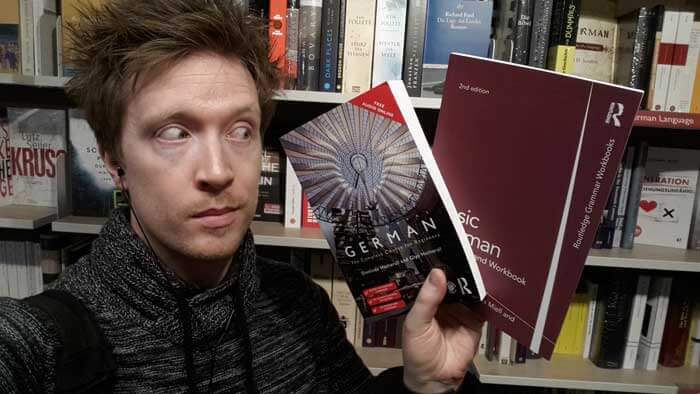
Years ago I learned German as a one-month project. Every morning I put in 45 minutes with textbook dialogues.
I would listen to the same dialogue many times. Then I'd listen and read together. Then I'd listen again without the text, to test myself.
It was a simple routine, and it had one aim. I deliberately didn't speak, because that month I wanted to understand how German works, not to talk.
After Japanese, Cantonese and Arabic, German was the first language in years I could read from the beginning. Much of it is close to English, and that helped from the very start.
That early comfort with reading is exactly what pulls a learner towards B1. An intermediate learner is usually around B1: able to read a lot, not yet able to follow fast speech or speak freely.
That's the strange thing about B1. Reading can feel solid while speaking is still out of reach, and the gap between the two is where the frustration lives.
Then written German stops matching spoken German. You can follow a sentence on the page, but the same sentence at normal speed disappears.
Take the listening half. In casual speech, hast du often runs together as “haste”.
Written German keeps the two words apart. Spoken German pulls them together, and you're left with a phrase you don't recognise.
When a friend asks “Haste mal Zeit?”, they're only asking “Have you got a minute?” The word you knew on the page has changed its shape.
The page taught you the full form. Spoken German doesn't wait for you to catch it.
It's easy, then, to think your ear is the problem. It isn't. The sound changed, not you.
Now the speaking half. German word order refuses to follow an English speaker's habits.
In English you'd put the verb early. In “weil ich heute keine Zeit habe“, “because I have no time today”, the verb goes to the end.
The word “because” starts the clause in both languages, but German pushes the verb to the very end. You can't simply build the sentence as you go.
To say a sentence like that yourself, you have to know where the sentence is going before you start, at speaking speed. The grammar on the page has to run in real time.
So each half wants its own practice. The listening half wants hours of German by ear, the speaking half wants regular speaking, and the options below are sorted by which of the two they actually give you.
Best Online German Course For Intermediate Learners: The Comparison Table
| Provider | Best-for CEFR | Primary skill | Speaking support | Structure | Study load | Method | Price (as of October 2026) | Track record |
|---|---|---|---|---|---|---|---|---|
| Goethe-Institut | All levels | Mixed | Live human (taught courses and tutoring) | Fully sequenced, fixed schedule | Deep | Taught courses with official exams | Varies by country and course format; check your local Goethe-Institut | Official; 1.1 million exams taken at its exam centres in 2025 |
| Busuu | A1 to B2 | Mixed | Feedback (community, not live); Premium Plus adds AI conversation | Fully sequenced, CEFR-mapped | Light to medium | Structured course plus community feedback | Free tier; Premium about $69.99 a year (about $5.83 a month); Premium Plus costs more | Established |
| Babbel | A1 to B2, foundations of C1 | Mixed (grammar and dialogue) | Scripted (live classes are a separate product, Babbel Live) | Fully sequenced | Light to medium, 10 to 20 min | Dialogue lessons with explained grammar | About $8.95 a month on the 12-month plan ($107.40); lifetime $299.99, often discounted; all 14 languages | Long established |
| StoryLearning (German Uncovered Intermediate) | B1 to B2 (Advanced: B2 towards C1) | Reading and listening | Guided (each course has a speaking section, built for use with a tutor you find and pay for separately) | Fully sequenced | Medium to deep | Comprehensible-input reading (one continuous story) | $297 per course, one-time (from $397); 7-day free trial; 365-day guarantee | Established indie brand |
| Deutsche Welle | A1 to C1 | Reading and listening | None | Loose (placement test, self-paced) | Flexible | Graded news and video courses | Free | Germany's public international broadcaster |
| italki | Any level | Speaking | Live human | Freeform | Deep, lesson length you choose | Live one-to-one tutoring | $5 to $50+ an hour, pay per lesson | Large, established marketplace |
| Langua | A2 to C1 (practice tool) | Speaking | AI conversation | Loose | Flexible | AI conversation with real-time correction | Free account to try; Standard $19.99 a month or $149.99 a year; Unlimited $29.99 a month or $199.99 a year | Newer (2024 onwards). Olly has invested in Langua |
| Pimsleur | A0 to about B1 (Level 5 is “intermediate”) | Listening and speaking | Scripted, plus AI pronunciation feedback | Fully sequenced | Medium, 30 min | Audio-immersion | $150 per level; $575 for all five levels; often discounted | Long established |
| Duolingo (beginner tool) | A0 to B2 content (Duolingo, April 2026) | Vocabulary (recognition) | Scripted; Max adds AI conversation | Fully sequenced | Light, 5 to 15 min | Game-style drills with spaced review | Free (the whole course); Super and Max prices are set in the app and not published by Duolingo | Market leader |
| Language Transfer (beginner tool) | Beginner; Complete German unfinished | Grammar through speaking | Guided (audio prompts) | Fully sequenced | Light to medium | Audio explanation, build sentences aloud | Free | Independent, free project |
Goethe-Institut: The Official Route, With Teachers And Exams
In 2025, 1.1 million German exams were taken at a Goethe-Institut centre.
That's a lot of people chasing the same proof you're probably thinking about.
The Goethe-Institut is Germany's cultural institute, and it runs German courses for adults at every level.
You can study on site in more than 90 countries, or online, in a group or one-to-one with an individual tutor.
Prices vary by country and course format, so you'll need to check your local Goethe-Institut to see what it costs.
The schedule is where it asks the most of you. Group courses run on a fixed timetable with a teacher, which suits you if you need structure and a certificate. It suits you less well if your week changes at short notice.
Individual tutoring is the more flexible option.
Best for: the intermediate German learner who needs a set schedule, a real teacher, and a clear target like the Goethe-Zertifikat to work towards.
Not for: anyone whose week changes at the last minute and who needs to study only when the time actually appears.
Busuu: Real People Check Your German, Up To B2
Intermediate German has a lonely stretch.
You can follow a news article, but you've no idea whether your own sentences sound like German or like English in a German coat.
Busuu tackles that with a structured, CEFR-mapped course from A1 to B2. C1 content exists only for English.
Alongside the lessons, you send written and spoken exercises to fluent speakers and get corrections back.
Busuu's price won't scare you. There's a free tier, and Premium is about $69.99 a year, as of October 2026.
Just be clear about what those corrections are. They come from volunteers, not tutors, so quality varies. They also arrive asynchronously, rather than in a live conversation.
Best for: the intermediate German learner who can read and listen well, but wants a structured run to B2 and real people checking their output.
Not for: anyone whose bottleneck is live speaking, because a delayed written correction won't do that job.
Babbel: A Structured Course That Runs To B2
The grammar finally makes sense. Then a real person asks you something and the reply falls apart.
Babbel approaches that problem with a structured system from the very beginning of A1 up through B2, with extra content reaching the foundations of C1.
The lessons are structured dialogues with grammar explained as you go, aimed at adults and sized around 10 to 20 minutes each.
One subscription now covers all 14 languages. It costs about $8.95 a month on the 12-month plan ($107.40), as of October 2026. A lifetime plan is $299.99 and is often discounted.
Speaking is where it stays scripted. You repeat set phrases and speech recognition listens. Live classes exist, but they're a separate paid product called Babbel Live.
Best for: the B1 German learner who wants a clear, sequential route through B2 without having to assemble it themselves.
Not for: the B1 learner whose main gap is unscripted conversation. If you freeze when you have to produce your own sentence, scripted repetition won't fix that on its own.
StoryLearning German Uncovered: My Own Course

This course is mine, and you should read the rest of this section with that in mind.
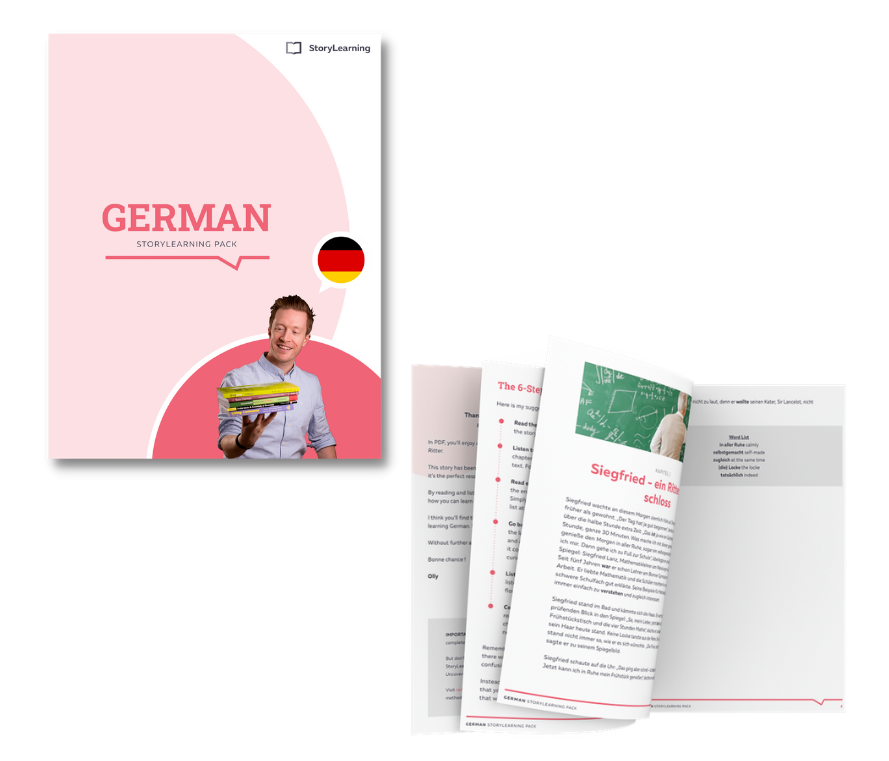
German Uncovered teaches through a story, which you read and listen to with native German audio.
The intermediate course follows a story called Das Schwert von Vercingetorix, and the grammar is unpacked from the story rather than drilled at you cold.
It's built on comprehensible input, which just means learning from German you can mostly follow.
Six levels run from beginner to mastery. Three are on public sale: German Uncovered, Intermediate and Advanced. The in-between levels open once you finish the one before, so you can't buy the whole ladder at once.
Intermediate starts at roughly B1 and aims for B2, and Advanced works from B2 towards a confident C1. In practice, any single course takes you to roughly its own level rather than promising the whole journey at once. Each course has 10 chapters.
Price, as of October 2026: $297 per course, reduced from $397. That's one-time, with lifetime access, a 7-day free trial and a 365-day guarantee. Going further means more courses at that price, one after another, and I won't dress that up as a total.
Lifetime access means what it says, but it doesn't make the first payment smaller. The guarantee and trial take some of the risk out, but the up-front cost is still the up-front cost. You're paying once, though, not subscribing every month.
There is no independent research on outcomes for German Uncovered. Its track record is customer reviews and an established brand, not published evidence. That's less than you'd want from a course at this price, and it's worth knowing going in.
On speaking, each course has a speaking section, but it's built for use with a tutor you find and pay for separately. Nothing in the course listens to you or responds.
If conversation is the thing you're most stuck on, that extra work and cost sits with you.
So across the method, you finish understanding far more German than you can spontaneously say. That gap is real, and it catches people who came for conversation. You'll read a chapter happily, then freeze trying to say the same thing out loud.
It also needs self-discipline. There's no streak or game pulling you back in, the chapters are real work, and if you need a nudge to come back, the course won't provide it. The price is premium and paid up front, which makes showing up your job rather than the app's.
Best for: the learner who wants to read and listen their way through a full German story, move level by level, and show up without gamified nudges.
Not for: anyone who needs spoken German as the main thing from day one, wants a cheap monthly app instead of a one-time premium payment, or relies on streaks to keep going.
Deutsche Welle: The Free Course Germany Pays For
A free German course with a placement test is sitting on a broadcaster's website right now.
It's Deutsche Welle, Germany's public international broadcaster. The material runs from A1 to C1, and Nicos Weg, its video course, carries beginners.
The pieces I'd point an intermediate learner to are the daily news texts, written at B1, B2 and C1. You're reading real German news, but at a level you can actually follow. There's also a job-focused course at B1 for practical, everyday German.
What it won't do is talk back. There's no tutor and no feedback on your speaking. You set the pace, you build the plan, and you supply the discipline.
Best for: the intermediate learner who can already read some German and wants structured material that pushes from B1 up through C1 without a textbook.
Not for: the learner whose speaking has stalled and who needs someone to correct it in real time. This course will feed your reading, but it won't do the talking for you.
italki: Where Your German Finally Has To Come Out
You understand the German question. You know the words for the answer. The sentence still refuses to leave your mouth.
italki is a marketplace of independent tutors for live one-to-one video lessons.
You pay per lesson, no subscription. You choose the tutor, book the time, and talk.
Rates start at $5 and run past $50 an hour, as of October 2026. Many tutors offer a discounted trial lesson, which is the sensible way to test how they correct you before you commit.
Of the eight products scored on this page, italki is the only one built around one-to-one conversation with a tutor you choose. That's the whole engine: you meeting a real person and finding out what happens when you have to answer.
The trade-off is structure. There's no built-in curriculum, and the quality of the teaching changes from tutor to tutor. You'll have to try someone, see how they work, and move on if it doesn't click.
Best for: the intermediate learner who can already understand a fair amount of German but needs to produce it in live conversation, with someone there to correct them.
Not for: the learner who wants a course to decide what comes next, because nobody hands you a plan here and you or your tutor have to build one.
Langua: Practice Talking Before Anyone's Listening
Watching a real person wait while you assemble a German sentence is a particular kind of dread, because the verb is still sitting at the end and every second stretches.
Langua removes the witness. You talk or type in German, and an AI conversation partner corrects you in real time.
I've invested in Langua, so you should weigh this section with that in mind. It suits learners from about A2 to C1, but as a practice tool rather than a full course.
On price, as of October 2026, Standard is $19.99 a month or $149.99 a year, with calls capped at 30 minutes a day. Unlimited is $29.99 a month or $199.99 a year, and a free account lets you try it.
There's no curriculum, so you supply the direction. An AI is not a person, however patient it seems. The transcription sometimes mishears you, and Langua is the newest product here, around since 2024.
Best for: an intermediate German learner who needs daily, low-stakes speaking without an audience.
Not for: an intermediate German learner who still needs structured progression, because Langua won't hand you a curriculum or tell you what to study next.
Pimsleur: German Drilled In, Thirty Minutes At A Time
Speaking is a skill, like tennis. You can know the rules and watch the pros, but until you've hit a thousand serves, you don't have it in your body.
That's what Pimsleur is: those thousand serves, drilled out loud.
Each lesson's about 30 minutes of audio. A voice prompts you to answer in German, then gives the answer. The same phrases come back later, and you'll say them again.
Pimsleur German runs to five levels, and Level 5 is Pimsleur's own top level. It lands at intermediate. If you're already intermediate, it's speaking practice rather than a next step.
On price, each level lists at $150 and the complete five-level course at $575, both frequently discounted, as of October 2026. The app adds Voice Coach, which gives you AI feedback on pronunciation.
The limit's the scope. The vocabulary's narrow and there's little reading or grammar depth. The speaking's scripted, not free conversation, so you can be flawless in the drills and still stumble when the script ends.
Best for: the intermediate German learner who wants a daily out-loud drill and is happy to work through Pimsleur's own levels from wherever they are.
Not for: an intermediate learner who needs wider vocabulary, real reading, or unscripted conversation. Pimsleur won't take you past its own intermediate ceiling.
Duolingo And Language Transfer: Good Tools, Wrong Job At This Level
I get messages about this all the time. Someone writes that they've kept a 600-day streak going, and they still can't hold a conversation in German.
I know that feeling. An app has a very different idea of progress than a real conversation does.
Since April 2026, Duolingo has said German learners can work through B2-level content, and its course is free. German is one of nine courses with that advanced material now.
That's a real step. But content in an app is not the same as holding a German conversation. A conversation has to be live and spoken.
Tapping the right answer doesn't prove you can find the right German verb when someone is waiting for you to speak.
Language Transfer is a different kind of free tool. It's audio that explains how German works as you build sentences, and it doesn't feel like a game at all.
The catch is that its Complete German course is unfinished, by the site's own note. You'll get real understanding, but you won't get a full path to B2.
Both of these are fine as extras. Neither is the main tool for getting from B1 to B2. Use them in the spare minutes, not as the main work.
How I Scored This
Every product above is scored on the same eight criteria: best-for CEFR range, primary skill developed, speaking and output support, structure and guidance, time commitment, method, price and value, and evidence and track record. StoryLearning included.
Speaking support, weakest to strongest:
- None. No spoken output at all.
- Guided. Prompts to speak, but nothing listens and nothing comes back.
- Scripted. You repeat set phrases and software scores you.
- AI conversation. Unscripted practice with software that responds in real time, but no person is there.
- Feedback. A person responds to what you produced, but not live.
- Live human. Real conversation, in real time, with a person.
On that scale, StoryLearning sits at Guided: each Uncovered course has a speaking section, built to be used with a tutor you find and pay for separately, and nothing in the course itself listens or responds.
Prices are stated as of October 2026. Duolingo doesn't publish its Super or Max prices, and Goethe-Institut prices vary by country, so neither is given a figure.
There are no affiliate links on this page and no commission on anything here. One thing to declare: I've invested in Langua, so weigh what I say about it with that in mind.
By the way, if you're looking for the best intermediate courses in other languages, take a look at my posts on the best French online courses and the best Spanish ones.
The Bottom Line: Read More, Speak Sooner
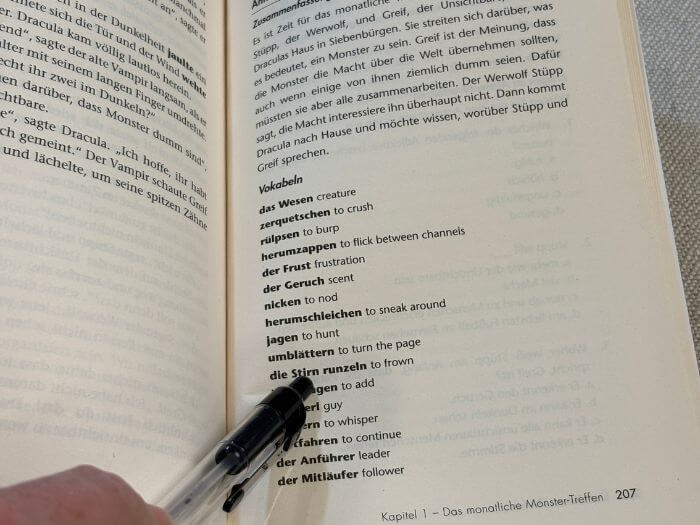
At intermediate level, pair one source of lots of German you can follow with one regular speaking habit. That's the recommendation, and it kept surfacing in every comparison above. It's simple enough to start this week.
For the input half, start with Deutsche Welle. It's free and its structured material runs from B1 up through C1. Busuu gives you a structured route to B2 with real people checking your output.
Babbel gives you a plain, sequential route through B2 grammar if you want it laid out for you. StoryLearning's German Uncovered Intermediate aims to take learners from about B1 to B2 by reading and listening through a full German story.
You don't need all four. Pick the one that matches how you're stuck.
If you want a teacher, structure and an official certificate, the Goethe-Institut does all three. The price depends on where you live, so check your local centre. That's the route if a certificate or a teacher's eye keeps you showing up.
Don't let the input half crowd out the speaking half. They're separate jobs, and one can't do the other.
The input feeds your understanding. The speaking turns it into sentences.
For speaking, work down the ladder. italki puts you in front of a real person.
Langua gives you AI conversation for days when a live tutor feels like too much. I've invested in Langua, so keep that in mind.
Pimsleur works as a scripted audio stepping stone. It won't take you past its own intermediate ceiling, but it's a way to start out loud.
On a budget, pair Deutsche Welle with a few italki lessons. Teachers there start at $5 an hour, so live practice doesn't have to cost much. A free course plus cheap live lessons is a real path, not a compromise.
That combination may be all you need for a while.
You can stop comparing now. If you only do one thing, book regular conversation practice.
That single habit will move you more than another app or another vocabulary drill. You'll feel underprepared. Book it anyway.
There are no affiliate links on this page.
Best Online German Course For Intermediate Learners FAQ
What Is The Best Online German Course For Intermediate Learners?
There isn't a single best online German course for intermediate learners. It depends on what's missing.
If you want a course with an official exam, the Goethe-Institut runs taught courses at all levels and official exams. If speaking is the gap, italki gives you live one-to-one tutors.
For lots of German you can follow, Deutsche Welle's courses are free. StoryLearning's German Uncovered Intermediate is built for learners at roughly B1 and aims to take them to B2.
How Do I Get From B1 To B2 In German?
To get from B1 to B2 in German, pair lots of German you can follow with regular speaking practice. That's the core of it.
Deutsche Welle publishes free news texts written at B1, B2 and C1. Work through them, and find someone to correct you when you produce your own sentences out loud.
Is Deutsche Welle Good Enough To Reach B2 German?
Yes, Deutsche Welle's free German courses can get you to B2 for reading and listening. The material runs from A1 to C1, so the input side is covered.
But there's no tutor and no feedback on your speaking. Pair it with regular speaking practice, and you've got the other half.
Should I Take A Goethe-Institut Course Or Study German On My Own?
Take a Goethe-Institut course if you need a teacher, a fixed schedule or an official certificate. If you're looking for flexibility or a lower cost, study on your own and add a tutor for speaking.
Prices vary by country, so it's worth checking your local centre before you commit.
Why Can I Read German But Not Understand It When People Speak?
You can read German but not follow it spoken because written and spoken German move at different speeds.
On the page you can pause, scan back, wait for the verb. In weil ich heute keine Zeit habe (because I have no time today) the verb comes last, so at speaking speed you're holding the whole sentence open before it means anything.
The fix isn't more grammar. It's hours of German you can follow by ear, just above your comfortable level.
Can I Reach B2 German With An App Alone?
Not for most learners. Busuu and Babbel both run German courses to B2, so the content's already there.
What's missing is real conversation. Reaching B2 means using German live, where you can't pause and plan. No app's scripted or written practice will build that on its own.
Add a speaking habit alongside whichever app you choose. That's the step that turns B2 content into B2 ability.

Olly Richards
Creator of the StoryLearning® Method


Olly Richards is a renowned polyglot and language learning expert with over 15 years of experience teaching millions through his innovative StoryLearning® method. He is the creator of StoryLearning, one of the world's largest language learning blogs with 500,000+ monthly readers.
Olly has authored 30+ language learning books and courses, including the bestselling "Short Stories" series published by Teach Yourself.
When not developing new teaching methods, Richards practices what he preaches—he speaks 8 languages fluently and continues learning new ones through his own methodology.